
The history of Mexican drug trafficking is being written in US courts
‘El Mayo’ Zambada, ‘El Chapo’ Guzmán, and Caro Quintero — the three kings of Mexico’s drug empire — will spend their final days in the prisons in the United States
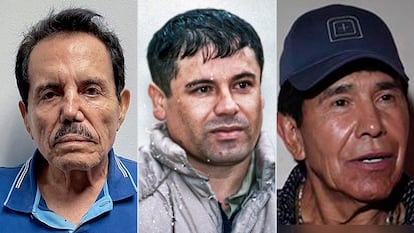

The drug map in North America has shifted. The old mountains of the Golden Triangle, the cradle of Mexico’s drug trade, have given way to an unlikely route — from New York to Colorado — mandatory stops for the Mexican drug traffickers who dominated the past half century but now live behind bars, convicted or awaiting their fate.
Joaquín “El Chapo” Guzmán, 68, Ismael “El Mayo” Zambada, 77, and Rafael Caro Quintero, 72, have traded their hometowns in Sinaloa, the mountains that saw them grow up in Sonora, Chihuahua, and Durango, for prisons with meaningless names in the United States — MDC Brooklyn, ADX Florence — spaces that hold what’s left of them, now that their mystical aura has been stripped away and criminal power broken.
It has been a slow process, and few would dare to call their captures a success. Each one ended up in prison in his own way. El Chapo was the first, sent to the U.S. under the Extradition Treaty — a relief for the Mexican prison system, which had barely managed to hold him in facilities from which he escaped twice.
Then it was El Mayo’s turn: he was kidnapped in Culiacán a year ago by his former allies, and flown across the border in a small plane as if he were livestock.
Finally came Caro Quintero, the third king in the deck, sent to the United States through a strange legal maneuver, handed over, as the current Mexican government put it, under the authority of the National Security Law.
The discussion now turns to the identity of the fourth king — and, for that matter, to the knights and knaves as well — a kind of national sport in Mexico, a country intent on sketching and resketching the supposed hierarchies of drug trafficking. It’s not that they don’t exist, or that they matter little, but such rankings impose on the criminal world a solidity and a vertical structure it doesn’t really have.
Drugs continue flowing into the United States despite the imprisonment of the three kings and several other kingpins, a situation that highlights the fluidity of trafficking, the adaptability of smuggling networks, and, in truth, the limited importance of the figures presented as leaders, bosses, or capos. Not that they were never influential, but the world the three kings once ruled became obsolete long ago.
Time, meanwhile, is marked by the tally of their sentences. In 2019, U.S. justice condemned El Chapo Guzmán to life in prison plus 30 years — an add-on that reflected how eager the country’s security agencies were to punish the trafficker. For Caro and El Mayo, the outcome will likely be similar.
This summer, U.S. prosecutors, led by Pam Bondi, announced they would not seek the death penalty for either man — a peculiar decision in Caro Quintero’s case, given that he was elevated decades ago into the pantheon of irreconcilable enemies of the nation for his role in the murder of DEA agent Enrique Camarena, now 40 years past. When Caro appeared for his arraignment in February, more than 100 DEA agents were present, a living image of a grudge that has become legendary.
El Mayo has followed his own path, though the result will likely mirror El Chapo’s, if not replicate it entirely. Last week, the veteran trafficker pled guilty to two charges filed by prosecutors in Texas and New York: running a continuing criminal enterprise and violations of the RICO Act, long used to bring down mafia bosses. At the hearing, El Mayo read a brief statement in which he admitted to trafficking at least 1,500 tons of drugs to the U.S., bribing politicians, police, and soldiers in Mexico, and ordering murders. He then apologized. His lawyer later suggested that the cooperation would go no further. The details of El Mayo’s comments on corruption, a problem long ingrained in Mexico, are still hanging in limbo.
As Zambada awaits sentencing in January, the Department of Justice continues its case against Caro Quintero. His lawyers this summer asked for compassion to be shown to the 72-year-old capo, whom authorities are keeping in near-total isolation, locked up virtually 24 hours a day. It is a plea reminiscent of the one once made by El Chapo Guzmán, perhaps a consequence of the path he chose. El Chapo refused to plead guilty to the charges and chose to stand trial. During his pretrial confinement, he protested the conditions in 10 South, the maximum-security wing of the Manhattan jail where he awaited judgment.

In Caro Quintero’s case, the next hearing is scheduled for September 18. The real story, however, is being written behind the scenes, as has been the case with El Mayo or with El Chapo’s imprisoned sons, especially Ovidio, known as El Ratón.
In July, Ovidio Guzmán pled guilty to the charges brought by prosecutors — drug trafficking, money laundering, and so on. With no sentencing date yet set, El Ratón seemed to be avoiding the fangs of the U.S. justice system, at least for now. The youngest Guzmán will have to give something in return — likely money, in line with the billion-dollar promise El Mayo made on Monday, and information, data that will allow U.S. law enforcement to continue its crusade.
Meanwhile, Caro Quintero is navigating the negotiation process, deciding whether to follow El Chapo’s path or that of the others. What seems clear is that the route of drug trafficking now necessarily passes through U.S. prisons. The fall of Sinaloa’s criminal royalty highlights an obvious paradigm: Mexico does not want to prosecute its drug lords. Its prisons often function as mere extensions of their criminal domains. Caro, El Chapo, and El Mayo are just three of more than 50 traffickers that the Mexican state has sent north of the border in recent years. The future of all of them points to a solitude behind bars.
Sign up for our weekly newsletter to get more English-language news coverage from EL PAÍS USA Edition









































