
Mexico finds an escape valve with the US in handover of drug lords
Donald Trump’s continued demands herald new stages in security cooperation against the backdrop of trade tariffs
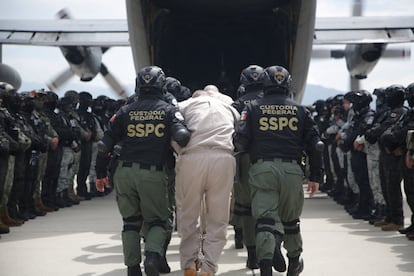

In President Donald Trump’s hugs one week, bullets the next policy with Mexico, the surrender of drug lords serving sentences has become a safety valve. The transfer to the United States of another shipment of 26 cartel criminals imprisoned in Mexico comes just a week after the announcement of a purported executive order that would allow the U.S. to use its military to combat drug cartels in Latin America. Security policies seem to dance every day to the tune of Mexico’s northern neighbor, from fentanyl seizures to the arrests of drug traffickers to the surrender of prisoners. With a crucial trade negotiation in the background, nothing indicates that the U.S. president’s demands will cease, nor that Mexico can impose limits. The question is whether Washington will settle for the surrender of drug lords or move toward another of the objectives Trump repeatedly mentions: politicians colluding with the cartels.
Trump is waging a war of words against Mexico, dropping missiles from time to time and reaping the rewards shortly afterward. “This bilateral relationship can’t be described as cooperation, but rather as extortion,” says security expert Carlos Pérez Ricart. “The new offering of prisoners, because it can’t be called anything else, is preceded by reports of an invasion of Mexico or Venezuela — it doesn’t matter — and Mexico responds to it to safeguard a greater good: its economic stability and the trade agreement,” explains the international researcher. He warns of the paradox that results from these exchanges, “which make Mexico increasingly weaker in the face of the hegemonic power, which acquires protected informants and a powerful tool to continue negotiating economic matters. It’s a vicious cycle that will be difficult to escape.”
The surrender of drug lords, “gratis et amore,” ultimately proves Trump right, revealing one of Mexico’s weakest flanks: its judicial system. President Claudia Sheinbaum has acknowledged on occasion when mentioning the judges’ weaknesses in the face of drug trafficking power — and as Secretary of State for Security Omar García Harfuch has just done — asserting that prisoners sent to the United States continued to commit crimes from prison and seek escape routes through the courts to lower security facilities or, directly, to obtain freedom through injunctions. The excuse offered is “the public safety” that Mexicans achieve by transporting convicted prisoners to the United States. The escape in mid-July of Zhi Dong Zhang, accused of money laundering and drug trafficking for the Sinaloa Cartel, has left difficult questions unanswered. Firstly, what was he doing under comfortable house arrest? Trump will also ask himself this question. And if they find him, it will only be natural for the U.S. president to claim him in the next shipment.
Some argue that the flight of the Chinese national has hindered the signing of the security agreement, which was presented as imminent on August 1 but has yet to materialize. Although it is possible, says Pérez Ricart, that the agreement is already being implemented even without a signature. He suggests that U.S. cooperation in arresting 27 individuals linked to the Jalisco New Generation Cartel on July 26 in Aguascalientes is an example of this. “Real security policy does not always follow the agreements to the letter; there are gray areas,” he says. But he believes that the asymmetry in relations between the two countries is one thing, and the relationship of dependence is another, something that “has its culprits, and we must look for them 30 or 40 years ago, in the times of [former president Carlos] Salinas de Gortari.”
To further complicate matters, international security experts always point out that the United States is not a monolithic entity, but rather a complex network in which it is difficult to determine which measures come from the president, which from the DEA, the CIA, or the Pentagon — different strategic interests that combine, says Pérez Ricart. Raúl Benítez Manaut gives the same warning to anyone tempted to think that only the whims of a president are at play here. “In terms of security, the United States is triangular, serving three vertices: the fight against drug cartels, in which Mexico participates; the fight against money laundering, which the United States unilaterally addresses against companies and banks; and, most difficult for Mexico, the battle against narco-politicians,” the security expert summarizes.
In another week of crossfire, Trump accused Mexican authorities of maintaining “intolerable alliances with drug traffickers” and the government of being “petrified” by the power of cartel bosses. The policy of restraint in the face of the Republican’s bravado sometimes forces Sheinbaum to swallow these lies and move forward for the greater good. But Trump is dropping clues about this supposed list of narco-politicians that no one knows about, but everyone is talking about: the withdrawal of visas to enter the United States is one of them. This recently occurred with the governor of Baja California, Pilar Ávila, but it’s something that also happened, Manaut notes, to Manuel Bartlett, who was director general of the CFE (Federal Commission of Mexico) during the López Obrador administration, among others, and who is linked to the case of the DEA agent murdered in Mexico in 1985, Kiki Camarena.
Will there come a time when the United States isn’t satisfied with drug traffickers and demands the heads of these politicians? For Pérez Ricart, this will undoubtedly be “the next step.” “I don’t know how far they’ll go; when you feed the monster, its heads grow,” he affirms, but the greatest danger he sees is a possible military intervention with U.S. drones, which are also buzzing through the skies of Mexico: “That would put the president in a very delicate situation,” he asserts. And not only that, the fact of having to hand over politicians, something Benítez Manaut also has no doubt will happen sooner or later, “could fracture the ruling party (Morena), because there are quite a few cases affecting it,” he says.
The one currently ongoing in Tabasco has hit hard at the head of one of Morena’s heavyweights, the coordinator of the party’s senators, Adán Augusto López, who appointed a secretary of security in that state accused of being the leader of the local cartel La Barredora. García Harfuch, Sheinbaum’s security strongman who must appease Trump’s appetite, has recently presented some results against this criminal group. But nothing clears up the question: will this be enough, or will politicians follow the cartel bosses?
Sign up for our weekly newsletter to get more English-language news coverage from EL PAÍS USA Edition









































