
Venezuela faces its most tense Christmas yet
This holiday season is overshadowed by unprecedented tensions between the country and the United States
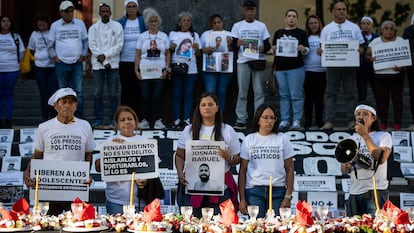

Christmas follows a routine: shopping, dinner, gifts, family celebrations that vary from humble to lavish, reflecting a country growing increasingly unequal, like Venezuela. The holiday season in Caracas in 2025 masks what is on the minds of many Venezuelans. Festivities are overshadowed by the greatest geopolitical tensions the country has faced in decades, amid the largest recent deployment of U.S. military assets — a volatile threat hanging over Venezuela’s Caribbean border.
The sense that something could happen “this time for real,” that chronic uncertainty Venezuelans have long felt over the prolonged political crisis, has shaped this Christmas. It is not openly discussed, at least not without circumspection, with the coded language of censorship. That is why concern over U.S. attacks and seizures of sanctioned oil tankers in the Caribbean — which forced the United Nations Security Council to convene on December 23 — goes unnoticed on the streets, which have been decorated for Christmas since October, when Nicolás Maduro’s government kicked off the holiday celebrations and “the rumba.” Even as U.S. drones target alleged narco-speedboats departing from Venezuela, and fighter jets patrol Venezuelan airspace.
On December 23, as ambassadors gave their speeches in New York, a manicurist in Caracas finished painting a client’s nails red and confessed her hope: “If what we’re all waiting for happens, we’ll have a good year. If not, we still have to keep going,” she says, brushing on the polish. “That’s right, my dear,” replies the older client. The coded conversation reveals what surveys showed before last year’s presidential election: most of the country wants political change and is still waiting for it.
On the streets, Venezuelans’ biggest concern is money: the accelerating rise of the dollar and how to stretch their income. “This year I decided to forget what’s happening, so I wouldn’t feel bad,” said Luis Martínez, 56, a retired public administration lawyer. Although some seek distraction during this tense time, social media alerts constantly stir anxiety with each ambiguous statement from U.S. or Venezuelan officials and updates on the movements of ships and military planes in the Caribbean. “Everyone, with varying degrees of desperation, is waiting for a change in the country, for something to happen, although now I have only vague hopes that it will,” Martínez says. With great effort, he has decided to spend New Year’s Eve on Margarita Island with his family, taking the cheapest route by road and ferry and bringing food from home to avoid spending money in restaurants. He was able to pay for his stay by taking advantage of the huge difference in the exchange rate when he sold some dollars he had saved.
Disconnecting from the news ‘to survive’
“People are distressed, especially about the economy. But everyone wants this to end, and it’s not an ideological problem. The longer the political situation drags on, the worse life gets,” says Mariana, a Venezuelan journalist who has asked to use a pseudonym for safety. or her, this is the Christmas of a “very poor” country, and she has also decided to disconnect from the news. “It’s a way to protect myself. Besides, staying informed in this country takes a lot of time, and I need that time to survive. It’s not like in other countries where you turn on the midday news and, more or less, with some editorial differences, you get a general idea of what’s going on,” says the 58-year-old reporter.
This December, she says, will be one of the hardest Christmases she can remember. “The family has been reduced to a bare minimum.” Life, too. For over a year, she has not found work in her field. After resigning from a fact-checking organization that later closed due to lack of resources and political pressure, she has been baking cookies and, occasionally, teaching courses on fact-checking, barely scraping by. She also doesn’t want to work in an environment where the risks for journalists have grown: 20 are in prison, and just this week the National Assembly approved a new law to penalize anyone who “promotes, instigates, requests, or supports” acts of piracy, blockades, and sanctions, which the Venezuelan government claims are carried out by the United States.
Venezuelans have run the marathon of survival, even in years with worse economic conditions. The last months of 2025 have been uphill. Still, Caracas malls are crowded with people taking advantage of store financing options. A platform called Cashea, launched by young tech entrepreneurs, has also gained widespread use, quickly finding a market in the absence of bank credit — a government measure to curb inflation. “Cashea saved Christmas for many,” says Martínez, who bought a few things this December by making a down payment and now has three months to pay the rest. “We’ll see what happens in January.” That’s how it is with installments — and with everything else.
The political crisis between the United States and Venezuela has been most visible in the emptiness of the international airport. Warnings from the U.S. aviation authorities about increased military operations in Venezuelan airspace have deepened the country’s isolation. Major airlines connecting Venezuela with Europe, Colombia, or Panama have gradually suspended their operations. This week, Iberia and Air Europa — previously scheduled to resume flights after the end-of-year break — announced extensions until January. Those who already had tickets had to change plans or arrange complicated connections through Colombian cities to be able to celebrate with their families.
Disconnection, isolation, and blockade have become the new normal in Venezuela. So too have reports of U.S. military planes flying over the country’s northern coast and, more recently, the seizure of sanctioned oil tankers. In this context, economic analyses paint a bleak picture of contraction at the start of 2026, due to the expected drop in government revenue from oil sales.
Meanwhile, President Nicolás Maduro and his wife, Cilia Flores, appeared dancing at a party in a Caracas neighborhood, and Vice President Delcy Rodríguez shared photos of herself making hallacas with her family. Defense Minister Vladimir Padrino, for his part, delivered toys to the children of officers and troops at an event at the La Carlota military base, asserting that Venezuela plays “a crucial role” in global stability. “The world order depends on what happens in Venezuela today,” he said. From outside the country, opposition leader María Corina Machado sent a holiday message on social media: “Very soon we will be together, with our families in Venezuela, building a great country.” Whether it happens remains to be seen in January.
Sign up for our weekly newsletter to get more English-language news coverage from EL PAÍS USA Edition









































