
The United States warns it will deprive Maduro of ‘the resources he uses to fund’ drug trafficking
The Trump administration argued before the UN Security Council that Venezuela is diverting oil revenues to the Cartel de los Soles
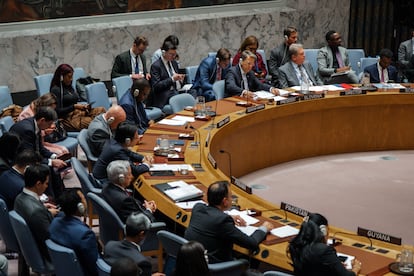

The crisis between the United States and Venezuela has reached the United Nations Security Council. During an emergency meeting held this Tuesday, the U.S. ambassador to the U.N., Mike Waltz, said that the United States will impose sanctions on Venezuela “to the maximum extent”, referring to the blockade the White House is enforcing against the fleet of sanctioned oil tankers that transport crude oil to and from Venezuelan ports.
“The United States will impose and enforce sanctions to the maximum extent to deprive Maduro of the resources he uses to fund Cartel de los Soles, which the United States has designated a foreign terrorist organization, along with the Tren de Aragua,” Waltz added. The U.S. ambassador to the U.N. reiterated that U.S. President Donald Trump has been “very clear” that he is going to use the “full power” and “full might” of the United States to confront the drug cartels.
“Maduro is a fugitive from American justice,” Waltz said at the beginning of his address. “The reality of the situation is that sanctioned oil tankers operate as the primary economic lifeline for Maduro and his illegitimate regime. These sanctioned tankers also fund the narco-terrorist group Cartel de Los Soles.”
He continued: “Further, not only does Maduro’s illegitimate regime openly cooperate and fund terrorists and criminal organizations, but it invites terrorist groups, like Hizballah, like the Iranian regime, militias like the ELN and FARC dissidents [in Colombia] to operate openly within their territory – unimpeded and unencumbered. Maduro’s ability to sell Venezuela’s oil enables his fraudulent claim to power and his narco-terrorist activities. The people of Venezuela frankly deserve better."
It was Venezuela that requested the Security Council session — currently chaired by Slovenia — following the seizure of two oil tankers in the Caribbean and the pursuit of a third by the United States. Maduro sent a letter to U.N. member states denouncing the “ongoing U.S. aggression,” warning that the blockade would affect the entire energy market and the most vulnerable economies.
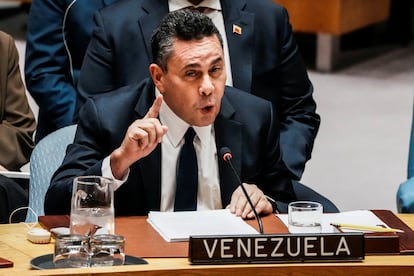
Venezuela’s ambassador to the U.N., Samuel Moncada, stated during his presentation that “the ambition [of the United States] is continental” and that the recent military actions in the Caribbean are “the greatest extortion known in our history.”
“This is a colossal crime of aggression in progress, beyond all rational parameters, all legal logic, all historical precedent. But it’s not just about Venezuela; the ambition is continental,” he said. Moncada accused the United States of seeking to sow division among the countries of the region. “They want us divided so they can conquer us piece by piece,” he said.
Russia, for its part, maintained that the United States has plunged the Western Hemisphere into chaos. It blamed Washington for “the catastrophic consequences of such cowboy-like conduct” and warned: “These are not one-off acts by the U.S. This intervention, which is unfolding, can become a template for future acts of force against Latin American states.”
China also expressed its support for the Maduro regime and called on Washington to lift sanctions and respect maritime safety.
Outside the major blocs aligned with the United States and Venezuela, there are two main positions among the members of the Security Council. On one side are countries seeking to contain the advance of U.S. threats and promote a negotiated solution to the escalation; on the other are those who insist that ending the democratic and human rights crisis in Venezuela — caused by the authoritarian drift of the Maduro regime — must be the priority.
During the debate, the representative of the United Kingdom delegation stated that Maduro’s claim to power “lacks legitimacy” and denounced the lack of transparency in the July 2024 presidential elections, for which, 18 months later, no official results have yet been published. Chile, Panama, and Argentina reiterated that they do not recognize Maduro as president. The Milei government denounced the situation of the more than 1,000 political prisoners, including Argentine officer Nahuel Gallo, who this month marked one year in prison in Venezuela.
Chile’s representative, Paula Narváez, criticized both Trump’s threats of war and what she considered serious human rights violations committed by the Maduro government: “Chile views with concern the deployment of military operations that could destabilize the region. Chile does not recognize the legitimacy of the current regime of Nicolás Maduro. The current climate of tension does not make us forget the deterioration of democratic institutions and the migration crisis. But Chile warns that the escalation of an armed conflict would have devastating humanitarian consequences. Venezuela’s challenges do not have a military solution.”
Colombia, Brazil, and Chile also spoke out against the use of force or threats against a state and insisted on a peaceful solution through dialogue. The Brazilian representative reiterated his country’s willingness to facilitate talks, as did the Mexican representative. In 2024, these attempts failed.
Sign up for our weekly newsletter to get more English-language news coverage from EL PAÍS USA Edition









































