
Trump orders a ‘complete blockade of sanctioned oil tankers’ going to and from Venezuela
The US president says the military deployment in the Caribbean will continue until the Maduro regime returns ‘the oil, land and other assets they stole from us’
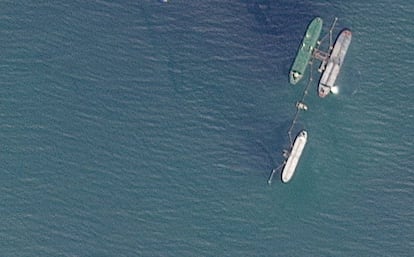

U.S. President Donald Trump on Tuesday ordered a “total and complete blockade of all sanctioned oil tankers going into and out of Venezuela.” The Republican leader has thus dispelled any lingering doubts about Washington’s interest in Venezuelan oil as part of the U.S. offensive against the government of Nicolás Maduro, which Trump had been justifying solely as a war on drugs.
Trump argued in a message on his social network Truth Social that the phenomenal U.S. military deployment in the Caribbean will continue until the Chavista regime returns “all of the Oil, Land, and other Assets that they previously stole from us.”
“The illegitimate Maduro Regime is using Oil from these stolen Oil Fields to finance themselves, Drug Terrorism, Human Trafficking, Murder, and Kidnapping,” he added. It was not immediately clear what Trump meant when he said the Venezuelan regime appropriates U.S. oil, “land, and other assets.” Nor was it clear how he expects these to be returned to the United States “IMMEDIATELY.”
The Venezuelan government took just a couple of hours to respond. In a statement, it condemned the Republican’s announcement and described it as a “reckless and serious threat” against the country. “He assumes that Venezuela’s oil, land, and mineral wealth are his property (...) he intends to impose, in a completely irrational manner, a supposed naval blockade with the aim of stealing the wealth (...)”. The text calls on “the people of the United States and the peoples of the world” to ‘reject’ this “extravagant threat that once again reveals Trump’s true intentions to steal the wealth” of Venezuela.
Trump’s message comes almost a week after the U.S. military intercepted a Venezuelan oil tanker in waters off the country’s coast, in a spectacular operation that Washington sought to publicize extensively. The following day, sanctions were announced against half a dozen other similar vessels, opening the door to further seizures. Penalties were also imposed on three of Maduro’s nephews.
These companies, recently sanctioned by the U.S. Treasury Department, own oil tankers flying the flags of the Marshall Islands, Panama, Hong Kong, or the Cook Islands, and have been accused of using deceptive practices, either by omitting their location or transmitting a false location. These are the so-called ghost ships that continue to operate clandestinely, transporting Venezuelan oil mainly to Asia.
The U.S. military operation and the subsequent sanctions were interpreted as an escalation of already high tensions in the Caribbean, where Washington maintains its largest military presence in decades. Trump has since continued to threaten attacks on targets in the South American country, although he has not followed through on those threats.
This new step, in any case, is, according to analysts, a way to stifle the Venezuelan regime’s financing channels. Chavista leaders depend on oil sales to China to circumvent the economic sanctions imposed by the United States that are stifling the Venezuelan economy.
Although the main justification for the U.S. offensive against Venezuela has been the fight against drug trafficking, Trump has publicly declared his interest in Venezuela’s oil reserves. In a famous speech from 2023, four years after failing in his first attempt to overthrow Nicolás Maduro, he sai: “When I left, Venezuela was ready to collapse. We would have taken it over. We would have gotten all that oil. It would have been right next door. But now, we’re buying oil from Venezuela. So, we’re making a dictator very rich.”
Sign up for our weekly newsletter to get more English-language news coverage from EL PAÍS USA Edition









































