
Seizure of Venezuelan oil tanker opens more intense phase in Trump’s campaign against Maduro
The White House anticipates further interceptions of vessels and is preparing sanctions against the nephews of the leader of the Chavista regime
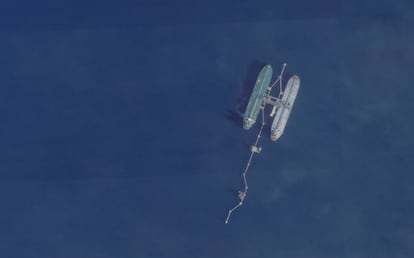

The United States has entered a new, even more intense phase in its pressure campaign against Venezuelan President Nicolás Maduro. The target now is crude oil, Caracas’ main source of income. Following the seizure of a tanker carrying Venezuelan oil in waters off the country’s coast—in a spectacular operation that the U.S. government sought to publicize extensively—Washington announced sanctions on Thursday against half a dozen other similar vessels, opening the door to further seizures. In addition, it imposed sanctions on three of the Chavista leader’s nephews.
The new phase has heightened existing tensions in the Caribbean, where Washington maintains its largest military presence in decades. President Donald Trump continually threatens to attack targets on the South American country’s soil.
In separate statements, the Treasury and State Departments announced sanctions against four individuals—three of them Maduro’s nephews—six shipping companies that transport Venezuelan oil, and six of the ships those companies use.
“The U.S. government will continue to deny financial lifelines to the illegitimate Maduro regime, which he uses to oppress the Venezuelan people. The United States is committed to keeping the American people safe by using all available means to eliminate threats of narco-trafficking and crime throughout our hemisphere,” it states.
Earlier, regarding Wednesday’s seizure, White House press secretary Karoline Leavitt confirmed that a formal seizure process has been initiated and the United States intends to take possession of the confiscated oil once the necessary legal steps have been completed.
The seizure of the oil tanker Skipper on Wednesday was led by the Coast Guard with support from the U.S. Navy, in an operation under the authority of the FBI. A video of the operation, released by the Department of Homeland Security on social media, shows images that look like something out of an action movie. According to senior officials speaking to U.S. media, military helicopters transported Coast Guard personnel from the aircraft carrier Gerald Ford, the world’s largest and most modern carrier and part of the massive U.S. naval deployment in the Caribbean, to the cargo ship.
The video shows Coast Guard personnel rappelling from helicopters onto the deck of the seized vessel and moving about with their weapons seemingly ready to fire. According to senior officials, the crew of the Skipper offered no resistance.
“Successful operation”
“a successful operation directed by the president to ensure that we’re pushing back on a regime that is systematically covering and flooding our country with deadly drugs and killing our next generation of Americans,” Homeland Security Secretary Kristi Noem said during a House hearing on Thursday.
The tanker was sailing under the Guyanese flag, although the Guyanese Maritime Administration has confirmed that it was a false flag and the vessel is not listed in its official records. Announcing the seizure, Trump described the ship as “very large, largest one ever seized, actually.” When asked about the fate of the crude oil, he added, “Well, we keep it, I guess.”
The case of this vessel is unique. The ship, formerly known as the Adisa, was previously linked to the smuggling of Iranian oil within a black market that the FBI and the Department of Justice had been investigating for years. In the social media post accompanying the video, Attorney General Pam Bondi wrote that “for multiple years, the oil tanker has been sanctioned by the United States due to its involvement in an illicit oil shipping network supporting foreign terrorist organizations.”
An unusual act
But the involvement of U.S. military personnel in seizing a merchant ship is unusual. And the announcement of the operation comes a month after a U.S. warship intercepted a Russian vessel bound for Venezuela, forcing it to divert to Cuba, as reported two weeks ago by Bloomberg. The Russian merchant ship was carrying naphtha, a chemical that Venezuela needs to import to dilute its heavy crude oil for sale.
Caracas has denounced Wednesday’s seizure as “an act of international piracy.” “The true reasons for the prolonged aggression against Venezuela have finally been exposed. It is not migration. It is not drug trafficking. It is not democracy. It is not human rights. It has always been about our wealth, which belongs exclusively to the Venezuelan people,” a government statement reads.
Senior officials who spoke with The New York Times stated that they anticipate further seizures in the coming weeks, as part of the Administration’s efforts to weaken the Chavista regime by depriving it of oil revenues. The energy sector is the main engine of the Venezuelan economy, and the country’s dependence on it has grown due to the long list of international sanctions it faces.
Last month, the South American country produced nearly 900,000 barrels per day. Its main customer is China, although it must sell to them at discounted prices due to competition from Russia and Iran, two other oil-producing countries heavily sanctioned by the international community.
“The United States is placing Venezuela under a blockade,” said Francesca Emanuele of the Center for Economic and Policy Research (CEPR) before the seizure took place. In addition to the seizures, she noted, the U.S. has closed Venezuelan airspace, and hardly any international flights are entering the country, with the exception of planes transporting deported migrants, which Venezuela has only recently begun to accept again. “Threats are one thing, but now we are adding the possibility of a blockade, which would worsen the already horrific circumstances of the 78% of Venezuelans living below the poverty line,” she stated, urging European countries to strongly condemn the situation.
The operation to seize the merchant ship intensifies the Trump administration’s efforts to pressure Maduro. Since August, the United States has maintained a naval deployment off the coast of Venezuela, which last month included the USS Ford and involves fighter jets and nearly 15,000 troops.
The military operation, known as Operation Southern Spear, is aimed at combating drug trafficking, according to the United States. Since September 2, it has attacked at least 22 suspected drug-running boats in bombings that have killed 87 people.
But the Venezuelan government, as well as numerous experts, believe the true objective of the deployment is to try to force Maduro from power. Washington describes the Chavista leader as a drug kingpin, has added the Cartel of the Suns—the alleged criminal group it claims Maduro heads—to its list of foreign terrorist organizations, and has doubled the reward offered for his capture to $50 million.
Sign up for our weekly newsletter to get more English-language news coverage from EL PAÍS USA Edition









































