
Jailhouse rock: Guards and prisoners united through music at Modelo penitentiary in Bogotá
A band named Simbiotes seeks to reduce hostilities, build bridges and open up a space of dignity in confinement


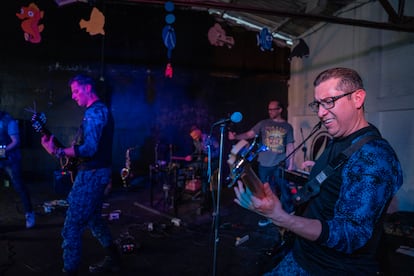
“Moshing and headbanging” at a death metal concert. That’s paradise for prison guard Lelio Camacho, a member of the psychosocial support team at La Modelo medium-security prison in Bogotá. A metalhead to the core, he says he’s unique among the 17,000 employees of Colombia’s National Penitentiary and Prison Institute (INPEC). “With great humility, I consider myself unique for doing what I love at my job,” he says, sitting in the prison’s courtyard number one. In 2022, he fulfilled his dream of forming a band in prison. But not just any band: half the members of Simbiontes, as they named the group, are INPEC staff; the other half are inmates. “It’s a symbiosis, a fusion,” he says, gritting his teeth and clasping his hands, excited, before taking the stage in the prison auditorium to play for the visitors. The audience cheers.
Simbiontes declares itself the first band in Colombia, and perhaps the world, to do what they’ve dubbed “jailhouse rock.” It’s a rehabilitation project through music. “We want to show that there’s life in prison too, that guards and inmates can work together, that we can help them transform their lives, and teach people on the outside not to end up in here,” says Camacho, the guitarist and bandleader, known inside as Mi Soo. “Here, the nickname is the most important thing,” he asserts.

The band was a failed project until prison guard Óscar Betancourt, known as “Lobito,” an amateur musician and current bassist for Simbiontes, took over as director of the prison’s Artistic Creation program, which focuses on rehabilitation through art and culture. “We have a very clear motto: music is liberating,” he says. “The idea is to promote unity and reduce hostility, because the atmosphere in prison is tense between inmates and staff. We’re not enemies; we’re together because that’s how it is, us doing our job and them serving their sentences. The idea is to manage it in the best way possible, and music is a great help.”
Located in west-central Bogotá, La Modelo prison exemplifies the structural crisis of the Colombian prison system. Built between 1957 and 1960 on the outskirts of a city with around a million inhabitants, it now sits amidst a sprawling urban area with some 10 million people. Population growth and social changes have long since surpassed it. It is a cruel, painful reality, one that Simbiontes sings about.
So cruel is the situation that the Constitutional Court declared a state of unconstitutionality in the country’s prisons in 1998, and reiterated this assessment in 2013, 2015, and 2022, after confirming a massive violation of the rights of those deprived of their liberty: extreme overcrowding, unsanitary conditions, violence, corruption, and a lack of effective policies. Designed for 2,662 inmates, La Modelo houses 4,496, according to official figures from the National Penitentiary and Prison Institute (INPEC), although Camacho puts the figure at 5,000. The prison is divided into 15 courtyards, distributed in two wings, north and south. There is a specific courtyard for people with psychiatric disorders and another one for those behind bars for sex crimes, a practice heavily persecuted by the rest of the inmates.

Each cellblock has its own “boss” or “chief” who wields de facto power. “They’re the ones in charge behind bars,” several officials say. Despite being a medium-security prison in Colombia’s prison classification system, it serves as a hub for urban organized crime networks, particularly those involved in extortion and contract killings. For newcomers, the violence is immediate: “Do you wash or do you fight?” the older inmates often ask the newcomers as soon as they enter, holding a knife in one hand and a bar of soap in the other. Some choose to wash and become servants of the more powerful; others choose to fight, and guards frequently have to carry them out wounded. In other cases, they suture their own wounds.
That’s nothing, the guards say, compared to what used to happen in the late 1990s and early 2000s, when the armed conflict in Colombia was at its apex. Guerrillas took control of the northern wing and paramilitaries of the southern wing, continuing the war that ravaged the country. They committed systematic murders, massacres and dismemberments; they even threw bodies down sewers or dug mass graves. Between 1999 and 2001, according to the Attorney General’s Office, at least 100 people were dismembered in the prison and their remains thrown down the drains. One of the most brutal episodes was a massacre committed by paramilitaries between April 27 and 29, 2000, when they murdered 32 people. A month later, a journalist named Jineth Bedoya, the only reporter who entered the prison to investigate what had happened, was kidnapped, tortured and gang-raped for 16 hours by paramilitaries.
The prison was also marked by the violent riot of March 21 and 22, 2020, when inmates rose up in protest against the spread of Covid-19 and the precarious sanitary conditions that, they felt, were condemning them to death. The confrontation left 23 prisoners dead and 83 wounded. In October 2025, in front of the prison, a hitman killed an Inpec official and wounded three others as part of the so-called “pistol plan” activated by Andrés Felipe Marín, alias “Pipe Tuluá,” leader of the La Inmaculada criminal gang, who was incarcerated in another prison.
“Prison is tough, that’s a fact. People have to be careful not to end up here,” says Jonathan Pedraza, known as Cabito, guitarist, vocalist, and main songwriter for Simbiontes. With his arms crossed and surrounded by windows with metal bars from which hang blankets, clothes, sneakers, stuffed animals, shoes, and several images of Our Lady of Mercy, patron saint of inmates, he adds: “But the band is life, it’s like being reborn, a refuge in the middle of the storm.” He arrived at La Modelo prison five and a half years ago and has five more years to go. The hardest part, he says, is not seeing his children, being separated from his family and society “for hurting them.” As a young man, he was a musician in a Christian church, and he’s been playing the guitar ever since. “For a musician, music comes first, then life: let’s try to bring that into our daily lives,” he says, and that’s what he’s been doing in prison.
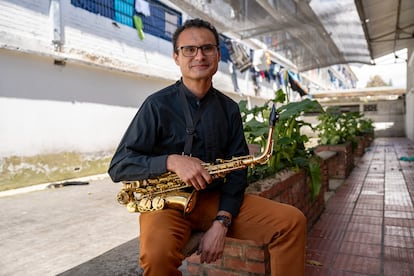
Miguel Ángel Barrero, known as El Profe (The Teacher), is the saxophonist for Simbiontes and describes his experience in the band as a “total balm.” He has been in prison for 12 years out of a 16-year sentence, which he has managed to reduce. For every two days of work in rehabilitation activities such as studying, working or teaching, his sentence is reduced by one day. “The band helped me say, ‘I’m in prison, but I don’t feel deprived of my freedom,’” he says, saxophone in hand. A professional musician, he is awaiting a judge’s authorization for his release. He says he will resume his career as a musician and describes Simbiontes as “a wonderful school for planning my future.”
With the sun on his face and his back to “La Jaula” (The Cage), as the former maximum-security wing was nicknamed, prison guard and drummer Jeffrey Otavo, Otto, smiles after the concert. “There’s always been a stigma that the guards and the inmates have nothing in common.” He says it’s something the band disproves: “We’re a group that comes together to make music; on stage, we’re a family. We break down that wall.” And Barrero adds: “Before we’re guards and inmates, we’re human beings with a love for music.”
The band boasts a wide repertoire of covers in Spanish and English, as well as seven original songs that reflect their experiences in prison. They sing about anxiety, overcoming adversity, and even love. “Singing from prison is very symbolic,” says Camacho, adding that self-love and love for family are recurring themes for them. Pedraza, who wrote five of the seven songs, says that finding creativity in prison isn’t difficult, but that the themes inevitably tend to repeat themselves. “Loneliness, strength, overcoming adversity… The hardest thing is projecting happiness, which doesn’t manifest itself as such, but rather through things like resilience,” he explains.

Inside the prison, they’re true rock stars, especially Camacho. At 6′3″, he’s impossible to miss. Few fail to stop and greet him as he walks through the dark, damp prison corridors; some bump fists, others give him a hug. Unlike other stars, he reciprocates every gesture with an equally sincere one. “What’s up, Mi Soo!” is a constant refrain, demonstrating how the gang has managed to break down the barrier between the two worlds.
Simbiontes has played on various stages outside prison walls, including the Casa de Nariño (the presidential residence in Colombia), and they would like to do a “prison tour” of all the prisons in the country. Their biggest dream, however, is to perform at the Rock al Parque festival, held annually in Bogotá and one of the largest free festivals in Latin America. Iconic bands like Sepultura, Anthrax, and Testament, as well as Los Fabulosos Cadillacs, Los Auténticos Decadentes, and Aterciopelados, have played there. “I’ve gone to Rock al Parque every year to mosh, I love it,” says Camacho, excitedly. “It would be an honor for me and the whole band to step onto the stage and have people surprised and say, ‘What do you mean, a band of inmates and guards?’” He wants to go from the audience to the stage and be the one to start the mosh pits, far from the walls where he works.
Sign up for our weekly newsletter to get more English-language news coverage from EL PAÍS USA Edition









































