
The Colombian who was imprisoned in El Salvador on Trump’s orders: ‘Being tortured for four months when you’re innocent is a nightmare’
Brayan Palencia was one of more than 200 migrants sent by the United States to Nayib Bukele’s mega-prison CECOT for alleged links to criminal gangs


Like hundreds of thousands of others, Brayan Palencia decided to migrate to the United States to financially support his family. He didn’t earn much in Colombia and had a daughter to look after. He crossed the Darién Gap with an injured knee; he paid bribes to cartels in Mexico so that he would be allowed to continue his journey. Even so, he emphasizes, nothing compares to what he experienced at the Terrorism Confinement Center (CECOT), the mega-prison in El Salvador built by President Nayib Bukele. That’s where he was sent — along with more than 200 other men — after being accused by U.S. President Donald Trump of being members of the Tren de Aragua criminal gang.
“I have nothing to do with it, nor have I ever had anything to do with it,” he says, in a park in northern Bogotá, after almost five months of freedom. “It’s been very hard to go back to normal life. It’s like starting from scratch.”
The Colombian-Venezuelan spent about a year in the United States. After applying for asylum, he lived between Los Angeles and Miami, doing various jobs: repairing cars, washing dishes, making deliveries and working in construction.
In January 2025, he had a court date in California, in order to determine his immigration status. He went, hoping to finally regularize his situation. “They took me into a room and told me to wait a while. Without warning, four immigration agents came in, slammed me against the wall and handcuffed me. I explained that I hadn’t done anything, but they didn’t care.”
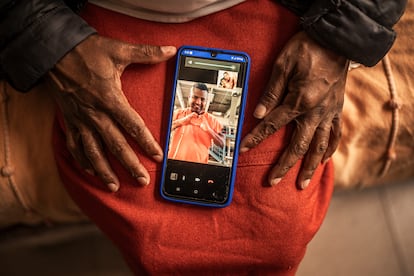
Palencia says they took him to a basement, where other migrants were being held in a kind of makeshift jail. They allowed him to make a single phone call to notify his family about his arrest. Agents then took him to a detention center in the border city of Calexico, California. There, along with other Venezuelans, he learned that they were being linked to the Tren de Aragua gang. The only basis for this? Their origins and their tattoos.
According to the American Civil Liberties Union (ACLU) — one of the largest civil rights organizations in the U.S. — there’s an arbitrary profiling system in place. If a Venezuelan migrant has tattoos of ordinary images — such as a clock, a crown, or a star — ICE may suspect them of being a gang member.
In early-March, U.S. authorities promised Palencia and his cellmates that they would soon be deported to Venezuela. By the middle of the month, they were on a plane to go home. Or so they thought.
Unbeknownst to them, President Trump had reached an agreement with his Salvadoran counterpart — Nayib Bukele — to deport more than 200 migrants to the Central American country under an 18th-century law that allows for the expulsion of “alien enemies” without judicial oversight. This meant that U.S. authorities never had to prove that the men were criminals.
Humanitarian organizations point out that half of those deported had no criminal record. The legality of this action — ordered by the White House — remains in dispute.
“The agents who were with us told us that we were going to Venezuela. We were happy and calm… even though our hands, feet and waists were tied up. On the first landing, they told us we had arrived in Honduras for a technical stop. The plane took off again, but touched down about 30 minutes later. We didn’t understand what was happening,” Palencia recounts. “We opened the windows and saw the army, riot police, trucks, armored vehicles…”
They were forcibly removed from the plane, beaten and taken to CECOT. In this mega-prison — according to several NGOs — hundreds of gang members are incarcerated and subjected to human rights violations.
Palencia had heard about this facility on TikTok. He knew gang members were imprisoned there, but he didn’t know that it was “a hellhole.”
As soon as they arrived at CECOT, the Salvadoran agents changed them into white uniforms and shaved their heads. “They told us that we were going to spend the rest of our lives there. That no one came out alive.” The routine consisted of waking up at 4 a.m., taking a shower and spending almost the entire rest of the day sitting in silence until bedtime, at around 9 p.m. If the prisoners made any noise or didn’t stick to the established schedule, the guards punished them without mercy.
The moments Palencia remembers most vividly are when the inmates tried to protest their detention. “We went on a hunger strike and a blood strike [self-inflicted wounds]; we rioted to keep the guards from entering our cellblock. But they came in anyway. Once, they used pepper spray on us, which [temporarily] blinded me and set my whole body on fire. They also hit me in the face with a baton. It opened a deep cut on my eyebrow, which a nurse closed without anesthesia,” he recounts.
Today, Palencia considers himself to be among the lucky ones. Several of his cellmates were hit at point-blank range by rubber bullets, causing serious injuries, as documented in a report published by Human Rights Watch.

Palencia was also on “the island” — the nickname for the isolation and torture cell at CECOT. “They dragged me in as I was bent over, almost licking the floor. The only thing I could see before they started kicking and hitting me with batons were their black boots. I had to pretend to faint for them to stop,” he recalls. “The island,” as he remembers it, has a few cells and a tiny opening, with a bit of light coming through. Each cell consists of a toilet and a small cement bed.
His release was sudden and without warning. It was July 18. “Around 3 a.m., some guards arrived and ordered us to shower. We couldn’t be sure, but several of us started celebrating and crying because it was very likely that we would be freed.” Indeed, this turned out to be the case.
That night, Palencia didn’t sleep in the cell where he had been held for what felt like years. He slept in a hotel in La Guaira, near Caracas. The horror was over. Trump had reached an agreement with Venezuelan President Nicolás Maduro’s government to exchange more than 200 migrants for prisoners in Venezuelan jails, including several U.S. citizens.
Looking back, he doesn’t hesitate to call what happened to him “the worst experience” of his life. “Being tortured for four months when you’re innocent is truly a nightmare,” he asserts. Palencia denounces the U.S. government’s policy on migrants, specifically Venezuelans. “They say we’re criminals, but they’re the real criminals.”
After a few months in Venezuela, he returned to Bogotá, where his parents and daughter live. “I cried with joy when we were reunited. I could only thank God for being with her again,” he sighs.
Otherwise, his return to freedom has been marked by uncertainty. “It’s been tough. I went [to the United States] with a purpose, to be able to [work and] buy the things [we needed]. Going back means starting from scratch. And I’m worse off than before I left: I came out [of the prison] with a diabetes problem. Because of the beatings, my arm can’t handle heavy work,” he laments.
Aside from the physical ailments, he says that he’s not sleeping very much. He sometimes wakes up in a daze. He drives a motorcycle for ride-hailing apps and delivery services, in order to continue supporting his family. When asked if he would consider returning to the United States, Palencia is emphatic: “If they give me papers, yes. But I’m never going back to prison.”
Sign up for our weekly newsletter to get more English-language news coverage from EL PAÍS USA Edition









































