
The People’s Self-Defense Forces, the group behind the ‘terrorist infiltration’ in Cuba
The incident involving a US boat demonstrates the existence of exile groups that advocate insurgency, a marginal strategy within the opposition but one with historical precedents
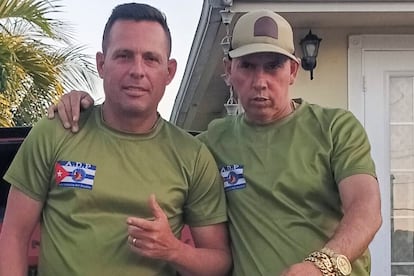

The 10 Cubans who set sail from Florida for the island and were intercepted in a fatal confrontation with the Cuban Coast Guard last week belonged to a little-known organization. The group, called the People’s Self-Defense Forces (ADP), promotes clandestine armed action against the Havana regime, and those on board were seeking to meet with other members inside Cuba, according to its leaders. While Cuban authorities refer to the incident as a “terrorist infiltration” by Cuban residents of Florida organized from Miami, this organization maintains that it was a “patriotic mission.”
“This is the only organization that is in place to overthrow the regime. These patriots are the only ones who have tried to liberate Cuba since the Bay of Pigs,” says Michel Naranjo Riverón, alias “Kiki Naranjo,” founder and leader of the ADP, 47, in a video call, referring to the failed invasion attempt of 1961. The incident has brought into focus the existence of Cuban exile groups that defend insurgency, a marginal strategy within the opposition but with historical precedents that have shaped the image of the diaspora in the United States.
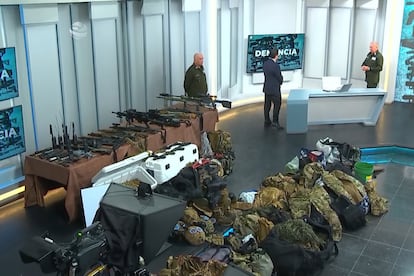
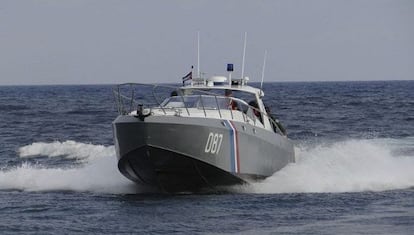
According to Cuban authorities, the men departed from Marathon in the Florida Keys on February 25 for Villa Clara, in the central part of the country, in a fishing boat about seven meters long, but they were intercepted by the Cuban Coast Guard. The men opened fire, wounding the coast guard commander, and in the ensuing firefight, the military eliminated the group, killing four and wounding the rest. A national television program displayed weapons found on board, including rifles, pistols, ammunition, and other supplies, as well as the insignia of the ADP and the November 30 Movement, an unrecognized political party.
Cuba reported the deaths of Pavel Alling Peña, Michael Ortega Casanova, Ledián Padrón Guevara, and Héctor Duani Cruz Correa, and injuries to Leordan Enrique Cruz Gómez, Conrado Galindo Sariol, José Manuel Rodríguez Castelló, Cristian Ernesto Acosta Guevara, and Roberto Álvarez Ávila. Amijail Sánchez González, identified as one of the organizers, was also wounded.
Naranjo asserts that the men are “heroes who were willing to give their lives for the freedom of their homeland.” The mission had a political objective, he adds. “This, although it may seem like madness, is not madness. It is a thought and an ideal.”
When he lived in Cuba, where he worked as a carpenter, Naranjo founded a movement called New Cuban Nation that painted graffiti, burned sugarcane fields, and called for civil disobedience. In 2021, he reached the Florida coast on a raft and requested political asylum. Shortly after, at Versailles restaurant, a regular meeting place for Cuban exiles, he met Sánchez González, also 47, who also had a history of opposition to the regime and shared his ideals. Both are on a Cuban Ministry of Justice blacklist that includes 20 organizations and 62 individuals identified as linked to acts of “terrorism,” and includes exiled leaders, opposition figures, and influencers. “I’m number 44 on the list,” Naranjo says proudly.
In 2022, he and Sánchez González founded the ADP. The organization’s social media accounts disseminate information about the actions of its clandestine members. A recent video shows graffiti reading “Patria ADP” painted in a plaza identified as being in Cienfuegos, in the center of the island. Another video from 2022 shows what appears to be an arson attack on a sugarcane plantation. Other recordings from the island show masked men with distorted voices to prevent identification.
On the group’s social media, they also discuss their political ideology or solicit contributions. “If you desire freedom and support those in hiding, we are ready to give our lives for our homeland. Long live a free Cuba,” says a Facebook video that has garnered dozens of reactions and comments, mostly supportive.
According to Naranjo, the actions of the ADP, such as the graffiti, are focused on the struggle within the island. Regarding the boat operation, he claims he was unaware of its existence, although he knew everyone on board, and that he is bothered by the criticism he has seen on social media about the operation. “They are being denigrated on social media, saying they left in a washbasin. For me, what they did is an honor and a source of pride.”
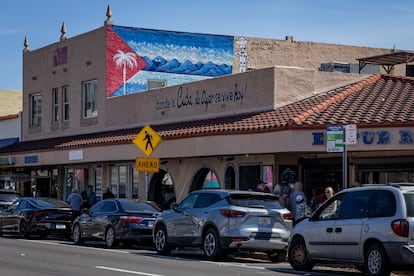
Most of the recent actions posted on social media by the ADP are anti-government graffiti. Sánchez González’s ex-partner, Niurka Préstamo, edits and posts the videos online. She explains that “the ADP are the underground movement within Cuba,” and the members in the U.S. “provide support” to those on the island. She maintains that she also knew nothing about the operation.
Other armed attempts
Cuban exile groups have attempted covert operations to overthrow the Castro regime since the 1959 revolution, and some received CIA backing during the Cold War. The most prominent were Alpha 66 and Omega 7. The latter carried out attacks inside the United States before being dismantled in the 1980s. Eduardo Arocena, Omega 7’s leader, was sentenced to life imprisonment in 1984 and died last year in Miami.
But as time went on, the opposition inside and outside Cuba leaned towards civic struggle, and the small groups that insisted on armed initiatives were sidelined and — until now — had little visibility.
“The prevailing perception here was that these groups didn’t exist, that there was simply an exile community dominated by individuals, mostly linked to the Republican Party,” explains Eduardo Gamarra, a political science professor at Florida International University (FIU) who has extensively studied the Cuban exile community and regional politics. “Alfa and Omega were groups that obviously aimed for armed struggle, but also to eliminate anyone in the community who opposed them. They saw anyone who spoke of negotiation or any kind of accommodation with Cuba as a communist or a useful idiot.”
Guillermo Grenier, a sociology professor at FIU who has extensively studied the Cuban diaspora, points out that many opponents who have arrived relatively recently come from Cuba with the idea of trying “to confront the government in the way that can be done there,” which is different from the way that has developed in exile.
“The Cuban exile community in South Florida established long ago that the only way the Cuban government will relinquish power is through armed struggle, and that any negotiation will reach a dead end. But that era passed in the sixties and seventies, and these groups are clinging to that anachronistic view. Cubans established in Miami have realized that their ability to influence Cuba depends on U.S. foreign policy. That’s why they’ve been marginalized,” the expert adds.
Organizing an armed incursion against another country from U.S. territory could have consequences under federal law. The Justice Department declined to comment for this report on whether it is conducting an investigation into the incident involving the boat.
Reactions in Washington focused primarily on demanding explanations from the Cuban government. Republican Representative Maria Elvira Salazar demanded that the facts be clarified and that the regime be held accountable, while Representative Carlos Giménez described the confrontation as a “massacre” and called for an urgent investigation to establish responsibility. Secretary of State Marco Rubio indicated that the U.S. would not base its response on Havana’s version of events, and even Florida Attorney General James Uthmeier announced that they were examining the case at the state level and that the Cuban government would have to answer for what happened if the allegations were confirmed.
The Trump administration has intensified pressure on Havana in recent weeks. Following the capture of Nicolás Maduro in Venezuela, the U.S. has restricted oil supplies. The confrontational climate has led to military mobilizations on the island.
Ramón Saúl Sánchez, founder of the Democracy Movement and considered one of the leading strategists of the exile community, asserts that Cuba “is probably militarized” out of fear “of an invasion.” “In times like these, and on top of that, landing in an overloaded boat during the day, these are all somewhat reckless decisions, without diminishing the seriousness I attach to a group of men willing to give their lives for the freedom of their country.”
Sánchez, who was imprisoned in the 1980s for refusing to testify before a grand jury in the Omega 7 case and has since promoted peaceful resistance, with hunger strikes, flotillas, and other demonstrations, says that since those involved “were going to land in Cuba, they probably didn’t consider the ramifications that this could have on this side,” and speculates about the possibility that the group had “an infiltrator who motivated them to do things a bit recklessly.”
Sign up for our weekly newsletter to get more English-language news coverage from EL PAÍS USA Edition









































