
Washington’s muted response to the attack on a speedboat in Cuban waters
The incident has occurred at a particularly sensitive moment in the relationship between the United States and Cuba
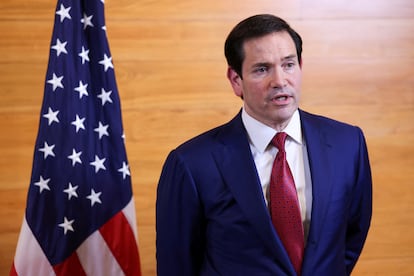
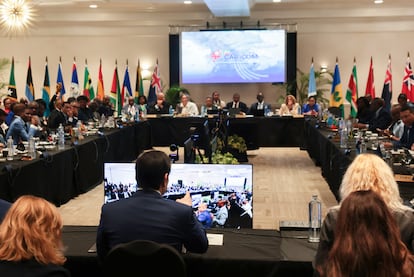
The U.S. government was slow to react. Secretary of State Marco Rubio was in the Caribbean when, in those same waters, the Cuban Coast Guard fired on a civilian boat carrying 10 people that had arrived from Florida. The Cuban-American, who had traveled to the Caribbean islands of St. Kitts and Nevis to defend Washington’s agenda at the Caribbean Community (CARICOM) leaders’ summit, had to pause before reporters eager to hear his reaction to the incident in Cuban waters, which left four dead, including a U.S. citizen. “I’m not going to opine on what I don’t yet know,” he said. “But we’re going to find out exactly what happened here, and then we’ll respond accordingly.”
It was a muted response, far removed from the visceral outbursts that have characterized other officials’ reactions during sudden crises. This restraint contrasted with Rubio’s usually hard-line position toward Havana, but it has extended across both the U.S. and Cuban government. The U.S. president himself, Donald Trump, who since the arrest of Nicolás Maduro in Venezuela has frequently lashed out at the regime in Havana, refrained from posting any incendiary messages on social media. And Cuba has also sought to highlight the fact that Washington is cooperating to help clarify what happened, instead of resorting to its usual invective.
The restraint shown on the U.S. side was all the more striking given that one of the four people killed, and one of the injured, are U.S. citizens —something that, under other circumstances, might have constituted a casus belli. Now, at a highly delicate moment in bilateral relations, that does not appear to be the case.
In St. Kitts and Nevis, journalists wanted to know more and pressed Rubio on whether he was in contact with the Cuban side, whether it was a plan by the Donald Trump administration, or if, should any U.S. citizens be involved, his government would take any kind of retaliation. Rubio handled the questions prudently, in a remarkably subdued tone for a politician who dreams of bringing down the Castro regime.
In each of his answers, he spoke of the Cuban government with a level of respect unusual for him, the son of island emigrants raised in Miami’s conservative anti-Castro environment. He said he knew only what the Cuban Interior Ministry had already reported about the incident, that the border guard was in “constant contact” with the U.S. Coast Guard; he denied that it was an attack ordered by his administration, and said that, despite historical precedents, it was “highly unusual to see shootouts on open sea.” “It’s not something that happens every day.” he added.
In each of his responses, he spoke of the Cuban government with a respect uncharacteristic of him, the son of immigrants from the island and raised in the conservative anti-Castro circles of Miami. He said he knew about the incident just as the Castro regime’s Interior Ministry had reported: that the border patrol was in “constant contact” with his Coast Guard. He denied that it was an attack by his administration and asserted, despite historical precedents, that it seemed “extremely unusual to see shootings like that on the open sea.” The Secretary of State chose to say that this “is not something that happens every day.”
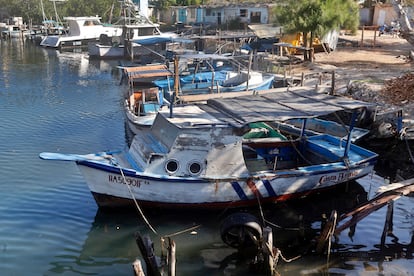
The attack on the civilian boat on Wednesday has shocked Cubans everywhere. The attempted landing stirred memories for exiles of events such as the downing of two planes belonging to the humanitarian organization Brothers to the Rescue 30 years ago, or the sinking in 2022 of a vessel in Bahía Honda, where four adults and a two-year-old girl died.
But that shock has not been reflected by the U.S. government. Democratic Congresswoman Debbie Wasserman Schultz, from Florida, was one of the first to notice the “the silence from the Trump administration on this deadly incident.”
Cuban authorities have also handled the episode cautiously, especially given that it comes amid the national emergency the United States declared over the island. Like their U.S. counterparts, they have adopted a more tactful tone.
A statement from the Cuban Ministry of Foreign Affairs, presented to the press by Deputy Minister Carlos Fernández de Cossío, said that Cuban authorities “have maintained communication” with their U.S. counterparts, including the State Department and the Coast Guard. It insisted not only that “. The Cuban government is willing to exchange information with the United States on this matter,” but also that “U.S. government authorities have expressed their willingness to cooperate in clarifying these regrettable events.”
This mutual restraint highlights how delicate the moment is in relations between the two long‑standing adversaries. Nearly two months after the intervention in Venezuela, Trump’s repeated declarations that the Castro regime’s days are numbered, and the tightening of the oil blockade, Washington’s plans for Havana remain unclear.
There has been much speculation: first, that Washington was talking with Alejandro Castro Espín, son of the nonagenarian Raúl Castro; then, that it was talking with Raúl Guillermo Rodríguez Castro, alias “El Cangrejo” (The Crab), bodyguard and favorite grandson of the former Cuban president. But there has so far been no explicit confirmation, beyond Trump’s claim that contacts exist and that Marco Rubio is leading them.
Washington’s subdued response to the boat incident is seen as another sign that dialogue may be underway between the two governments, even though Havana continues to deny any talks. The Miami Herald has reported that U.S. officials met with Raúl Rodríguez Castro during the summit in Saint Kitts and Nevis.
The pervasive Cold War-style rhetoric seems to have eased for now, and that may be because both sides are at the negotiating table. Even Washington has eased its recent economic embargo, opening the possibility of selling oil to the private sector.
From Havana, Rafael Hernández, an analyst at the Juan Marinello Center for Cuban Cultural Research, offers his own opinion on the incident in Cuban waters, where the regime claims that the boat’s crew were the first to open fire. He wonders if the boat’s trip was intended “to try to force the Trump administration into a very difficult position, regarding the use of force and responding with force to what has been a clear provocation.”
No one yet knows what might happen next after an incident that opens up many possible paths in the middle of ongoing negotiations — and pressure — with Cuba. Those who have demanded a strict and immediate stance are the Cuban-American members of Congress, Republicans from Florida, who once again seem out of step with the policy Washington is pursuing with Cuba.
While the lawmakers continue with their hardline discourse against the regime, the administration is betting that change in Cuba should be economic first, then political. It is not what they expected, but it is what seems to be coming. “Cuba needs to change,” Rubio said in Saint Kitts and Nevis. “And it doesn’t have to change all at once. It doesn’t have to change from one day to the next. Everyone is mature and realistic here.”
Sign up for our weekly newsletter to get more English-language news coverage from EL PAÍS USA Edition









































