
Dengue, Oropouche fever, chikungunya: an epidemiological crisis has Cuba on edge
Authorities attribute the situation to the hot, rainy months, when the mosquitoes that transmit the virus increase in number. But Cubans say that systemic neglect has led them to this situation
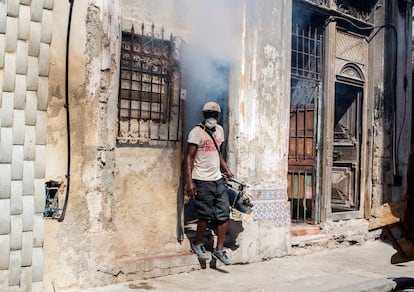

By the end of the summer months, people in Cuba, especially in the western end of the island, were wondering what “rare” disease had them bedridden, with body aches and swelling, fevers as high as 40ºC, vomiting, diarrhea, headaches, and even skin blemishes. In Matanzas, the epicenter of the disaster, entire families reported infections, which then spread to every neighborhood, then to the entire province, almost encompassing the entire country. No one knew exactly what it was, and there were barely any reagents in the municipal laboratories that, at the beginning of the outbreak, could confirm what is known today: Cuba is experiencing a combined epidemiological crisis, with the simultaneous presence of dengue, Oropouche fever and chikungunya, which until now the authorities had tried to ignore.
After several weeks of silence, officials came forward to deny rumors of illnesses unrelated to the island. “They are neither new, nor rare, nor unknown,” said Cuban Minister of Public Health José Ángel Portal Miranda last week. Although reports of hundreds of infections, and even deaths, were mounting, authorities persisted in denying any deaths. “No one can hide an epidemic or deaths,” the minister stated. Meanwhile, the well-known Dr. Francisco Durán García, national director of Epidemiology and a familiar face for Cubans due to his daily reports amid the coronavirus pandemic, declared on October 8 that there were neither 11 deaths as reported, nor were the hospitals overwhelmed with cases.
The Cuban intellectual Alina Bárbara López had asserted on Facebook that authorities were “manipulating” the “extremely serious situation” in Matanzas, the city where she lives. “The order to deny the deaths from arboviruses has been given,” she insisted. At the time, there was talk of the death of young Yuniel in the municipality of Cárdenas, due to hemorrhagic dengue fever, a death that was not included in the Cuban Ministry of Health statistics. It wasn’t until this Wednesday, when the island was already an undeniable hotbed of disease, that authorities in Havana acknowledged the deaths of three people from dengue fever, without providing much further information about the cases. Deputy Minister of Public Health Carilda Peña García acknowledged to the official press that nine respiratory viruses are currently circulating in the country and that there is an increase in acute diarrheal diseases and the presence of hepatitis A. However, she did not offer data that could illustrate the scale of the phenomenon.
A chain of crises
In the absence of transparency in official figures and recognition of the seriousness of the epidemiological chaos, it has been citizens themselves who have taken it upon themselves to denounce, raise awareness, and bring to light a situation that today affects everyone from children to the elderly across the country. “If we don’t open our eyes, we’re going to die like abandoned stray animals,” wrote Matanzas artist Sindy San Miguel Fariñas on Facebook. Due to the disease, she could barely lift her feet or bend her knees, her joints were swollen and she suffered from pain.
Today, it is known that dengue and Oropuche fever are present in at least 12 provinces of the country, while chikungunya is present in about eight, according to official data. Authorities attribute the situation to the hot, rainy months, during which the breeding of mosquitoes increases. But Cubans claim that systemic neglect in Cuba has led them to this point. Not only do they have to deal with the long hours of blackouts and the lack of water that prevents them from maintaining minimum hygiene conditions, but the proliferation of garbage on every corner has already become part of the daily landscape. Official sources have stated that, in Havana alone, where 30,108 cubic meters of garbage are accumulated daily, more than 40% of garbage trucks were out of service last year. There has also been a growing shortage of workers at the state-owned company Comunales, which is responsible for this type of public service.
Although authorities have called on the population to maintain hygienic conditions, other infrastructure issues have contributed to this epidemiological drift: there is talk of a lack of fumigation to control mosquitoes due to limited fuel, a lack of screening, and constant leaks of water from pipes that becomes stagnant. The epidemiological crisis is further aggravated by the lack of laboratory reagents for diagnostic testing, meaning that in many cases, patients never known what virus they are suffering from, and the 70% shortage of medicines in Cuban pharmacies makes it impossible to treat the symptoms.
Even so, the Minister of Public Health has assured that “the situation is under control.” “We have to convey to the people that we are aware of the problems we have, but that we are doing everything possible to save their lives,” he maintained. But faced with a situation of total crisis, with many hospitals in Matanzas overwhelmed by the influx of patients, Cubans are once again turning for help to exiles, and mobilizing resources to alleviate the shortages.
Sign up for our weekly newsletter to get more English-language news coverage from EL PAÍS USA Edition









































