
A gang leader released by Bukele reveals his pacts with the government of El Salvador
In an interview with ‘El Faro,’ Charli, leader of a faction of Barrio 18, details how the rapprochement with the president’s circle began
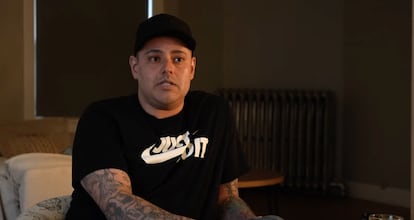
While thousands of innocent people remain incarcerated in inhumane conditions in the prisons of El Salvador, one of the most recognized gang leaders in the Central American country, Carlos Cartagena López, aka Charli de IVU, was secretly released by the government of President Nayib Bukele and has since given an interview to the digital media El Faro in which he shows his face and shares details about his deals with the Bukele administration.
In a 41-minute interview, Charli, an important leader of the faction known as the Barrio 18 Revolutionaries, sits in a comfortable sand-colored chair wearing jeans, sneakers, a cap, and a black shirt that reads “Just Do It,” Nike’s slogan. Occasionally smiling, he provides details about how his gang began to approach Bukele’s circle, the favors he received, and how the gangs allegedly helped the president rise to power.
Óscar Martínez, editor-in-chief of El Faro and co-author of the article, told EL PAÍS that “[this interview] describes how gangs turned Bukele into a relevant politician. It allows us to reach the stark conclusions that it is impossible to understand Bukele’s rise to total power without his association with gangs.”
Bukele launched his so-called war against gangs on March 27, 2022, following a massacre of 87 people organized by criminal organizations across the country. According to journalistic investigations, this massacre occurred after the government’s secret pact with the Mara Salvatrucha 13 gang and the two factions of Barrio 18 was broken. Since then, nearly 85,000 people have been imprisoned in deplorable conditions, without the right to a legal defense, and nearly 400 of them have died without trial, many with signs of torture.
This Wednesday, another Salvadoran media outlet, the magazine Elementos, revealed that Charli was captured on April 21, 2022, at a police checkpoint, 25 days after the start of the state of emergency. But after just a few minutes, he was not only released but even “escorted to his home,” all due to “higher orders.” A day after the magazine story was published, the interview with Charli came out in El Faro. So far, Bukele has not reacted to either publication.
Charli became one of the most famous gang members in El Salvador after starring in the BBC miniseries Eighteen with a Bullet. In the series, Charli, at just 16 years old, already emerges as the leader of one of the most important strongholds of Barrio 18, the IVU neighborhood in the capital. In the video, he confesses to having committed several murders and other crimes. His criminal record has only lengthened over the years, and he is currently a fugitive from justice.
According to the magazine Elementos, at the time of his arrest, Charli was accused of one homicide and 46 extortions, including against a mayor’s office and two companies. During the state of emergency, but especially in those first months, authorities arrested thousands of people for reasons as generic as being the target of an anonymous complaint, having artistic tattoos, being a relative or a neighbor of a gang member, or simply for getting nervous during a police search. Many of these people remain in prison, and others have died without being convicted of any crimes.
During Bukele’s administration, at least one other gang leader has been illegally released: Elmer Canales Rivera, aka Crook, one of the top MS-13 leaders worldwide. Crook was requested for extradition by the United States in late 2020. He was supposed to be serving a 40-year sentence in a maximum-security prison in El Salvador, but was captured in November 2023 in Mexico, after El Faro reported that he had been released and transferred to Guatemala with the help of a public official.
Since the pact between Bukele and the gangs broke down, the Salvadoran government has desperately sought to bring back the gang leaders who are aware of its dealings. It was also previously reported that the government offered Mexico’s Jalisco New Generation Cartel (CJNG) a million dollars through an intermediary to bring Crook back to El Salvador. This past Monday, CNN revealed that a brother of the president offered the Donald Trump administration a 50% discount on the rental of its mega-prison for deporting migrants if it returned nine gang leaders in its custody.
Bukele maintains a merciless public rhetoric against the gangs and has marketed himself as a global example of crime-fighting. For its part, the Republican administration in the U.S. has supported his achievements despite knowing about his pacts. In December 2021, the State Department sanctioned two senior Salvadoran officials for negotiating with gangs to reduce homicides in exchange for prison benefits.
Boosting Bukele
In addition to Charli, El Faro interviewed another Barrio 18 gang leader. The latter showed his gang-related tattoos on camera but asked to remain anonymous. For over half an hour, both leaders reconstructed details about the gangs’ pacts with the Bukele administration.
Both assert that their rapprochement with Bukele’s circle began in 2014, when the current president decided to run for mayor of San Salvador. Bukele had been a council member of a small municipality called Nuevo Cuscatlán and was aspiring to a position of national relevance.
“Remember that whoever controls San Salvador controls everything. The important thing back then was getting to be mayor of San Salvador, because that was what would propel him to where he‘s gotten now,” says Charli.
According to both gang members, the approaches began through Carlos Marroquín, an urban artist known as Slip, who has been by Bukele’s side throughout his political career. According to various journalistic investigations, Slip has been the main liaison between Bukele and the gangs, and he is one of two current government officials sanctioned by the U.S. State Department. The other one is Osiris Luna, the director of Penitentiary Centers.
The gang members claim that as part of the negotiations, Marroquín would warn them about police operations targeting their neighborhoods, and he also brought projects to their communities to curry favor with them. “He would say, ‘I’m coming on behalf of so-and-so,’ and this is going to be done. And it happened,” says the other gang member interviewed by El Faro.
According to both gang leaders, Bukele demanded their support in return. This consisted, in practice, of gang members threatening opposition activists in their neighborhoods, as well as forcing their families and neighbors to vote for Bukele.
After winning the mayoral race, Bukele managed to rehabilitate San Salvador’s historic center, something he has touted as the crown jewel of his administration. There, his popularity increased exponentially until he became a presidential candidate. He subsequently maintained his pact until he reached the central government. Since then, El Salvador has seen an unprecedented reduction in homicides — until the gangs made a clear statement with the March 2022 massacre.
There is a wealth of evidence regarding the negotiations between the Salvadoran gangs Barrio 18 and Mara Salvatrucha 13 with the various governments of Nayib Bukele: prison intelligence documents, prosecutorial investigations, photos, audio recordings, and even accusations from the U.S. State Department. Now, these two testimonies from gang leaders are added, providing details of the pacts for the first time.
For Martínez, editor-in-chief of El Faro, the investigations into the negotiations between Bukele and the gangs are not yet over. “There are things we still don’t know. Why did the March 2022 massacre happen? Were more people released? Why was Crook released? The gang pacts with Bukele are not a thing of the past; it’s a present-day aspect of how one man came to amass total power,” he says.
Sign up for our weekly newsletter to get more English-language news coverage from EL PAÍS USA Edition









































