
Julie K. Brown, the journalist who brought down Epstein: ‘I fear the Trump administration will try to cover up for powerful men’
The reporter talked to EL PAÍS about the imminent release of the case files against the pedophile and his connections to power. ‘Ghislaine Maxwell thinks she’s going to be pardoned’
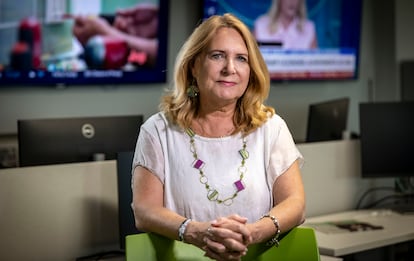

In 2017, Julie K. Brown, a journalist for the Miami Herald, was waiting to hear back about a job application at The Washington Post while watching in horror as the Senate confirmed Alex Acosta, nominated by Donald Trump, as secretary of labor. She knew all too well who this man was — the former U.S. attorney in South Florida who, in 2008, agreed to bury the first trial against a multimillionaire named Jeffrey Epstein, accused of abusing dozens of minors at his Palm Beach mansion. Acosta rewarded him with a lenient plea deal that allowed Epstein to serve just 13 months in jail.
Brown wondered what those victims must have felt, seeing the man who let their abuser get away succeed. So she proposed to her editor that they revisit the story, and she did so “as if resurrecting a cold case crime,” she explained last Friday in a phone interview. She located around 80 victims, some of whom were only 13 years old when the financier assaulted them. The Post eventually called to say they weren’t interested. “Sometimes things happen for a reason,” she recalls now.
The series of reports she published ultimately derailed Acosta’s career, led to Epstein being prosecuted a second time, and resulted in the conviction of his accomplice, Ghislaine Maxwell, who was sentenced to 20 years in prison. Federal prosecutors in New York used that reporting to charge the disgraced financier in 2019 — amid the #MeToo movement — with sex trafficking for acts committed between 2002 and 2005 in Miami and New York. In August of that year, Epstein killed himself, according to the coroner, in a Manhattan maximum-security cell while awaiting trial.
Brown has been following with great interest both the latest declassifications of documents in the case and the process that led Trump to sign a bill giving the Department of Justice 30 days to release Epstein’s files after months of opposing the measure. “Honestly, I never thought this moment would come,” says the reporter.
Question. Are you afraid that the Justice Department will exploit loopholes in The Epstein Files Transparency Act to withhold information?
Answer. Absolutely. I think they will try to cover up for powerful men. And like they say, the cover-up is often worse than the crime itself. This has been a phenomenal cover-up operation for decades. I can’t help but be skeptical.
Q. The law requires that materials be distributed in a downloadable format and be searchable. What’s the first thing you’ll type into the search engine?
A. Everyone will be searching for Trump’s name. Maybe “Acosta.”
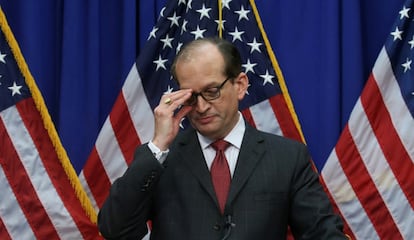
Q. What do you think drove Acosta to do what he did?
A. Ambition. He wanted to advance his career. He wasn’t interested in going up against someone so influential. In the end, it hurt his career more.
Q. He’s surprisingly absent from the conversation these days…
A. He should be front and center. And not just him. In one of the latest document dumps, we learned that Epstein corresponded with another prosecutor in Acosta’s office, and that he had dinner with him in the years after he got his plea deal. That they became friends seems very serious to me. There was another prosecutor who went on to work for Epstein. I do not understand why the Justice Department has not looked at this closer.
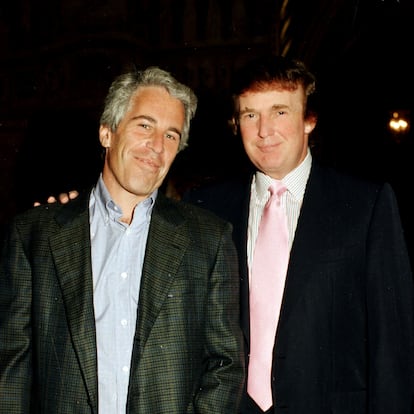
Q. The big question is: What is Trump hiding about Epstein?
A. I don’t know the answer. I may know a lot about the case, but I do not know why he has been fighting this. I don’t know what he saw in the files, or what someone told him they saw in the files, but there are obviously things in there that he doesn’t want released. And the more agitated he becomes, the angrier he becomes. It’s worse because it just makes people more and more suspicious.
Q. Why have the powerful figures who have fallen so far been brought down abroad, rather than in the United States? I’m thinking of former Prince Andrew, modeling agent Jean Luc Brunel (who killed himself in prison in France before his trial for rape), Peter Mandelson, the British ambassador to the United States…
A. That’s a very good point. Perhaps other people around the world have taken this case more seriously than our own elected officials.
Q. Or is that in the U.S. money can buy almost anything?
A. When I wrote my series of articles, members of Congress were already demanding a more thorough investigation. The Justice Department did its own investigation, but held no one accountable. The only person who has been held accountable is a woman: Ghislaine Maxwell. I hope the forthcoming files will explain why it was only her.
Q. She is now receiving preferential treatment after cooperating with the Trump administration. Is there a possibility she will be pardoned?
A. I think she believes she’s going to be pardoned. She has a lot of information, and she’s setting herself up for a pardon.
Q. Is the Epstein list a conspiracy theory?
A. I think there is a list, but not as a specific document. There is a list of people who helped Epstein, and I’m sure the FBI, at some point, compiled a list of those potential suspects.
Q. Tell me how you approached your investigation...
A. I knew there were a lot of people involved, important and influential people. And I wondered: How is it possible that a guy who molests and rapes dozens of girls and young women is still free? Now we know there are almost 1,000 victims. I focused on the crimes for which he had already been tried. I found about 80 victims, but only a handful wanted to talk to me.
Q. Was it a well-known case in Florida?
A. Yes, but there’s a difference between knowing about something and taking it apart and really looking at it and examining how it happened. That’s what I did. I started with the new information that had come out thanks to several civil lawsuits. I decided to pore through everything meticulously. If he had been imprisoned for sex trafficking back then, as he deserved, we wouldn’t be talking about this now.

Q. Last week, the focus was on the victims. They presented themselves in Washington as a group of courageous women... What were they like when you first started talking to them?
A. Very different. After my articles were published, Epstein was arrested again. Many of the victims came together at the court hearings and became friends. A lot of these women were suffering their trauma, alone and in silence. They formed a group that they never wanted to be a part of. Virginia Giuffre [who died by suicide in April], whom I miss very much, got the ball rolling. At first, they were afraid to come forward and put their face out there as they do now; they feared how the public or their families would react. It takes a lot of courage to do what they have done.
Q. Some of them have said they know names, but are afraid to reveal them because they could be taken to court or their lives could be in danger…
A. Some of those women were victims of trafficking and handed over to other men. So, of course, they know who they were trafficked to. There were other men involved. And the truth is, if you review some of these emails, you can put together who some of them were. I mean, there are cases where they are very careful in these emails not to spill the beans, but from the way they spoke… I’m not saying they committed a crime, but it’s clear that the lives of some of those men revolved around sex. That was Epstein’s world.
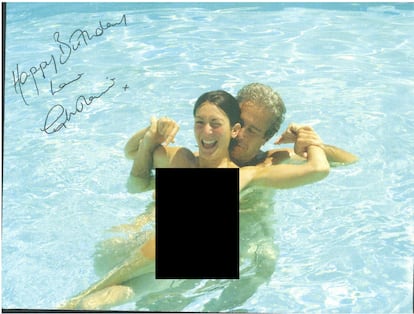
Q. Reading some of those materials, such as Epstein’s 50th birthday book, allows us to glimpse a world in which certain things were acceptable, a world that spoke openly of being with young girls without any remorse…
A. Even if they weren’t directly involved, practically all of those people... Sure, there are exceptions, but they all knew what Epstein was doing, and by being complicit in some way, I think they emboldened him. They knew what he was doing and allowed it to happen in front of them. If any of those powerful people had said to him, “You have to stop, I’m going to report you,” maybe it would have made a difference. Many of the documents that are coming out are from after he was already a known sex abuser of children. Think about that. And these people were still associating with him.

Q. What did they want? His money? His influence?
A. It’s a whole range of things; different people wanted different things, and he was like their fixer. It wasn’t just Democrats or Republicans. He didn’t discriminate.
Q. Larry Summers is the latest high-profile figure whose reputation has been affected. The name of the former Harvard president, who was also a member of Bill Clinton’s Cabinet, appears in the documents….
A. They’ve gone after him, but he’s not the only one. There were many people involved. For example, Steve Bannon, who has been proven to have tried to help Epstein repair his reputation after it became known that he was a pedophile. Let’s remember that Bannon is one of the founders of the MAGA movement.
Sign up for our weekly newsletter to get more English-language news coverage from EL PAÍS USA Edition









































