
The new gold rush is gripping investors: ‘In the past four years, I’ve invested much more heavily’
The precious metal has outperformed stocks and cryptocurrencies so far this year, hitting record highs. In times of uncertainty, its allure draws both major investors and small savers
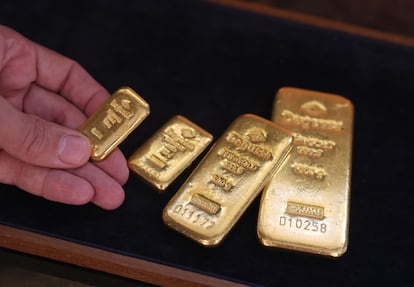

Twenty-first-century gold seekers don’t need to dig through earth or sift through water to find it: they can buy it at a shop or on any online investment platform, to name just a few options. And they pay handsomely for it — or cheaply, depending on how you look at it. Never before has an ounce of this precious metal cost more than it does now, above the $3,500 mark, yet its appreciation shows no signs of slowing. Some even predict a dazzling future beyond $5,000, which would make current levels seem affordable. Its buyers — central banks, family offices, insurers, and increasingly individual investors seeking to profit — have seen their balances and accounts grow for months thanks to this timeless asset whose popularity never wanes. And they keep opening their wallets.
“It’s the ultimate safe haven, with a long history of preserving value in times of economic uncertainty, inflation, or volatility. It allows me to diversify and reduce the risk of my investments. It offers protection that stocks and bonds can’t guarantee,” says Guillermo, a 30-year-old programmer from Seville who prefers not to give his last name, one of those riding the wave.
When he started investing in October 2024, gold made up 5% of his portfolio, but the sharp rise in its price has increased its share to 8%. His system relies on discipline: every month he logs into his MyInvestor account and hits the buy button, using a method widely known as DCA (Dollar-Cost Averaging). By spacing out purchases rather than investing all at once, the approach reduces the risk of buying at the wrong price.
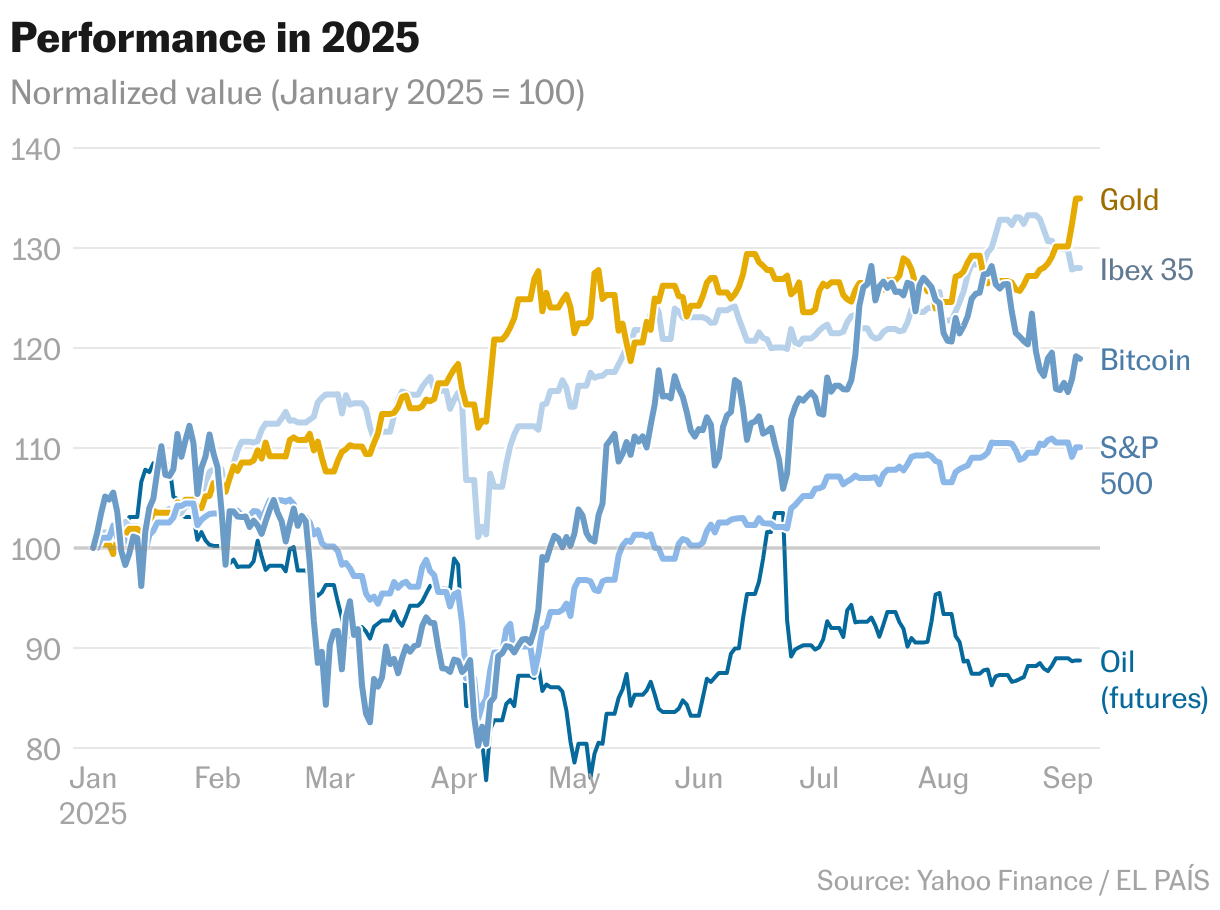
“I think gold is the safe-haven asset of the past and present, and bitcoin is the safe-haven of the present and future. That’s why I invest €200 [$230] a month in gold and €100 [$117] in bitcoin,” says another small investor, a 40-year-old from Bilbao working in the tech sector, who prefers to remain anonymous.
So far this year, gold has surged more than 35%. Neither the major stock markets nor bitcoin have reached that level. Not even Spain’s hot real estate market, where almost everything is worth more than yesterday but less than tomorrow, comes close to those dizzying percentages. Why now? Economist Javier Santacruz explains: “Gold is considered a safe-haven asset against two scenarios: inflation and tensions in the monetary system. Although the peak of price increases is behind us, many see it as a bet on inflation returning in the coming years. That, combined with the situation at the Federal Reserve, has made it an attractive asset.”
The U.S. central bank is a powder keg. One of its governors, Lisa Cook, received a dismissal letter from Trump, whom she is suing. And its chairman, Jerome Powell, has been the target of a months-long campaign by the White House. With his term set to expire in May 2026, the market assumes that his successor, appointed by Trump, will be a puppet controlled by the Republican. Without independence, the Fed’s credibility would be compromised, and the dollar will feel the impact.
That depreciation benefits gold, which typically moves inversely to the greenback: the stronger one is, the weaker the other. In the summer of 2022, when the dollar reached parity with the euro, gold suffered. Since then, its price has doubled.
The same used to happen between stocks and gold. When stocks tumbled, gold strengthened as a refuge for risk-averse investors seeking safety, and vice versa. But with both markets now near highs, that connection is shifting. “The apparent gold-stock market paradox responds to compatible narratives: stock markets rise due to expectations of Fed cuts, while gold benefits from the weak dollar and uncertainty over Trump’s tariffs,” analyzes Judith Arnal, senior researcher at the Elcano Royal Institute and CEPS.
All these issues are music to the ears of those profiting from the precious metal. “We are facing the third major bullish cycle in the history of gold,” says Gustavo Martínez, a stock market expert and wealth advisor who has been buying gold for more than a decade. “In the past four years, I’ve invested much more heavily,” he says with conviction. His thesis is that the large national deficits incurred by states fuel their debts, devaluing fiat currencies. In his view, gold provides immunity against this ongoing loss of value of the euro, the dollar, and other currencies in which people receive their wages, which mean they are at risk of losing their purchasing power.
That is why Martínez, like other staunch proponents of gold as an investment and store of value, rejects the idea that housing and other basic goods have become more expensive. Instead, he prefers to say that currencies have been devalued by inflation, noting that in comparison to gold, houses are worth less than in the past.
Physical or digital?
One of the dilemmas facing those who want exposure to gold is how to go about it. They can buy shares in mining companies, which are posting soaring profits as the price of what they extract rises. Shares in the Canadian Barrick Mining Corporation, for example, are up 70% in 2025, buoyed by strong performance at its mines in Argentina, Chile, Ivory Coast and the Congo. Others, such as the U.S. firms Newmont Corporation and Gold Fields, or South Africa’s AngloGold Ashanti, are also posting hefty gains.
Another option is to invest through ETFs that replicate the real-time price of gold, which can be bought or sold instantly via any online brokerage. And then there’s the most traditional route: walking into a branch and leaving with coins or bars. Some even offer delivery, in sealed packages that are only handed over in person upon presentation of an ID.
That last business — selling gold you can actually touch — is where Giulio Buoncore, 53, comes in. He runs the Madrid branch of Degussa, short for Deutsche Gold- und Silber-Scheideanstalt, one of Europe’s largest precious-metals dealers. Located on Calle Velázquez, a stone’s throw from Retiro Park and the Hotel Wellington, where last Friday the cheapest room topped €500 ($590), the store sees a steady trickle of clients inspecting its display cases of coins and bars.
“We’re noticing more people coming. There’s a lot of interest from both street-level clients and family offices [investment vehicles that manage the assets of wealthy families] and high-net-worth individuals we contact,” he says.
The gold they sell comes from Swiss refineries, although for security reasons they prefer not to disclose how much they hold. Orders can reach €3 million ($3.5 million) or €4 million ($4.7 million), but the clientele is varied. Walk-in buyers tend to purchase 10-gram, 20-gram and one-ounce bars (31.10 grams), while wealthier clients and institutions start with 100-gram or 150-gram bars and go up to the one-kilo size, the largest they sell.
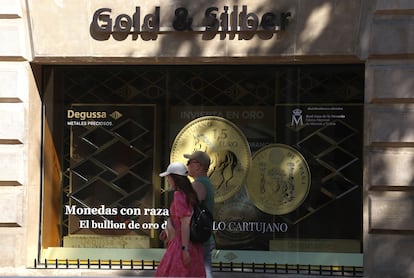
Those 1,000 grams now fetch close to €100,000 ($117,000), which makes stashing them under the mattress a risky proposition. Degussa offers to keep them in safety deposit boxes, as do banks.
Gold buyers can resell their bars or coins back to Degussa at any time — whether they need liquidity for a home purchase, want to cash in after gains, or simply for other reasons. As with currency exchange or share sales, the price is usually a bit below market, since it’s subject to transfer taxes and transaction costs. Even so, payment is fast: funds are transferred within 24 hours.
Pros and cons
Why do some people prefer physical gold? “It’s independent of the banking system; if a major financial crisis hits, many people prefer the security of physical gold,” explains Buoncore. Another advantage is that bars over two grams are exempt from VAT — unlike silver, another metal on the rise.
To understand today’s boom, you have to look back. In 1971, U.S. president Richard Nixon ended the fixed convertibility of gold, which for decades had been pegged at $35 an ounce. The British economist John Maynard Keynes had derided gold in 1924 as a “barbarous relic,” criticizing the rigidity of the gold standard. Its demise allowed the price to float freely with supply and demand — ushering in uncertainty. “Gold does not earn interest, and unless its price rises, it generates no economic return,” a 1979 Morgan Guaranty Trust Company study (predecessor of JPMorgan) concluded, predicting a bleak future for the metal.
Half a century later, those dire forecasts have been proven wrong. Gold is now worth 100 times more than in the gold-standard era. Even central banks are hoarding it. By the end of 2024, the ECB held €40.9 billion ($48 billion) in gold, €10.5 billion ($12.3 billion) more than a year earlier, thanks to price gains. Many others are stockpiling reserves. Why?
Judith Arnal of the Elcano Institute points to three reasons: “First, for geopolitical reasons: the Russian central bank’s asset freeze has been a wake-up call, and many emerging countries are accumulating gold as insurance against financial sanctions. Second, because it’s a traditional reserve asset that provides diversification against the dollar and other currencies. And third, because after the recent spike in inflation, they see it as a way to stabilize their reserves.”
With prices soaring, the natural question is whether a correction looms or there’s still room to climb. U.S. investment bank Goldman Sachs said last week it wouldn’t rule out gold reaching $5,000 an ounce — a further 40% increase — if doubts about U.S. debt, fueled by Trump’s interference in the Fed, push investors to shift even a sliver of their bond holdings into gold. Just 1% would be enough to make it happen.
Gustavo Martínez goes further, invoking history to argue gold’s potential is far from exhausted. “In the first bull cycle, the price rose twentyfold. In the second, sevenfold. In this one, we’ve barely doubled,” he says.
Gold usually isn’t the main position in investors’ portfolios. It tends to make up a smaller share than stocks and bonds, and the rise of bitcoin has increased competition, with many of its followers hailing it as a kind of digital gold. Still, this centuries-old asset is gaining ground.
Javier Santacruz compares it to real estate, another physical store of value: “It has a millennia-long history as a store of value and medium of exchange. It’s a metal that exhibits stable physical and chemical characteristics over time. All transformations made to gold, whether bars or coins, don’t lose mass. And that’s a quality that no other element in nature possesses.”
Sign up for our weekly newsletter to get more English-language news coverage from EL PAÍS USA Edition









































