
Genetic patch curbs Dravet syndrome, a disorder with seizures triggered by geometric patterns
The first gene-regulating treatment for epilepsy achieves promising results in an initial trial with 81 patients
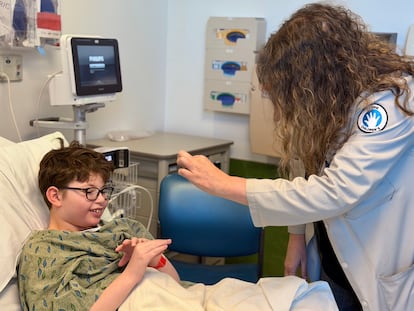

A revolutionary genetic “band-aid” has managed to curb seizures in children and adolescents with Dravet syndrome, a rare, intractable form of epilepsy in which attacks can be triggered by infections, heat, or even visual stimuli such as geometric patterns — stripes, checks, or diamonds.
Spanish neurologist Antonio Gil‑Nagel explains that one of his patients, a four‑year‑old boy who suffered around 20 seizures a month, was among the first to receive this experimental therapy, developed by Uruguayan biologist Isabel Aznárez and her colleagues at the U.S. company Stoke Therapeutics.
“The improvement was immediate, from the first injection. If things are as they seem, it’s impressive,” says Gil-Nagel, from the Ruber International Hospital in Madrid.
The child, treated in 2023, went from experiencing around 20 seizures a month to having only about one a year, according to the neurologist. Gil‑Nagel’s young patient received the therapy at Great Ormond Street Hospital for Children in London, which has been partially funded by the copyright of the Peter Pan character since 1929, when the Scottish novelist James Matthew Barrie donated it to the institution. The promising results of that first clinical trial, conducted in the United States and the United Kingdom, were published on Wednesday in The New England Journal of Medicine. “It is the first gene-regulatory treatment for epilepsy,” says Gil-Nagel.
One in every 16,000 newborns has Dravet syndrome. In most cases, the condition is caused by a mutation in the SCN1A gene, which alters the behavior of neurons and leads to frequent epileptic seizures. The mortality rate reaches 15%. The experimental treatment — administered into the cerebrospinal fluid through a lumbar puncture — is called zorevunersen and is a genetic patch that reduces the effects of the mutation.
The clinical trial involved 81 children and adolescents between the ages of two and 18. The experiment was designed to test the treatment’s safety, but scientists also observed an 85% reduction in epileptic seizures within three months among participants who received high doses. These improvements persisted over 20 months of follow‑up, with reductions ranging from 60% to 90%. Because the therapy targets the underlying cause of the disorder, it also improves other aspects of the syndrome, such as severe cognitive and motor delays.
Researchers at Lurie Children’s Hospital in Chicago, led by neurologist Linda Laux, shared the case of Owen, a 12-year-old patient with uncontrolled seizures, intellectual disability, and difficulty walking. The boy’s mother, Austin, explained in a statement that after receiving the experimental treatment, her son speaks more easily. “He is able to make friends, which is kind of a new development. His quality of life has increased substantially,” she said.
The reported adverse effects are mild to moderate. The most concerning is an increase in cerebrospinal‑fluid protein levels observed in nearly half of the participants, although no cases of elevated intracranial pressure or hydrocephalus were detected. Stoke Therapeutics, which had more than €200 million ($215 million) in funding at the start of 2025, will finance a new clinical trial that will include at least two private centers in Spain: Ruber International Hospital and the Clínica Universidad de Navarra. The U.S. biotechnology company Biogen has paid over $160 million for the rights to market zorevunersen outside the United States, Mexico, and Canada, although additional trials are still required to confirm the treatment’s efficacy and safety.
Paradigm shift
Pediatrician Rocío Sánchez-Carpintero will lead the trials at the Clínica Universidad de Navarra. The researcher says that, until now, there were only treatments to alleviate the symptoms of Dravet syndrome.
“This is a paradigm shift. We’re going from treating one of the manifestations, the epileptic seizures, to treating the disease itself,” she says. “It’s like using an antibiotic to kill the bacteria that causes pneumonia, and then you no longer have a cough. Until now, we were only treating the cough. Epilepsy is a manifestation of Dravet syndrome, not its cause.”
“It’s a historic milestone,” she adds. “The quality of life for patients today is horrific. Horrible. They have epileptic seizures that are not controlled by any medication, an intellectual disability that becomes increasingly evident, difficulty walking as teenagers, some symptoms similar to autism… Families practically live to be able to care for them.”
She continues: “Because they have a risk of sudden death associated with epilepsy, many parents take turns at night so that, if there is a seizure, they can try to wake their child and prevent them from dying. It is very difficult to live like this.”
These types of genetic patches are called antisense oligonucleotides. The first similar treatment, authorized in 2016, was nusinersen, indicated for spinal muscular atrophy. It was priced at $750,000 the first year and $375,000 in subsequent years, per patient. The results of the next clinical trial, expected by the end of 2028, will determine whether zorevunersen is truly a potential treatment for the devastating Dravet syndrome. “The outlook is very promising. I’m very hopeful,” says Sánchez-Carpintero.
Sign up for our weekly newsletter to get more English-language news coverage from EL PAÍS USA Edition









































