
Colombian remittances equal the value of the country’s oil exports
Money sent from abroad becomes a vital source of income for the South American country’s economy. By the end of the year, it will account for nearly 3% of GDP
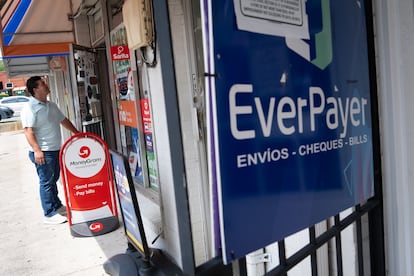

For the first time in history, the fiscal impact of money sent by Colombians abroad to their families at home has equaled the value of the country’s oil exports. Between January and July of this year, these international transfers amounted to $6.507 billion, while hydrocarbon shipments totaled around $6.491 billion. There is no doubt that this is an increasingly vital economic source. Some even speak of a boom. And although the South American country has not yet reached the level of dependence on remittances of Nicaragua (27.2%) or the Dominican Republic (8.8%), the positive balance of these transfers is already approaching 3% of GDP.
The largest senders of remittances to Colombia are the United States (42%) and Spain (11.3%). “If we compare ourselves with other economies in the Central American bloc whose remittance figures exceed 20% of their GDP, ours is not a risky or dramatic level for the economy. On the contrary, it provides support in terms of spending and managing local cycles,” explains BBVA’s chief economist, Alejandro Reyes. He is referring to the support it provides for low-income recipient families to cover their health, housing, food, and education needs.
In terms of figures, these remittances moved $1.158 billion in July of this year alone, according to partial data from the Colombian Central Bank. This represents a 15.1% increase compared to the same month last year: “Remittances have the positive impact of boosting consumption and, consequently, economic growth. One question we might ask is at what cost? Because part of the increase in this line is a direct consequence of the 1.5 million Colombians who have left the country since 2022,” explains Munir Jalil, chief economist for the Andean region at BTG Pactual.
Along the way, the impact of President Donald Trump’s immigration policy should also be analyzed. “The increase may be due to the short-term behavior of undocumented workers in the United States, who have begun to send their savings back to their countries of origin for fear of being repatriated. This has been observed in Mexico. But there is a second, long-term point that has to do with nationalist attitudes and suspicion of immigration in Europe,” explains Andrés Langebaek, director of economic studies at Grupo Bolívar. The same could happen, he adds, in the case of the United Kingdom, which has imposed entry visas on Colombians since last December.
In Europe, far from the situation for migrants becoming clearer, countries like Poland and Germany have already raised the possibility of issuing visas to Colombians in political debate. This fact supports Langebaek’s thesis: “A third point for the future has to do with demographic reality. Faced with the rising number of single-person households, or couples without children, the question is whether the incentives for emigration will be sustained in a decade. Probably not, because with fewer workers available, it’s possible we could see rising wages and incentives to retain employees in the country,” Langebaek argues.
Between January and July 2025, foreign currency sent from abroad to Colombia reached $7.575 billion, an increase of nearly 14% compared to the same period in 2024. Munir Jalil warns that, although this growth reflects the efforts of migrants, it may also be associated with complex problems. According to the economist, these remittances could be a proxy for the rise of illicit businesses such as drug trafficking or the illicit sale of gold. And, although Colombia has mechanisms to prevent these illegal funds from filtering through as legitimate remittances, he acknowledges that it would be naive to think the phenomenon is not permeable.
Alejandro Reyes agrees. But he also reinforces the message that the country’s history has forced authorities to establish “very rigid processes to review and control the source of these resources.” In any case, the BBVA economist is aware that “areas such as Valle del Cauca, the Coffee Region, and the Caribbean Coast have used remittances to cushion the impact of local macroeconomic variables.” That is, inflation that seems to be unrelenting, interest rates, or fluctuations in the value of the dollar. “It’s a significant source of foreign currency that also helps keep the exchange rate somewhat under control. If Colombia had fewer remittance inflows, it might have greater vulnerabilities in that regard,” Reyes asserts.
This is perhaps one sector within an economy experiencing some changes as it recovers from the blows of the mandatory paralysis of the Covid years. Along these lines, it is known that some two million Colombians, out of a population of just over 50 million, receive domestic and international transfers annually. To put this in perspective, these transfers triple the income generated by coffee exports. That’s why Jalil warns that the progress of this channel must be monitored: “External shocks could have a greater impact on the economy, and that is a factor that generates greater volatility.”
Sign up for our weekly newsletter to get more English-language news coverage from EL PAÍS USA Edition









































