
Texas opens investigations into school districts for allowing student protests against ICE
The state government maintains that schools helped organize the demonstrations, while civil organizations warn of possible political reprisals
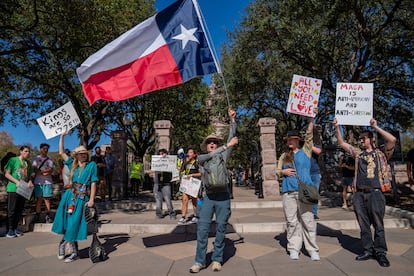
Following several weeks of student protests against Immigration and Customs Enforcement (ICE) operations, Texas Attorney General Ken Paxton announced this week that he will open formal investigations into three major school districts in the state. These new inquiries come in addition to the ongoing investigation against the Austin Independent School District (Austin ISD), from which Paxton demanded information in early February, alleging that its officials “knowingly allowed students to leave campus during the school day” to participate in the protests.
On January 30, students from a dozen Austin ISD campuses walked out of their classrooms and marched with signs to the state Capitol to protest the events in Minnesota during the massive immigration operation in the state, including the killing of two U.S. citizens, Renee Good and Alex Pretti, by immigration agents. In the following weeks, similar walkouts took place in San Antonio, Dallas, Waco, El Paso, Houston, and Fort Worth. Hundreds of students took to the streets demanding the dismantling of ICE. Most of the organizers said they acted with planning and in accordance with the law.
“It’s about time students like this were arrested [...] Schools and staff who allow this behavior should be treated as co-conspirators and should not be immune for criminal behavior,” wrote Republican Texas Governor Greg Abbott on X on February 3. He also threatened to cut state funding to districts that allowed walkouts. The Education Agency, for its part, declared that students who left campus would be marked absent, that teachers who facilitated the protests could lose their teaching licenses, and that districts could be directly taken over by the state. That same day, the attorney general opened an investigation into Austin ISD. Two weeks later, he announced new investigations into three of the state’s largest districts: Northeast San Antonio, Dallas, and Manor.
According to Paxton, in these districts, “administration and staff helped organize the protests,” and school officials failed to “ensure student safety or minimize classroom disruptions.” He demanded that they turn over documents regarding campus exit policies, excused absences, security protocols, internal communications about the protests, and the use of public funds. “I will not allow Texas schools to become breeding grounds for the radical Left’s open borders agenda,” he declared. “Let this serve as a warning to any public school official or employee who unlawfully facilitates student participation in protests targeting our heroic law enforcement officers: my office will use every legal tool available to hold you accountable.”
Meanwhile, a spokesperson for the Northeast District of San Antonio confirmed to KSAT that Paxton’s investigation is specifically focused on Churchill High School. “We are fully cooperating and gathering documentation to provide to the AG’s Office,” the spokesperson stated. Staff were also reminded that they should not “encourage, endorse, discourage, or attempt to persuade students about participating in a walkout or protest.”
The Manor district, for its part, stated in a press release that it is “confident the review will show that staff followed district procedures and Texas Education Agency guidance, including ensuring attendance guidelines were followed and keeping student safety as the top priority.”
Austin ISD Superintendent Matias Segura denied that the district supported the protests. “Our staff cannot physically prevent a student from choosing to leave campus,” he asserted. Furthermore, the district’s legal counsel sent a letter to the District Attorney’s Office rejecting the allegations and stating that “Texas law does not permit the use of any degree of force to compel school attendance.”
The American Civil Liberties Union (ACLU) of Texas reaffirmed its support for the young protesters in a statement. “Government officials cannot punish students simply because they dislike their message,” explained legal director Adriana Piñón. “Students do not lose their free speech rights when they enter their schools, and while the law may permit discipline in some cases, it certainly does not require it [...] The state is threatening drastic and severe consequences for peaceful speech that could amount to retaliation, which is unconstitutional”
Brian Klosterboer, senior staff attorney for the organization, noted that Attorney General Paxton “has long used his office to attack viewpoints he doesn’t like.” Regarding the investigations into school districts, he said that “no laws have been identified as having been violated, and no one’s constitutional rights have been restricted.” “Authorities should be listening to students who are respectfully participating in democracy, instead of wasting resources on suppressing their expression.”
Klosterboer also recalled the historical tradition of these protests in the United States. “Boycotts and walkouts are peaceful and long-standing forms of civic engagement, recognized by the Supreme Court. Neither students nor educators relinquish their constitutional rights by walking through the school gates,” he asserted.
Sign up for our weekly newsletter to get more English-language news coverage from EL PAÍS USA Edition









































