
The horrors of the Dilley family detention center, as told by detained children: ‘They don’t treat us like human beings’
Families held at the ICE facility report that the lack of adequate medical care is endangering children’s lives
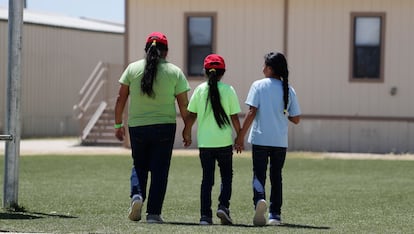

Last year, Habiba Soliman should have started university to pursue her dream of studying medicine at Harvard. After graduating with honors from her high school in Colorado Springs, where she lived with her family, her dream seemed within reach. Now her world has collapsed. “I’ve lost my dreams, my friends, my home. My family was the only thing I had left, so losing them too makes my life feel meaningless,” says the young woman of Egyptian descent from the immigrant family detention center in Dilley, Texas.
Habiba arrived there with her mother and four siblings in June, but in January, when she thought nothing could get worse, she was separated from her family and moved to another section of the facility. Habiba and her lawyer believe this is retaliation for a letter in which she denounced not only the injustice of her detention, but also the inhumane conditions endured by detainees in Dilley, where thousands of children suffer the physical and mental harm caused by confinement.
Eight months ago, agents from Immigration and Customs Enforcement (ICE) brought her there along with her mother and siblings after her father, Mohamed Soliman, carried out an attack in the city of Boulder, Colorado, against demonstrators calling for the release of Israelis kidnapped by Hamas — an attack that left one person dead and several injured. The family says they were unaware of the father’s plans, as he barely communicated with them, and the FBI’s investigation found no evidence to suggest otherwise. Despite having cooperated with authorities during the investigation, two days after the attack, on June 3, they were sent to the Dilley facility, where hundreds of families are held with their young children and survive in conditions detainees describe as inhumane.
ICE justifies separating Habiba from her family on the grounds that she is now an adult, but she argues that it is retaliation for speaking out about the deplorable conditions inside the center. In fact, she turned 18 in June, but she was only separated from her family a few days after making public a letter denouncing the treatment detainees receive — a letter that circulated in the media and on social networks. The separation, painful as it is, has not silenced her. “They’ve already taken everything from me. What more can they do?” she asks.
Please take the time to read the whole statement of Habiba Soliman, detained at Dilley for 8 months with her mom, 5 year old twin siblings, 9 yr old sister, and 16 yr old brother.
— Eric Lee (@EricLeeAtty) January 25, 2026
🧵 1/12 pic.twitter.com/T9XXbym31R
According to the young woman, in Dilley you have to fight for absolutely everything: food, clothing, medicine… She also denounces the trauma the children are suffering from being kept in a place with no school, no toys, and not even access to medical care when they need it. “They don’t treat us like human beings,” she says. Habiba has five‑year‑old twin brothers, a nine‑year‑old sister, and another brother who is 16. “They cry all day. They have nightmares and wake up crying at night. I can’t help my mother and I see her suffering. I can’t help my siblings and I see them suffering, I can’t help myself — it’s very, very hard,” she laments.
Her lawyer, Eric Lee, managed to secure permission for her to visit them for one hour a day, but she spends the rest of the time in isolation. One of the five‑year‑old twins suffered an acute appendicitis episode, with severe pain, but the staff member responsible for attending to him told his mother to come back in three days if the pain continued. He lay on the floor in agony for hours until, after they saw him vomiting, he was finally taken to a doctor and eventually underwent surgery. After he was discharged from the hospital, it was difficult to obtain the medication he had been prescribed.
Lee visited them in January and described the children’s situation. “The way the guards speak to the kids is terrible — they use bad language, they treat them as if they weren’t human. The food is inedible; my nine‑year‑old client isn’t eating three times a day and it’s affecting her mentally. When they ask the guards for more food, a little more water, anything, they say things like, ‘Don’t waste my time.’ Sometimes the food is frozen, other times it has bugs in it. The children beg you to give them a banana, some fruit, but they don’t allow you to bring any,” the lawyer explains. Several mothers have said that some children are so distressed that they have harmed themselves or talked about suicide.
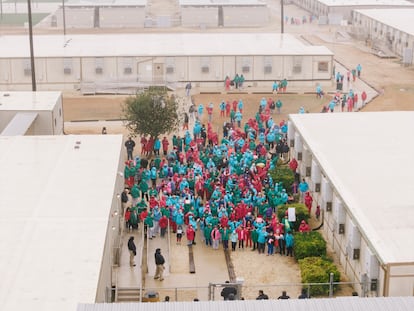
The Dilley detention center, operated by CoreCivic, was closed for years and only reopened in early 2025, when U.S. President Donald Trump returned to the White House. The need to detain everyone targeted in his campaign against migrants in his bid to carry out the largest deportation effort in U.S. history led to the reopening of shuttered detention centers and an expansion of available bed space.
Around 3,500 detainees, more than half of them minors, have been held in the center since it reopened. Although the 1997 Flores Agreement sets a 20‑day maximum for the detention of children in immigration facilities, a report by ProPublica revealed that about 300 minors sent to Dilley by the Trump administration remained there for more than a month. The publication has collected letters from the children held inside.
“They told me I could only be here 21 days but I have already spent more than 60 days waking up eating the same repeated meals,” wrote a 12-year-old Venezuelan girl, who said that when she felt sick and went to the doctor, “the only thing they tell you is to drink more water and the worst thing is that it seems like the water is what makes people sick here.”
Another girl wrote: “To get any medicine, pill, anything it takes a while, there are various viruses people are always sick. Serious situations happen and the officers can’t take them serious enough there are no consecuenses, they don’t care.”
There are growing complaints about the deplorable conditions endured by children at Dilley, and the case of five-year-old Liam Conejo Ramos, who was detained by immigration agents along with his father in Minneapolis, brought the Texas facility into the headlines. “No five-year-old should be detained in this way,” said Democratic Congressman Joaquin Castro after visiting the center, calling for its closure.
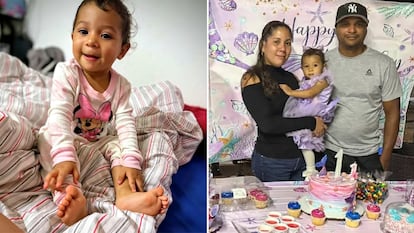
The parents of Amalia, an 18-month-old baby, have also spoken out about the lack of medical attention their daughter received after a crisis that threatened her life. The parents are Venezuelan asylum seekers who fled the Nicolás Maduro regime, and were detained at an immigration checkpoint in December. In early January, Amalia fell ill with a high fever, vomiting, and diarrhea, leaving her dehydrated and struggling to breathe. Despite her parents’ pleas, she received no medical attention and was only told to take basic remedies to reduce her fever.
On January 18, her blood oxygen saturation dropped drastically to 50, and she was transferred to the hospital, where she was admitted to intensive care. Amalia was diagnosed with COVID-19, respiratory syncytial virus (RSV), viral bronchitis, and pneumonia. Ten days later, she was discharged, but despite the severity of her illness, she was returned to the Dilley facility, where her nebulizer, medications, and prescribed nutritional drinks were confiscated. Her parents waited for hours each day in long lines to receive one of the nutritional drinks, but they did not receive the rest of her treatment.
Elora Mukherjee, a professor at Columbia Law School and director of the Immigrants’ Rights Clinic, filed a request for the family’s release due to the child’s fragile health. After the initial request and subsequent appeals failed, Mukherjee filed an emergency lawsuit in federal court following confirmation of a measles outbreak in Dilley, and successfully obtained their release.
“The children and families lack access to sufficient clean water, nutritious and age-appropriate food (parents and children have found worms, insects, and mold in their meals), meaningful educational opportunities, and adequate medical care. The lights are on 24 hours a day, seven days a week, making it difficult for them to sleep. Detaining immigrant children in inhumane and degrading conditions is illegal, unconstitutional, and un-American. The children and families in Dilley must be released,” says Mukherjee.
Habiba and her family were granted bail by a judge in September, but the government appealed, and the judge reversed his January 21 decision, arguing that they had no money and could flee. Thanks to donations from a thousand people, they have raised $100,000, which Lee hopes will allow them to challenge the judge’s decision. Habiba’s teachers and neighbors have organized protests to demand her release. “The detention has to stop before something bad happens. We need everyone to step up and say that detaining families for indefinitely long periods should be illegal. This place could be bearable for 20 days maximum,” Habiba writes in one of her letters.
Sign up for our weekly newsletter to get more English-language news coverage from EL PAÍS USA Edition









































