
Liam Conejo Ramos: The face of the hundreds of minors in immigration custody under the Trump administration
The five-year-old remains in a center with his father in Texas. His case has reignited the debate about the conditions of juvenile detention in the United States

January 27 marks one week since Liam Conejo Ramos, a five-year-old Ecuadorian boy, was detained by Immigration and Customs Enforcement (ICE) agents in Minneapolis while returning from school with his father. Images of the child, wearing his blue hat and carrying a Spider-Man backpack, guarded by federal agents, instantly became a symbol of the indiscriminate nature of President Donald Trump’s immigration crackdown in the United States, and reopened the debate about the treatment of children in migrant detention centers.
While this was a central issue during Trump’s first term — especially family separation and detention centers for minors at the border — in the first year of his second presidency, the treatment of migrant children didn’t feature prominently in the debate or in the protests against the Republican administration’s anti-immigrant policies. Until now. Following the arrest of young Liam and his father in Minnesota, reports about the number of minors in detention and the conditions they face have become the focus of controversy.
According to limited data compiled by the Deportation Data Project, ICE took 3,800 children into immigration detention with their parents between January and October 2025, including children as young as one or two years old. The data shows that more than 2,600 of these children, like Liam Conejo, were detained within the country — a significant policy shift, as previously children were only detained at the border. There is no publicly available data on the number of children currently in migrant detention centers. However, more than 2,500 unaccompanied minors are reported to be under the care of the Office of Refugee Resettlement, the agency responsible for the care of migrant children without a locatable legal guardian.
On the other hand, although the so-called Flores Agreement, a 1997 law, requires that migrant children be released within a maximum of 20 days, during Trump’s second term many minors have spent much longer in detention. In December, an ICE report indicated that at least 400 migrant children remained in federal custody beyond the limit, some for more than five months. The agency acknowledged that the problem was widespread and attributed the delays to transportation issues, medical needs, and legal procedures.
Liam has been in custody for seven days. On January 20, in front of his family’s home in Columbia Heights, a suburb of Minneapolis, the little boy was returning from school with his father, Adrián Conejo Arias, when ICE officers pulled him from the moving car. According to the school district, which reported the arrest in a statement, the officers’ objective was for the boy to knock on the door so he could act as “bait” to detain others inside the house. “Liam is a bright student. He is very kind and caring, and his classmates miss him. He comes to class every day and brightens up the classroom. All I want is for him to come home safe and sound,” said the boy’s preschool teacher.
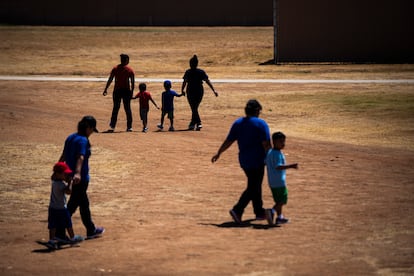
During the operation, an adult in the house offered to care for Liam, but was refused by the officers. Afterward, both the father and the child were taken to the South Texas Family Residential Center in Dilley, about an hour from San Antonio.
“A horrible place”
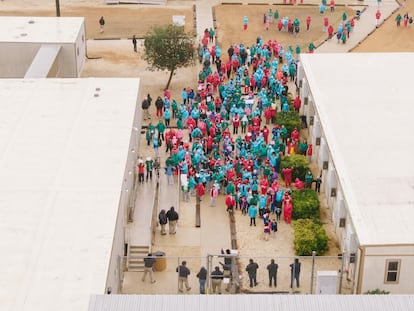
This Saturday, while Minneapolis was reeling from the shooting death of Alex Pretti by Trump’s immigration agents, Liam’s case sparked a massive protest inside the Dilley detention center. Immigration attorney Eric Lee, who witnessed the events, said detainees chanted “freedom.” He also said he heard what sounded like hundreds of children screaming and “coming out of the dormitories behind a chain-link fence.”
The lawyer, echoing the complaints he has been making for months about migrant detention centers, also described the conditions at Dilley as deplorable. “It’s a horrible place. The drinking water is putrid and often undrinkable, and the meals have contained insects, dirt, and debris. The guards are just as harsh as the guards at adult facilities. This is not a place where you would want to leave your child for even 15 minutes.”
The Dilley Family Residential Center, the largest of its kind in the country, was built in 2014 with a capacity for 2,400 people. It was closed in 2024 under the administration of Democrat Joe Biden and reopened in March 2025 following a contract between ICE, the private company CoreCivic, and the city of Dilley, which extends until March 2030.
The conditions at this detention center have generated numerous complaints. Leecia Welch, deputy director of litigation at Children’s Rights, has said that “the children suffer nightmares, loss of appetite, and their health deteriorates. They have little to do and toys are scarce.” She adds that the children held at the facility “are hungry, sleep-deprived, bored, and desperate. Mothers have to beg for diapers, watch their children lose weight and deteriorate from stress, and bear much of the responsibility for raising them alone, as the parents are separated at night and for much of the day.”
The Department of Homeland Security (DHS) defended the January 20 operation, arguing that ICE focused not on the child, Liam, but on his father, who, according to the agency, “fled upon seeing the agents.” “After making the arrest, my officers took care of him, took him to a drive-thru restaurant for a meal, and spent hours making sure he was well looked after,” stated Marcos Charles, the top ICE official in Minneapolis, contradicting other accounts of the events.
The family’s attorney, Marc Prokosch, explained that the Conejo family presented themselves to border officials in Texas in 2024 to request asylum through CBP One, an application created by the Biden administration to manage border entry appointments in an orderly fashion, which was eliminated by Trump. “They are not illegal immigrants,” Prokosch insisted. “They did everything correctly when they arrived. The family is pursuing an asylum claim, which is legal.”
From the La Planada neighborhood in Quito, Liam’s grandparents and aunts and uncles also reject the official version of events presented by the U.S. government. Speaking to local Ecuadorian media, Lucila Arias, the boy’s grandmother, tearfully asserted that her son “never tried to run away” and remained calm during his detention. José Conejo, his paternal grandfather, denied that his son had a criminal record in Ecuador or had acted violently, explaining that the family migrated for economic reasons.
According to the family, Adrián Conejo left Ecuador in July 2024 with his wife Pamela, Liam, and his 13-year-old son. They traveled by plane to Guatemala and then overland for months to reach the Mexican border. After the arrest, Liam’s mother, who is pregnant, suffered health problems and was taken to a hospital.
Sign up for our weekly newsletter to get more English-language news coverage from EL PAÍS USA Edition









































