
First complaints arise about conditions at Alligator Alcatraz: No water to wash and just sandwiches for meals
Immigrants at Florida’s Everglades detention center speak out about ‘abusive’ treatment, one week after its opening
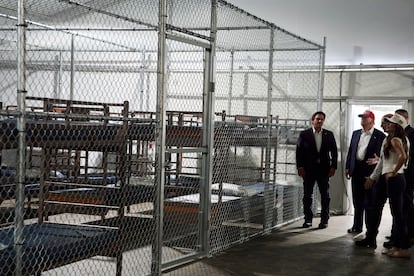

The controversial immigrant detention center Alligator Alcatraz, in Florida, has had a rocky start, marred by allegations of poor conditions and lack of access to local authorities and the press. Operations officially began on July 2, following a visit from U.S. President Donald Trump.
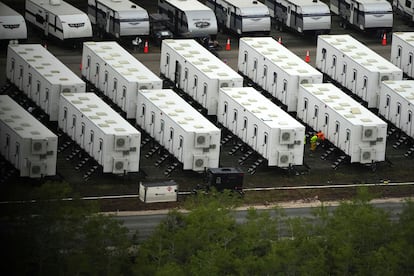
The Florida government set up the detention center in less than two weeks at an old airport in the middle of an ecological reserve in the Everglades, west of Miami. They installed canvas tents with bunk beds inside wire mesh cells, portable toilets, and electric generators. The construction sparked protests from environmentalists and Native American tribes during the few days it lasted. Additionally, denying local authorities access led to criticism over the lack of public oversight and clear legal guarantees.
A man detained there since Thursday, July 3, when the first inmates arrived, says he has no way to wash or brush his teeth, that the food consists exclusively of sandwiches “with a little piece of ham,” and that sometimes the electricity fails, his wife told EL PAÍS.
“If someone needs to go to the infirmary, they take them handcuffed hand and foot — it’s an abuse,” the woman added. Her husband, a Mexican national, was arrested on June 27 for driving without a license while going to his job at a construction site near Tampa. He was later transferred to Clearwater, Naples, Miami — where he spent two nights “in a tiny place” — and finally to Alligator Alcatraz on July 3, she said, adding she “hopes” he will be deported soon “to Mexico, and not somewhere else, like El Salvador or I don’t know where.”
The 38-year-old father of four has lived in the United States for 20 years. He was arrested in 2014 for driving under the influence of alcohol. According to his wife, he’s a hard-working person who doesn’t hurt anybody. “Unfortunately, some people make mistakes when they’re young, but everyone has the right to correct their mistakes,” she said.
In a recording of a call from the detention center, he can be heard saying: “If anything happens to me, you have all my information there, sue them, because having it here is useless, it’s absolutely useless.”
Reports about the conditions at the center and that a detainee had been transferred to a hospital sparked reactions from state officials and the Department of Homeland Security (DHS), who denied the information as “fake news” and accused the reporter of promoting what they called “conspiracy theories” on social media.
DHS posted on X that the “fake news media” were peddling “the false narrative of criminal illegal aliens convicted of rape, homicide and child sex crimes,” alongside a Miami Herald articles that included testimonies from relatives of three detainees at Alligator Alcatraz.
The DHS added that it “has higher detention standards than most U.S. prisons that hold actual U.S. citizens” and that “all detainees are provided with proper meals, medical treatment, and have opportunities to communicate with lawyers and family members.” A Florida state spokesperson referred EL PAÍS to those statements.
Miami-Dade County, owner of the Dade-Collier Airport where the center was established, was left out of Florida’s plans. The state occupied the facilities, citing emergency powers of Florida Governor Ron DeSantis. On Monday, Miami-Dade Mayor, Democrat Daniella Levine-Cava, formally requested access to the center in a letter to Florida Attorney General James Uthmeier. The mayor said she was “gravely concerned about the alarming number of deaths and medical emergencies at immigration detention centers in Florida & nationwide.”
At least five people have died in immigration custody in Florida so far this year, a significant increase compared to previous years. Overcrowding has also been reported in immigration detention centers, raising concerns about conditions.
Democratic state lawmakers who tried to visit the detention center last week were turned away by state officials citing security concerns. On Wednesday, the Florida government issued a formal invitation to state lawmakers and members of Congress for a tour of the facility next Saturday, the Miami Herald reported.
A spokesperson for Immigration and Customs Enforcement (ICE) told this newspaper that the state of Florida is in charge of Alligator Alcatraz. “ICE does not operate this facility. The facility is managed by the state of Florida through the Division of Emergency Management. Florida has National Guard members operating under the 287(g) program who have been trained to perform detention duties,” it said in a statement.
“Under President Trump’s leadership, we are working at full speed on innovative and cost-effective ways to fulfill the American people’s mandate to carry out mass deportations of illegal immigrants with criminal records,” it added.
The wife of the Tampa man detained said that “no person, no matter how bad they are,” deserves such treatment. “If they’re going to deport them, then deport them, but don’t treat them this badly. They don’t deserve this. We come to work, not to be treated like animals. Nowadays, animals have more rights than people,” she said.
Sign up for our weekly newsletter to get more English-language news coverage from EL PAÍS USA Edition









































