
Golf, cows and a fake triumphal arch: Welcome to Trump’s MAGA fair for America’s 250th anniversary
Around a dozen states decline to take part in an ‘America First’‑style celebration, as critics accuse the Republican administration of politically exploiting the celebration

To celebrate the centenary of the Declaration of Independence, the United States held its first world’s fair in Philadelphia in 1876. It was a major success, with nearly 10 million visitors. Two hundred buildings were erected, the event brought advances in women’s rights, Richard Wagner composed a march in honor of the young nation, and Alexander Graham Bell demonstrated a strange contraption called the telephone for the first time.
This Thursday, the Great American State Fair opened its doors as an unusual hybrid of a business showcase and a tourism expo. It runs through July 10 on the National Mall, the vast green at the heart of Washington, where the country tells its story. The event — which marks the 250th anniversary of the Declaration of Independence this coming Saturday — has a proposal notably less ambitious than the one staged in 1876. But, above all, it is a proposal more in keeping with the America First ethos of President Donald Trump’s MAGA movement.
The anniversary organizers invited all 50 states and six associated territories, but about a dozen of them declined to participate. They are missing a 16-day fair, free to the public, where visitors move from booth to booth to have a passport stamped proving they visited them all. Early in the afternoon, the crowd was overwhelmingly American, taking part in what felt like a simulation of a distinctly national ritual: the challenge of visiting every state in a country that spans a continent—before reaching a certain age.
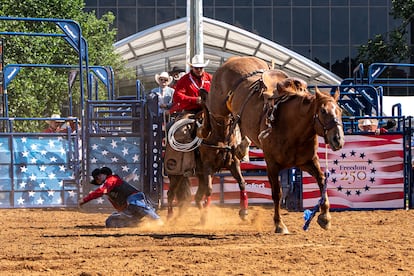
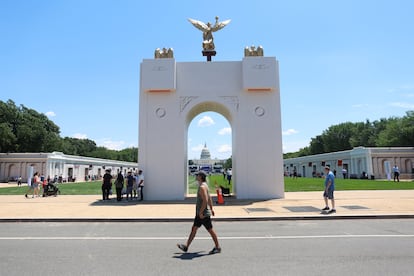
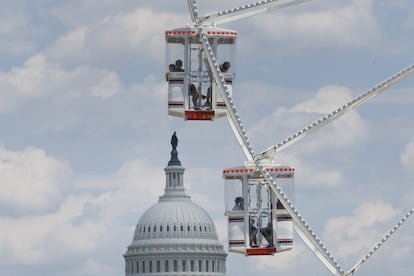
The spaces allotted to each delegation are spread across two temporary structures arranged like a row of military barracks, set out in parallel lines around a slowly turning Ferris wheel and a modest rodeo arena. There is also a fake triumphal arch — as if to indulge Trump, who hopes to build a 250‑foot granite version, not far from the fairgrounds. These fairgrounds are flanked by an area set up to watch World Cup matches, with the Capitol to the east and the Washington Monument to the west.
Faux Greco-Roman
Everything has a kind of faux Greco‑Roman feel — again, the explanation lies in the president’s aesthetic fixations. Shortly after returning to power, Trump signed an executive order to “make federal architecture beautiful again.” It effectively declared war on modern buildings in Washington, especially brutalist ones.
Like so many of his executive actions, it has so far amounted to little more than a largely symbolic gesture with authoritarian overtones. Courts have blocked many of Trump’s initiatives, but the construction-happy president has at least managed to put up these temporary structures in a style that, he often claims, would have delighted the Founding Fathers.
Trump also signed a separate executive order on “restoring truth and sanity to American history.” This has amounted to an ideological purge of cultural institutions, with U.S. history reframed to ignore issues such as racism or the genocide of Indigenous peoples. Those uncomfortable truths are almost entirely absent from the fair. Amid so much unrelentingly positive history, it was not possible to find any mention, for example, of the civil rights movement or the empowerment of Indigenous communities in the 1960s and 1970s. There are, of course, prominent Black figures on display — and some Indigenous ones, though fewer — but they appear chiefly as icons of music or sport.
It is unclear what guidelines participants were given in deciding what to showcase, but what each delegation has on offer varies depending on how much effort their authorities chose to invest. That includes those who opted not to take part, in protest at what they describe as the Trump administration’s “politicization” of the anniversary.
When he returned to the White House last year, Trump once again created — by executive order — the Salute to America 250 Task Force, under which a body called Freedom 250 operates. This effectively sidelined another initiative, America 250, set up a decade ago by Congress. Freedom 250’s plans have already begun to take shape: a large Christian service on the Mall, a violent mixed martial arts fight at the White House, and the first of two rallies Trump plans to hold in the shadow of the Washington Monument. The first took place on Wednesday as a prelude to the fair’s opening, which the president promised would be “incredible.” The second is expected on July 4.
Among those that chose not to take part — also citing budget constraints — are several states (most governed by Democrats), including Oregon, Washington, Massachusetts, Maine, Vermont, Hawaii, Alaska and Connecticut, as well as the territories of American Samoa and the U.S. Virgin Islands. Others, such as California, have only a token presence. And New Jersey and North Carolina seem to have opted for something of a third way: iven their lack of interest in taking part, they have ceded their space to private companies — Spevco, a manufacturer of specialty vehicles, in North Carolina’s case — or to Cape May County (in New Jersey’s), allowing its tourism board to promote the area as a destination to be discovered.
Arizona was the only pavilion drawing noticeable lines on Thursday, thanks to a virtual reality experience showcasing the state’s attractions. Florida was another favorite, attracting crowds that were hard to quantify but appeared to fall well short of the expectations set by Freedom 250’s CEO, Silicon Valley entrepreneur Keith Krach, who told EL PAÍS last week that the fair could draw “between 100,000 and 150,000 visitors a day.”
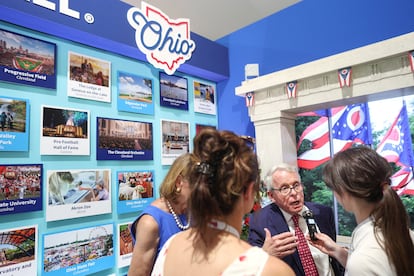
Republican governors Mike DeWine of Ohio and Jim Pillen of Nebraska were there to promote their states — Pillen, for instance, highlighting among other things that Nebraska has some of the lowest electricity prices in the country. In West Virginia, everything revolves around John Denver’s Take Me Home, Country Roads, the omnipresent unofficial anthem, while in South Carolina, a representative at the stand said they had chosen to focus on two defining features: “golf and Southern hospitality” (to which a passerby added a third: “air conditioning”).
Golf — Trump’s favorite sport — along with cattle and potatoes, features prominently in several states’ displays. And Abraham Lincoln is a point of rivalry between Kentucky (where the 16th president was born) and Illinois (where he made his name in politics, now commemorated by a hologram of an actor not quite as tall as the original).
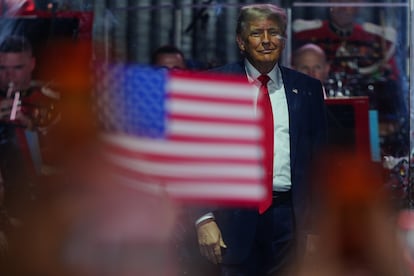
One woman emerged from the Massachusetts booth visibly annoyed to find the space empty. “I guess they don’t feel part of the United States,” she said. Ed Beach and Phil Hough, two friends in their fifties who had travelled especially from Michigan, could not understand how anyone could see anything political in the fair — or in Trump’s rally, which they had attended the previous evening.
There were many families, like that of Marcus Walters, who was wandering around with his two children. The family had come from Pennsylvania to visit the capital and stumbled upon the fair by chance. Renee Thompson had come from Texas because her daughter works at the Idaho stand. Everyone was stocking up on stickers and other promotional materials while collecting stamps in their passports.
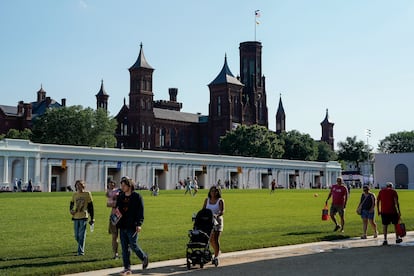
Few were aware that they could complement the experience with a visit to an excellent exhibition — unrelated to Freedom 250 — on display until September at the Renwick Gallery, part of the Smithsonian museum network. The show offers a more sophisticated look at the best of the artistic production associated with the state fairs that have been held across the country every summer since the 19th century. These fairs are another distinctly U.S. institution and a source of pride for the rural side of a nation that will mark its 250th anniversary on July 4.
Sign up for our weekly newsletter to get more English-language news coverage from EL PAÍS USA Edition









































