
Supreme Court upholds birthright citizenship: What it means for Trump
The court blocked the president’s attempt to restrict automatic citizenship for the children of undocumented immigrants and those with temporary status
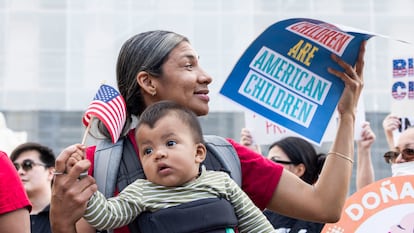

The U.S. Supreme Court has put an end to one of the biggest legal battles of Donald Trump’s second term by rejecting his attempt to limit birthright citizenship, one of the Constitution’s most firmly established guarantees.
In a 6-3 split decision, the highest court struck down the executive order through which the president sought to deny automatic citizenship to the children of undocumented immigrants and of people who are legally in the country on a temporary basis, such as students, tourists, or visa holders. The ruling represents one of the biggest setbacks for the White House’s immigration agenda and leaves the system in place since the late 19th century unchanged.
The ruling also puts an end, at least for now, to the debate over whether a president can use an executive order to alter the scope of the Fourteenth Amendment. The justices concluded that birthright citizenship is protected by the Constitution and that only a constitutional amendment or a change in the Supreme Court’s own interpretation could alter that right.
What does this mean for the right to birthright citizenship?
In practical terms, nothing changes. The decision upholds the principle that, with very limited exceptions, every person born on U.S. soil automatically acquires citizenship, regardless of their parents’ immigration status.
That right is enshrined in the Fourteenth Amendment to the Constitution, ratified in 1868 after the Civil War, which states that “all persons born or naturalized in the United States and subject to its jurisdiction are citizens of the United States and of the State in which they reside.”
This interpretation was reaffirmed by the Supreme Court itself in 1898, in the case of United States v. Wong Kim Ark, which recognized the citizenship of a man born in California to Chinese immigrant parents. Since then, that precedent has served as the basis for recognizing automatic citizenship for virtually all those born in the United States, except in exceptional cases, such as the children of foreign diplomats.
What did Trump want to change?
The executive order signed by Trump on January 20, 2025, sought to change that long-standing practice. The measure stipulated that a child born in the United States would only obtain citizenship if at least one of his or her parents was a U.S. citizen or a legal permanent resident. The restriction would have affected both undocumented immigrants and people legally residing in the country on temporary visas, including students, tourists, workers, and some applicants for permanent residence. The administration argued that the children of individuals without citizenship or permanent residency were not “subject to the jurisdiction” of the United States as defined by the Fourteenth Amendment, and therefore should not automatically receive U.S. citizenship.
Why did the Supreme Court reject the order?
The majority of the justices concluded that both the text of the Constitution and more than a century of judicial precedent support a broad interpretation of birthright citizenship. The justices noted that the meaning of the Fourteenth Amendment was settled decades ago and that a president cannot restrict a constitutional right through an executive order.
Three justices—Clarence Thomas, Samuel Alito, and Neil Gorsuch—disagreed with that interpretation.
What options does Trump have left now?
The ruling definitively overturns the executive order and requires the government to continue recognizing automatic citizenship under the current rules.
House Speaker Mike Johnson expressed disappointment with the ruling and stated that the decision subjects the country to “serious challenges.” He also maintained that Congress must continue to study the issue and added, “I’m sure that the conclusion from this decision is you have to amend the constitution to fix that.”
For Trump to succeed in eliminating the right to birthright citizenship, he would need to amend the Fourteenth Amendment, which requires approval by two-thirds of the House of Representatives and the Senate, as well as ratification by three-quarters of the states. In fact, after Trump issued his executive order, more than 20 states filed a lawsuit to block it.
Sign up for our weekly newsletter to get more English-language news coverage from EL PAÍS USA Edition









































