
World Cup spurs Mexican-Americans to reconnect: ‘Putting on the Mexican jersey this time took on a different meaning’
Mexico’s historic run has inspired millions of migrants and their descendants to seek out and rebuild their roots with their country of origin
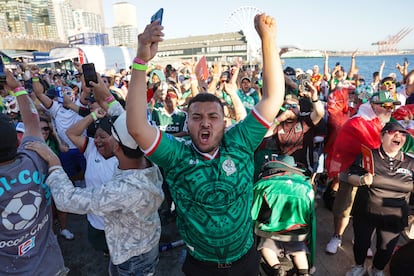
Mexico’s improbable World Cup winning streak ended Sunday with a loss to England, but it didn’t keep the team’s heart and tenacity from delivering one successful outcome: A notable increase in Mexican-Americans venturing south to reconnect with their roots, language and culture, longtime observers and travel figures show.
The trend, which emerged long before the World Cup, gained intensity against the backdrop of uncertainty in the United States generated by what many see as an anti-immigrant climate led by an intense crackdown on immigrants. Latinos, with or without papers, generally say they feel targeted in what may become the nation’s biggest round-up of undocumented migrants — and others suspected of undocumented status — in almost 70 years.
The sense of rejection is palpable across the United States, in Mexican-American communities from Los Angeles to El Paso, and among U.S. Latinos interviewed in Mexico City. It’s even reflected in the true indicator of the moment: sale of FIFA jerseys. More than five million sold – half of them in the United States – have shattered records. Millions more are moving on the black market.
The dream continues
“Putting on the Mexican jersey this time took on a different meaning,” said Leny Hernandez, 32, a businessman and former combat soldier stationed at Fort Houston in San Antonio. His journey from El Paso to Mexico City was documented by Puente News, starting in early June. “I don’t see this as a defeat, but as a victory. I still believe in the dream.”
While demographic data don’t pinpoint how many Latino or Mexican-Americans travel annually to Mexico, the travel site Road Genius said almost 5 million of the 48 million foreign travelers visited the country in December, a time when Mexican-Americans have traditionally returned for religious celebrations and weeks-long vacations. An estimated 40 million Mexican-Americans call the U.S. home. Mexico’s population is about 133 million.
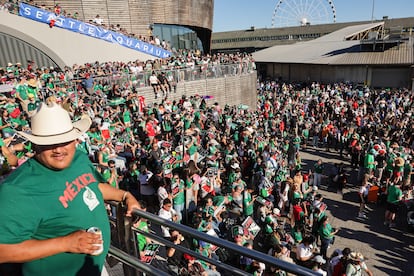
For decades, the Mexican government has tried building bridges, a soft-power initiative known as acercamiento, with its rising global diaspora. It’s had some success. But what makes this latest outreach so compelling is that it wasn’t designed by the government. It’s the result of an organic Mexican-American grassroots movement that saw immigrants and their offspring reaching across the border in greater numbers, searching in their homeland, some said, for acceptance to overcome that sense of rejection.
Borderless social media spread the message across the two countries.
The World Cup was the lightning rod, said Carlos Gonzalez Gutierrez, the Mexican Consul General in Los Angeles. Gonzalez has witnessed the evolution of the ties between Mexico and its emigrants abroad for more than four decades, starting as a young consular officer in the administration of Mexican President Carlos Salinas de Gortari.
A new slate
“What makes this acercamiento today so interesting is that it’s more mainstream, with younger people,” Gonzalez said, pointing to a sense of urgency as a key difference. “The exciting part is that this generation is not about wiping the slate clean, but about beginning a new slate. They don’t have the same mistrust and resentment that their parents and ancestors carry against the country (Mexico) that was unable to keep them from migrating north.”
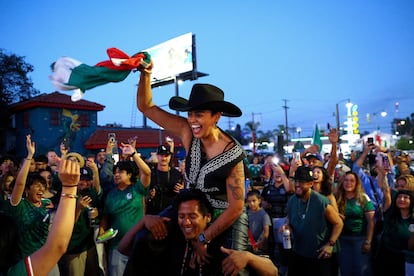
Since June 11th, when the World Cup kicked off in Mexico City, Mexican-Americans have flocked to fan gatherings throughout the country or made the trek to Mexico City to its signature venue, the so-called Cathedral of soccer, El Estadio Azteca – called the Mexico City Stadium during the World Cup, under FIFA rules.
In Los Angeles, the consulate sponsored watch parties at Casa Mexico L.A. in the city’s downtown, across from Plaza Olvera, the cultural heartbeat of the Mexican community. The historic landmark is also the birthplace of North America’s second-largest Mexican community.
The game between Mexico and Ecuador drew some 3,000 fans to one of the consulate’s events. Going into the match, images of Immigration and Customs Enforcement swarming neighborhoods, Home Depot parking lots, favorite fruit or taco stands and car washes were fresh on the minds of many. Far from being the criminals the Trump administration insists they are targeting, the majority of people detained are everyday workers.
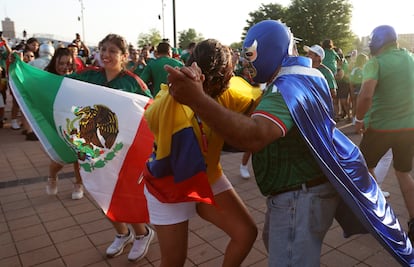
Most of those detained were not violent criminals but had lived in the United States for years, where they had jobs and raised families. According to data compiled by the Mexican Consulate in Los Angeles, of the 2,154 Mexicans detained since June 6th 2025, when the nationwide raids began in Los Angeles, about 46% of those interviewed in ICE detention centers by consulate officials had lived in the U.S. an average of 10 years. Some 36% had U.S.-born children. Of the jobs they held, 15% were in construction, followed by landscaping, farm work and car wash centers.
Scared, sad, vulnerable
The ICE roundup left emotional wounds that won’t easily heal for many who described their parents and grandparents, including those living in the country legally, as “scared,” “sad” and feeling “vulnerable.”
“Many of us, our families have PTSD,” said Daphne Amezcua, 21, a child development social worker wearing a green tank top with the Mexican flag. “Mom is still afraid to go out and she has her papers in order.”
Next to her was a colleague, Santiago Salazar, 22, clad in his black Mexican World Cup team jersey. “It’s not lost on me that a year ago in June, our community (in Los Angeles) was under attack by ICE raids,” he paused and added: “When one side rejects you, you look south, the land of your ancestors, to look for acceptance.”
Today, the raids continue, with new clips popping up all over social media: A mother separated from her child in Houston. Chases in Los Angeles, San Antonio, or the sound and sight of U.S. border patrol helicopters hovering over border communities like El Paso, where construction on parts of a new border wall continues.
In a span of five days, the New York Times reported recently, ICE nabbed at least 10,000 migrants nationwide, part of a new surge in activity by the government’s ICE agency.
The beautiful game
Even in majority-Mexican American border cities like El Paso, where the presence of ICE and U.S. Border Patrol agents have long blended in the community almost like a part of the landscape, some residents are on edge.
Thanks to soccer, often called the world’s beautiful game, many found a needed distraction.
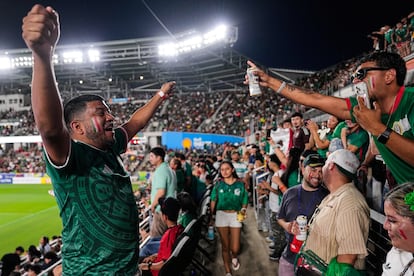
“I haven’t been to Mexico in a very long time, so being able to do this and supporting them (Mexican team) does make me feel a little closer to home,” said Elizabeth Garcia, 46, who watched the Mexico-Ecuador cup game at a downtown park in El Paso. “… A lot has to do with political issues.”
Mexican-Americans, fans and players, have stood tall during the first phases of the World Cup as a passionate demographic driving a growing national love for the sport, their fan duality displayed in draped flags that blend both the Mexican and U.S. insignias, cheering for the U.S. team when Mexico is not on the day’s match schedule. Underscoring their dual affinity: Two Mexican-Americans play for the U.S. national team – one from Ciudad Juárez and another from El Paso – and two more play for the Mexican team.
“I get chills,” said Pamela Huebner, a bartender in Los Angeles. “We have players on both sides.”
‘Found something else’
At the beginning of the tournament, Team Mexico’s run seemed promising. Thousands of Mexican-Americans ventured south to reconnect with family and, perhaps, witness a sports Cinderella story, the classic underdog team taking on the world.
In the first game, Alejandro Rodriguez, who had traveled from Houston, sang his lungs out to the immortal, thunderous song “El Rey” in unison with more than 81,000 fans in the stadium. He was teary-eyed, overwhelmed with joy.
“We really needed this,” Rodriguez said. “To be here, this moment, away from the chaos (back home in Texas).”
Near him was an effusive couple calling a family in California: “We won!” A few rows away, Hernandez, the El Pasoan decked in a black Mexican jersey, was ecstatic, slapping high-fives with strangers around him.
These days, even though Mexico is out, Hernandez is in, he says, for the long haul. He’s joined a volunteer group to provide donations for an orphanage back in the Mexican capital. He plans to load up a truck with clothes, food and other items and make the nearly 2,000-mile trip south to Mexico City later this year.
‘The experience of being in Mexico City was mind-altering for me. I was overcome by the experience, the emotion of being there,” said Hernandez. “I had planned on having a wonderful time, get lost in the debauchery, degeneracy, but I discovered something else, deeper, more profound.”
Puente News Collaborative intern Mariana Chavez and editor Ricardo Sandoval contributed to this report.
Corchado is the executive editor and correspondent for Puente News Collaborative.









































