
The Azteca Stadium gets a (slight) facelift without losing its soul
The world’s largest soccer stadium underwent a controversial and delayed renovation two years before the World Cup began. It reopens this Saturday with a friendly match between Mexico and Portugal
The literature surrounding the Azteca Stadium is endless. From cathedral of world soccer to temple and sanctuary. Hyperbole upon hyperbole that magnifies its nearly 60-year history. It will reach its 60th anniversary on May 29, a few days before the opening game of the World Cup between Mexico and South Africa on June 11. Such euphoria clashes with its turbulent renovation, which began and now continues with delays.
This stadium is a soccer treasure. Its stands witnessed the feats that propelled Pelé to the pinnacle of greatness at the 1970 World Cup, the first to be broadcast on color television. Sixteen years later, having withstood one of the worst earthquakes in history, the Azteca hosted the legendary goals of Manuel Negrete and Diego Armando Maradona, including the infamous “Hand of God” and the dribbles that left more than one defender in knots. Its pitch can boast of having hosted 24 World Cup matches: 10 in 1970, nine in 1986, and five more this year. Never before in history has a country hosted soccer’s premier tournament so many times.
To all of this — which may be more or less debatable, since it appeals to emotions — must be added something non-negotiable: Mexico entered soccer history in June 2018, when FIFA granted it, along with the United States and Canada, the opportunity to host the World Cup for the third time. From then on, talk began that the Azteca Stadium would have to be remodeled to be worthy of the biggest World Cup of all time. Expectations were high. The plans that were made public included remodeling the exterior of the stadium and adding a shopping mall, apartments, and a hotel, which would directly impact the residents of the Santa Úrsula neighborhood due to water shortages and gentrification of the area. In August 2022, the Mexico City government announced that the project called Conjunto Estadio Azteca was being cancelled because Televisa, the large media conglomerate in Latin America and owner of the property, had not reached an agreement with the government or with the residents of the Tlalpan and Coyoacán boroughs, who rejected the plans because they would exacerbate the water and mobility crisis.
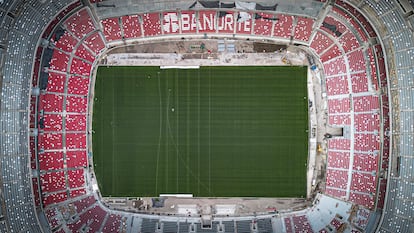
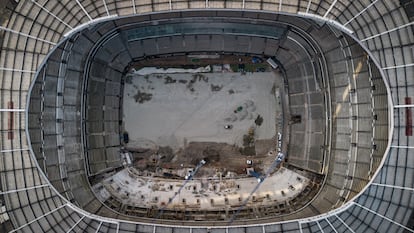
The start of the renovations was delayed several times. The then-president of the Mexican Football Federation, Yon de Luisa, assured in 2020 that the stadium’s renovation would begin between 2023 and 2024 at the latest. The work, which was initially promised to be limited to the exterior, had to be restricted to the renovation of the turf, seats, and locker rooms, and finally began in June 2024 — just over two years before the World Cup. “We’ll be ready by the end of 2025,” said Félix Aguirre, director of Estadio Azteca. Even in March of this year, just days before its reopening, the stadium was still under construction.
The plans for the Azteca Stadium’s renovation were also unclear. Public information was limited to internal changes such as the installation of 2,000 LED lights, new exclusive areas for wealthier fans, new locker rooms, 200 security cameras, and 1,000 Wi-Fi hotspots. There was never a plan shared with the media, nor was it posted on the stadium’s website. EL PAÍS contacted Grupo Ollamani, Televisa’s parent company, for details but received no response.
Identity, for sale
The renovation of the Azteca Stadium, even if only the interior was affected, required significant funding. Televisa, through the Ollamani Group, chaired by Emilio Azcárraga, sold the naming rights to the stadium, changing its name from Azteca to Estadio Banorte. The Mexican bank provided a loan of 2.1 billion pesos to acquire the naming rights. According to a statement released in March 2025 — less than a year before the start of the World Cup — this was “an alliance consisting of financing, advertising, and sponsorship components to promote the modernization and transformation of the historic stadium.”
The setback, however, came days later when the bank itself had to announce that the stadium couldn’t be named Banorte because it violated one of FIFA’s World Cup rules, which prohibits using commercial names for sports venues. Therefore, they had to change the name again and temporarily renamed it Estadio Ciudad de México for the duration of the tournament. Furthermore, fans are unhappy with the idea of giving a different name to the stadium that put Mexico on the soccer map, a name that honors one of its great cultures.
Before Christmas Eve last year, Grupo Ollamani sold 49% of Club América’s shares to General Atlantic, a U.S. investment fund. The total value of the team, including the stadium itself, where it plays its home games, was estimated at around $490 million. Part of the proceeds helped accelerate the renovations at the Azteca Stadium.
A mea culpa
One problem that erupted for Grupo Ollamani was the issue of the VIP boxes inside the Azteca Stadium. The construction of the sports complex in 1966 had to be financed by private investors who paid for the VIP boxes with a 99-year contract, which allowed them access to any event, whether sporting or musical. Before the 2026 World Cup, Televisa and FIFA had to negotiate with the owners of these exclusive spaces because, during the World Cup, these seats are designated by FIFA. In September 2025, the issue was resolved when an agreement was reached with the box owners, who will be able to attend all matches, with Ollamani covering the cost. Another problem that tarnished the Azteca was the ticket sales for its reopening, because on the day the resale was scheduled to begin, the Fanki ticketing system crashed and had to be suspended for a day.
On February 6, there was some friendly fire. Azcárraga stated that the dates given to him by the builders didn’t match the ones he had requested, “but everything is going very well. There were many difficulties at the beginning, but everything has been improving,” he said. He also hinted that the renovations would continue until before the World Cup.
The renovation of the Azteca Stadium, the fourth in its history, aimed to convey something symbolic: to have another footballing great on its pitch, Cristiano Ronaldo. An injury to the Portugal captain dashed any hopes of him joining the ranks of Maradona, Pelé, Beckenbauer, Casillas, and Ronaldinho. And amid all the construction, there won’t be parking for fans either, as it’s not yet finished.

- The stadium will turn 60 in May
- Inauguration: May 29, 1966
- It has undergone four remodelings (1984-85, 1999-2001, 2013-2016 and 2024-26)
- It hosted the 1971 Women's World cup
- It has hosted NFL games, concerts including Shakira and Michael Jackson and welcomed Pope John Paul II

- Seat refurbishment
- Current capacity: 87,000
- Capacity in 1970: 110,000
- There will be 1,000 Wifi connection points and 40,000 meters of fiber optic
- Refurbishment of bathrooms
- New VIP hospitality zones

- Games
at the 1970 World Cup: 10 - Games
at the 1986 World Cup: 9 - Games scheduled
at the 2026 World Cup: 5
- Total World Cup games: 24
- Renovation of locker rooms
- Change of turf: to natural hybrid

- The stadium will incorporate 2,000 meters of LED lights
- More than 300 loudspeakers
- 200 security cameras