
Gabriela Cuevas: ‘Today we complain about potholes, but during the 1986 World Cup, half the city was devastated by the earthquake’
Mexico’s tournament representative affirms that the country will not be overshadowed by the United States in the 2026 edition
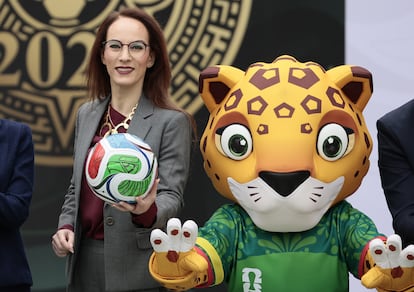

The 2026 FIFA World Cup will be the largest ever, the first co-hosted by three countries — Mexico, the United States, and Canada — and the debut of the expanded format with 48 teams and 104 matches. The economic and tourism expectations being generated are equally enormous. FIFA estimates an economic impact exceeding $11 billion, while Mexico anticipates the arrival of some 5.5 million visitors, primarily to the host cities of Mexico City, Guadalajara, and Monterrey. Working within this colossal framework is Gabriela Cuevas (Mexico City, 46 years old), appointed a year ago by President Claudia Sheinbaum as Mexico’s representative for the tournament. “I want to organize the best World Cup in history,” she states in an interview with EL PAÍS. She clarifies, however, that her role is not that of an all-powerful director, but rather a mediator between institutions as diverse as FIFA, the Mexican Football Federation (FMF), government agencies such as customs, immigration, and airports, as well as the three host cities.
Cuevas acknowledges that she has set herself an enormous goal, but bases her ambition on the precedents of 1970 and 1986, when Mexico hosted two unforgettable tournaments. “It’s like saying you threw a great party; the more people in the picture, the better the party was,” she summarizes. With fewer than 200 days until the World Cup opening ceremony, Cuevas assures that preparations are progressing at a “very good” pace. However, FIFA’s recent announcement that Guadalajara and Monterrey will host the inter-confederation playoff matches in March has accelerated the organizational efforts. “Every day we work against the clock, but it will serve as a great rehearsal for all the processes of travel, press, immigration… The same goes for the reopening of the Azteca Stadium,” she points out. She also highlights the “great work” of Mexican stadiums, which have invested to meet international standards. “The Azteca will become the only stadium on the planet to host three World Cups; it’s a historic privilege,” she says.
This year’s heavy rains in the capital caused severe flooding, damage, and even collapses at Mexico City International Airport (AICM), raising doubts about the city’s capacity to host an event of such magnitude. But Cuevas remains optimistic. “The largest federal investment is concentrated in the AICM, with nine billion pesos ($490.5 million) allocated for its modernization. Anyone passing by can see that they are working intensively,” she says. “Of course, modernization is necessary. Today we complain about potholes, but during the 1986 World Cup, half the city was devastated by the earthquake,” she recalls. “Mexico’s conditions for hosting a World Cup are better than they were 40 years ago.”
Cuevas also acknowledges the concerns of the neighborhoods near Azteca Stadium and other venues, which have reported negative impacts such as water shortages, displacement, and increased rents. “In Mexico City, there are regular meetings with residents and a program that includes the rehabilitation of 400 [soccer] fields and the construction of another 100.” In Jalisco, she estimates that between 270 and 300 fields will be restored. However, the residents consulted say they have not had any communication with the tournament organizers. Although she understands that public works projects cause disruption, the official insists that they will bring lasting benefits and that citizen participation will be key to accountability. “It is our obligation to bring soccer from the elite sphere to the streets,” she maintains.
For her, the cost-benefit ratio will be proof that the World Cup was worthwhile. Mexico, she asserts, isn’t making investments exceeding the expected return. She cites the case of the United States, which approved $625 million for the 12 months leading up to the tournament: “That’s not happening here.” Another indicator she highlights is the growing tourist interest in cities that won’t be hosting the World Cup. “In Cancún, there are already many hotel reservations for those dates,” she notes. And she predicts that this influx will increase after the December 5 draw for the tournament: “If Brazil or Argentina plays here, it would be wonderful.”
Cuevas highlights one of the national proposals, which they’ve called the Social World Cup. “It’s a distinctive feature of Mexico,” she says. “Neither the United States nor Canada has anything similar.” The goal, she assures, is to leave real benefits in the host cities and in all 32 states “by putting people at the center of the decisions, not the tickets.” The program includes health campaigns, school cups for students, and international competitions for children living on the streets. There will also be a women’s tournament, a robotics world championship, and a national plan to reclaim sports fields and public spaces. “In my generation, we still played pickup games in the street. Reclaiming these fields can strengthen the social fabric.” The grand finale will be the free, public broadcast of matches in public spaces throughout the country, in addition to the Mexico 2026 Festivals promoted by the Ministry of Tourism in 177 “Pueblos Mágicos” (Magical Towns) and state capitals.
The United States will be the main host of the World Cup, with 11 of the 16 stadiums, the majority of the matches, and growing political interest in the sport driven by President Donald Trump. The magnate promoted the bid during his first term and brought it into the spotlight by hosting this year’s Club World Cup, further strengthening his relationship with FIFA President Gianni Infantino. Despite this weight, Cuevas maintains that Mexico will not be overshadowed. “Yes, the United States has more matches, but we have the great advantage of the opening ceremony,” she affirms. “The most-watched moment, the peak of all the indicators, is the World Cup opening. That is a huge responsibility.” Sheinbaum has expressed doubts about her attendance at the opening match on June 11 at Azteca Stadium, even though the tournament tradition includes the participation of the host head of state. The Mexican president instead wants to give her ticket to a girl or young woman. “It doesn’t surprise me,” Cuevas assures. She believes Sheinbaum’s stance has been “very transparent” and seeks to make the event more inclusive. She adds that the decision has already been made known to FIFA and “has had no consequences so far.”
Cuevas asserts that Mexico will stand out for a less measurable quality: “We are the most fun country to watch a World Cup in. We have the best fans. Mexico is a globally recognized country for its hospitality and attention to tourism. Today we are the sixth most-visited country in the world.” She avoids, however, comparisons about which host city has the best atmosphere: “I’m from Mexico City and I won’t fall for any provocations.” But she acknowledges that in Monterrey, Fundidora Park “brings a lot of life and festivities.” Perhaps, she points out, the World Cup atmosphere isn’t as fervent as in previous editions because, as a host nation, Mexico didn’t have to qualify: “Four years ago we were struggling.”
A key part of the national plan is to retain travelers between games with tourist routes. Cuevas is convinced that this combination of visibility, atmosphere, and cultural offerings will make Mexico stand out. “Yes, the United States will have more games,” she summarizes, “but we have something that can’t be replicated: the fans and a country that captivates.”
Sign up for our weekly newsletter to get more English-language news coverage from EL PAÍS USA Edition









































