
Five years after Maradona’s death: Tributes, a retrial and inheritance disputes
After a mistrial was declared over a scandal involving one of the judges, seven healthcare professionals will be tried in March for alleged negligence in the death of the Argentine soccer great
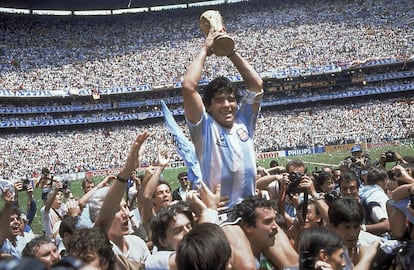

“So many times they killed me, so many times I died, yet I am still here, rising again,” they wrote on Diego Armando Maradona’s account to honor him five years after his death. The verses of the song “Como la cigarra” by María Elena Walsh serve as a reminder that for Argentinians, their beloved idol is eternal. The Maradona family believes that the football star’s death—from cardiorespiratory arrest weeks after his 60th birthday—could have been prevented, and they are demanding justice so that he can rest in peace.
The first trial ended in a declaration of mistrial, and one of the judges was removed from her post. The second attempt to determine whether the medical team treating Maradona was responsible for his death will begin on March 17, 2026.
Maradona died in a rental house on the outskirts of Buenos Aires, where he was recovering from surgery. The news that his heart had stopped beating plunged Argentina into collective grief, breaking the restrictions imposed by the COVID-19 pandemic.
“We will always miss you,” “We love you,” “Diego forever,” numerous fan accounts posted on November 25, along with images and photographs of Pelusa.
Boca Juniors, the club the star described as “his place in the world,” paid tribute to him with a video in which Xeneize fans of all ages place daisies on the left leg of the statue of the number 10 located in one of the corridors of La Bombonera. “Only those who are forgotten truly die, and we remember you, Diego, every day,” added the Argentine Football Association in another video.
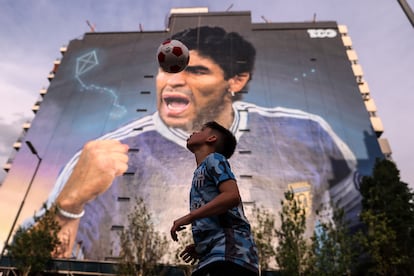
The tributes crossed borders and resonated especially strongly in Naples. In that southern Italian city, the memory of Maradona as a star player for Napoli, with whom he won two Scudettos in 1987 and 1990, remains alive.
Maradona’s death sparked a bitter inheritance dispute among his five recognized children: Dalma, Giannina, Diego Jr., Jana, and Diego Fernando. After years of public clashes, they reached a truce last month, following the joint signing of an agreement with the Swedish-Iranian company Electa Global for the manufacture, distribution, and marketing of products under the Maradona brand.
M10 Memorial
The remains of the 1986 World Cup champion rest in the Bella Vista cemetery, on the northern outskirts of Buenos Aires. This is a temporary location, as his children plan to move his body to a memorial to be erected in front of the Casa Rosada, in the center of the Argentine capital.
The proposal for the memorial was presented last year, but its construction is at a standstill. “With everything that happened with the trial, everything else was overshadowed. The memorial is important, but the legal matter is more immediate. The trial is front and center,” his eldest daughter, Dalma Maradona, told the newspaper La Nación a few weeks ago.
A mistrial
The first trial was annulled amid a massive judicial scandal. After several months of hearings, it emerged that one of the three judges on the panel, Julieta Makintach, had secretly authorized recordings for a documentary, “Divine Justice,” which featured her as the main subject. Makintach, the daughter of a well-known judge, was removed from her post and barred for life from holding judicial office. She will also face criminal charges for her actions.
The new trial will be presided over by a different court, composed of judges Alberto Ortolani, Pablo Rolón, and Alberto Gaig. The judges ruled that all procedural acts carried out since the addition of the “actress” judge Makintach were null and void, but upheld the validity of the evidence and other measures produced prior to that date.
The autopsy determined that the cause of death was “acute pulmonary edema secondary to an acute exacerbation of chronic heart failure.” It also revealed that the former player suffered from liver cirrhosis, a long-standing pulmonary condition, a “monstrous enlargement of the abdominal cavity,” and serious abnormalities in his kidneys and especially his heart, which, according to experts, weighed “more than twice the normal size.”
Although his health was precarious, the quality of the medical and human care that the former soccer player received between November 11 and 25 is central to understanding what responsibilities fall to the health professionals who were in charge.
The main suspect in the case is the neurosurgeon Leopoldo Luque. Luque was in charge of Maradona’s recovery and, according to his daughters, was the one who convinced them to move him from the clinic where he had undergone surgery and continue his care at a private residence. The list of the accused also includes psychiatrist Agustina Cosachov, psychologist Carlos Díaz, nurses Ricardo Almirón and Mariano Perroni, private insurance coordinator Nancy Forlini, and physician Pedro Di Spagna.
The house where he was recovering lacked emergency medical equipment or a bathroom that met the accessibility requirements of a patient with reduced mobility. Gianinna Maradona, another of his daughters, stated that the doctors promised “serious home care” but, in practice, it was “a disastrous charade.” The family insists that Luque ignored their warnings until it was too late.
Sign up for our weekly newsletter to get more English-language news coverage from EL PAÍS USA Edition









































