
‘It’s not Tlaloc’s fault’: Mexico City floods due to a broken system
The impact of the rainy season reveal decades of neglect, poor urban management, and institutional neglect that has worsened the flooding


The Mexicas were bold to found a city on a lake, but 700 years later, the people of Mexico City are paying dearly for that decision with flooding and subsidence. Each rainy season in Mexico City seems worse than the last, and year after year it is said to have broken its own record for the amount of water falling from the sky.
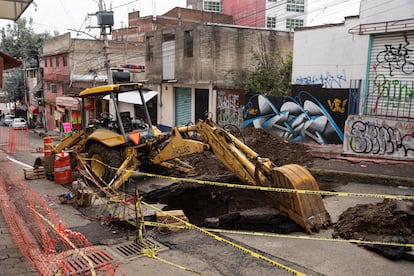
The capital’s residents, exhausted from living in an already stressful city, endure months of collapsed streets, endless traffic, and disaster zones where neighbors lose their possessions, while authorities pass the blame around, attributing the problem to geography or the environment.
“It’s not Tlaloc’s fault, nor is nature punishing us,” says Víctor Magaña, a Doctor of Atmospheric Sciences at the National Autonomous University of Mexico. According to experts consulted by this newspaper, the city collapses again and again due to a lack of preventive measures, a precarious water management system, and scarce maintenance. EL PAÍS visited some affected areas after a July that once again flooded the nation’s capital.
As the city grows — it is already home to more than 9 million inhabitants, 22 million if the metropolitan area is included — the rains strike with unequal force. In Colonia del Mar, in Tláhuac, Mari and Jaime live next to the Canal Nacional, which overflows when heavy downpours hit. Tired of losing furniture and appliances, they built a half-meter-high wall at their front door. To enter or leave, the family of six has to jump over this makeshift barrier. “Without this wall, we would have nothing left,” explains Jaime.
Mari, who also raised the level of her home to keep water out, runs a dessert stand in front of their house that becomes unusable every time it rains.
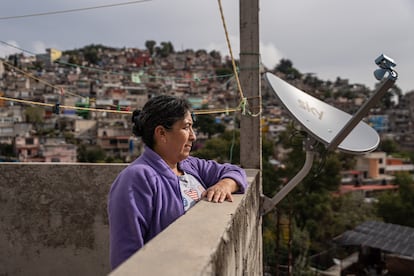
In the Magdalena Contreras borough, where the river rose on July 19 and the water reached one and a half meters inside her house, Ángeles dries family photos and furniture in the brief sunlight, refusing to lose them. Her voice breaks as she tries to explain what losing the car, mattresses, washing machine, and pantry means for her family. “The important thing is that we’re alive,” she resigns herself.
After the flooding, the city’s head of government, Clara Brugada, along with other officials whose names she can’t remember, visited her home and promised support to help her recover. She trusts they will follow through, although she reproaches politicians for “only coming for the photo op.” Higher up, on the hillsides, water doesn’t enter homes but opens sinkholes and potholes that affect the battered roads used by nearly 250,000 people living in Magdalena Contreras.
The material losses don’t tell the whole story. The impact of the rains is also felt in physical and mental health. “People are exhausted, age faster, and become more prone to chronic illnesses,” warns Carlos Contreras, a sociologist at the Metropolitan Autonomous University. “The weariness increases violence and intolerance, which is why it’s common to see fights in traffic or over something as simple as a jug of water.”
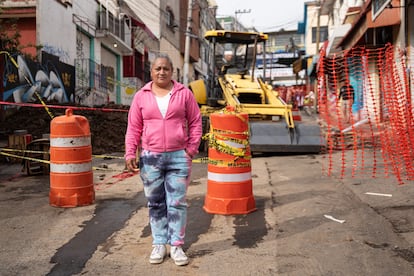
The capital, turned into a bedroom community where millions spend five or more hours a day commuting, becomes impossible to live in during the rainy season. For many, the journey home involves navigating puddles, crossing in makeshift boats, or carrying children and elderly on their shoulders.
“Here, we don’t prevent tomorrow’s problem; we barely address yesterday’s,” criticizes Contreras. Once the city is underwater, the local government struggles to manage the crises, deploying workers to rescue people from their cars, clear fallen trees, and respond to emergency calls.
Last June, Brugada distributed 11 million pesos ($616,000) among 736 families affected by the “atypical” rains. “Here you have a government that responds, that stands with you when you need it most, but above all, works to remedy risks, to mitigate them, and to prevent them from happening again,” said Mexico City’s head of government at the time.
Contreras describes it as a “vicious circle” that repeats every year: each storm causes a total transportation collapse, and the official response is minimal. “Citizens are always blamed for littering, but there is no efficient waste management system.”
Águeda López, a resident of Magdalena Contreras, says that in many neighborhoods in her borough, garbage trucks come irregularly or never, and in some areas they cannot enter because the streets are too narrow. “Life here is increasingly difficult,” she says.
Contreras compares the city’s floods with what happened in Valencia, Spain, on October 29 of last year. An upper-level isolated depression, or DANA, caused severe flooding, resulting in 224 deaths and a political dispute between local and central governments over the lack of foresight and response.
“The Valencians ended up getting their hands dirty to clean and help their neighbors, a phenomenon that is repeatedly seen in Mexico City with earthquakes and, every year, with the rains,” he explains. Residents pushing cars, carrying others to cross flooded areas, improvising walls, or draining water with buckets is the annual landscape in the capital. In Tláhuac, Magdalena Contreras, and all vulnerable neighborhoods in the east, north, and south, citizens take the problem into their own hands.
The paradox of Mexico City
Climate change does worsen the rains. Last month, an average of 298 millimeters of rain fell — a total that surpassed the historical record of 150 millimeters average rainfall during previous Julys. However, Magaña insists that the problem is a chain of wrong decisions accumulated over decades: a deficient water capture system, drains without maintenance, settlements authorized in risk zones, and a total absence of prevention. “Months in advance, they could clean and repair the drains, but it’s not done. Then they say, ‘It had never rained like this before,’ when the city’s history is full of severe floods dating back to the Mexica era.”
History supports his statement. Manuel Perló Cohen, a member of the Institute of Social Research at the National Autonomous University of Mexico (UNAM), recalls that as early as 1382, when Tenochtitlán was in full development, the rains were severe. There were floods lasting months in 1580 and 1607, and another one in 1629 that lasted five years and forced thousands of people to abandon the city.
During the rule of Porfirio Díaz (1876-1911), the government promoted the Tequixquiac Tunnel to carry water to Hidalgo, a project that took 14 years — from 1886 to 1900 — and expanded the drainage system, but even that didn’t solve the problem.
“We live in a paradox where there is no water, but the city floods,” Magaña summarizes. Today, the capital’s deep drainage system is one of the largest in the world, with thousands of miles of pipes, but it operates on a limited budget, focused more on supplying and distributing water than on maintaining, filtering, or treating the water already available. “We don’t solve the problems, we live with them,” Perló sums up. Meanwhile, the polluted water that floods streets and avenues — a mixture of rain, sewage, oil, and mud — is impossible to reuse.
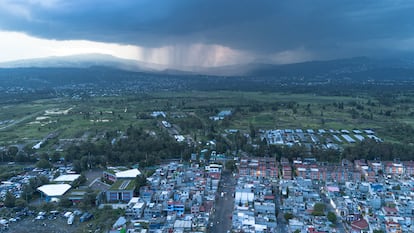
The geography explains part of the dilemma: the city is settled in a closed valley, 60% of its population lives on land that is sinking, and water which flows toward major avenues like Viaducto, Churubusco, or Insurgentes. But specialists insist that the greatest responsibility lies in urban management.
Housing complexes are allowed to be built in sinking or flood-prone areas, there is no separation between stormwater and sewage drainage, dams are not prepared to capture and treat water, and garbage collection is irregular, especially in low-income neighborhoods. Perló believes it is possible to mitigate the problem with solutions already tested in other cities: urban wetlands, parks or floodable sports fields, medians that retain water. But for that, investment and interest are needed.
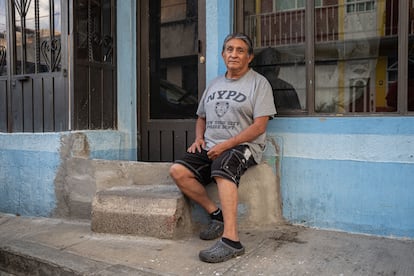
“It’s not a political issue,” Magaña insists. “Some administrations come and go, and nobody solves anything.” This echoes what Jaime, a resident of Tláhuac, has shared. “When the flooding happens, they say they will help us, and then they forget about us,” he laments. The city continues to rely on citizen resilience as the first line of defense.
The cycle repeats: rain, flooding, promises. And the certainty that when the waters rise again, it will be the same locals who build the walls, drain the streets, and help each other — with the physical and mental toll that entails. Contreras sums it up this way: “The stress and exhaustion stay with us, even after the rain has gone.”
Sign up for our weekly newsletterto get more English-language news coverage from EL PAÍS USA Edition









































