
Gianni Infantino: From La Liga intern to FIFA’s Balogun debacle
The head of world soccer lived in Madrid for three months before becoming the face of the Champions League draws and, much later, one of President Donald Trump’s closest allies
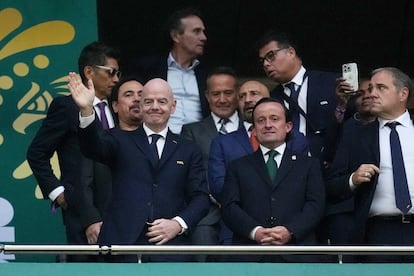

Gianni Infantino had a poker face as he watched Mexico take on England at the Azteca Stadium on Sunday. By then, controversy had already erupted over FIFA’s decision to clear U.S. forward Folarin Balogun to face Belgium on Tuesday after his red-card suspension was overturned.
Initially, Infantino appeared to believe he had contained the fallout and muted criticism of the FIFA disciplinary committee’s ruling. Then U.S. President Donald Trump upended everything with a social media post congratulating FIFA for granting a reprieve to his fellow American.
Infantino carried on in the VIP box at the Azteca as though nothing had happened, but he was already aware of the storm gathering around him. Sitting just behind the head of world soccer was the legendary Mexican striker Hugo Sánchez, watching the match unfold.
As the FIFA president’s popularity has sunk to new lows because of his decisions and the remarks he often uses to justify putting business ahead of the game, he has taken great care to surround himself with some of soccer’s biggest names. Over the past four years, figures such as Roberto Baggio, Hristo Stoichkov, Ronaldo Nazário, Kaká and Alessandro Del Piero have helped burnish his image, lending legitimacy and authenticity to his policies.
Chief among those policies has been preserving — and expanding — soccer’s new silk roads in search of fresh El Dorados. The hosts chosen for recent World Cups are unmistakable markers of FIFA’s march toward ever-greater wealth, a journey begun under Infantino’s predecessor, Sepp Blatter. South Africa in 2010, Brazil in 2014, Russia in 2018 and Qatar in 2022 were selected and promoted as World Cup hosts largely on the strength of their rising economic clout.
Infantino was not in charge of world soccer when Russia and Qatar won the rigged votes that later gave rise to the FIFA corruption scandal. He took office in 2016, but once at the helm of the game he stood firmly behind both host selections alongside Vladimir Putin and Qatar’s ruling family. Both decisions came under heavy international criticism because of the blatant human rights abuses in the two countries.
His speech in Doha on the eve of the 2022 World Cup — when he argued that Western countries had little standing to lecture Qatar about its customs and values — marked a turning point for his public image. Since then, his reputation has been badly damaged. Infantino countered that soccer was being singled out. Multinational corporations and democratic governments also work with authoritarian regimes, he argued, but rarely face the same scrutiny. What he overlooked was that such arguments effectively dismissed the international community’s long-standing role in speaking out against authoritarian excesses.
Since then, Infantino has fully embraced the role of a showman, a far cry from the affable, balding administrator who used to oversee and host Champions League draws in his days as UEFA’s general secretary. He joined European football’s governing body in 2000 under its then-president, Lennart Johansson of Sweden.
Just four years earlier, Infantino had been an inquisitive young intern at La Liga. He spent three months in Madrid studying how Spain’s professional soccer league operated, focusing on practical matters such as turnstile systems and ticketing controls. Pedro Tomás, La Liga’s president at the time, communications director Toni Fidalgo and Carlos del Campo — still deputy to Javier Tebas at La Liga today — have often recalled Infantino’s fondness for Madrid’s legendary Casa Lucio restaurant. They also discovered someone who could recite lineups of legendary clubs and national teams from memory.
When Frenchman Michel Platini became UEFA president in 2007, he elevated Infantino into the public face and chief architect of the organization’s technocratic leadership. Infantino played a key role in designing the penultimate Champions League format, which drove competition revenues sharply higher, and in creating the UEFA Nations League, which replaced friendly matches across Europe and gave national federations a more valuable product to sell to broadcasters.
The Club World Cup, which successfully staged its first edition last summer with most of Europe’s and South America’s biggest clubs, has been his latest triumph as FIFA president. His deep knowledge of the game’s leading commercial players — sponsors, broadcasters and investment funds — acquired during his years at UEFA, also helped him bring to life this 48-team World Cup, a project few believed in besides him.
The inspiring run of Cape Verde and the competitiveness shown by many of the tournament’s smaller nations had been the latest achievement he pointed to with pride. Then his outreach to Donald Trump backfired, casting a shadow over world soccer’s flagship competition — a tournament he appears set to oversee until 2031, barring an unexpected turn of events.
Sign up for our weekly newsletter to get more English-language news coverage from EL PAÍS USA Edition









































