
A CJNG kingpin at a World Cup semifinal: The double life of El Mencho’s brother-in-law before his US arrest
Gerardo González Valencia attended an Argentina match at the 2014 World Cup in Brazil while the DEA was tracking his movements
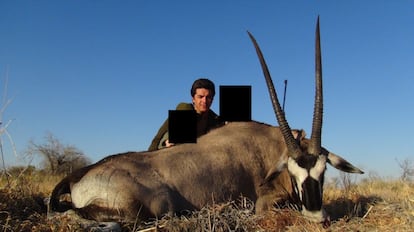

“Beautiful Juanita. The semifinal and final dates are coming up. So you can start looking for hotels and flights,” wrote Gerardo González Valencia, one of the leaders of Los Cuinis, the criminal clan that played a key role in turning the Jalisco New Generation Cartel (CJNG) into one of the world’s largest drug-trafficking organizations.
In the email, the Mexican kingpin asked his wife, Wendy Amaral, to organize a family trip from his hideout in Uruguay to two of the host cities for the 2014 World Cup in Brazil. Among the options he sent her were tickets costing as much as $21,300, according to a document attached to the message. “Also look for somewhere you’d like to spend your birthday so you can make a reservation,” he added.
González Valencia, who at the time was posing as a successful Mexican businessman running convenience stores across South America, attended one of the World Cup semifinals.
On July 9, 2014, he was in São Paulo for the match between Argentina and the Netherlands. Five days earlier, he had driven from Uruguay into Brazil through the Chuy border crossing, according to records from Uruguay’s National Migration Directorate that form part of his U.S. court file.
Seated close to the pitch at the Arena de São Paulo, the drug trafficker watched the dramatic match, which was decided on penalties. Lionel Messi and Argentina advanced to the final after defeating the Dutch.
Three days later, on July 12, González Valencia returned to Uruguay through the same border crossing. He would watch the final — in which Germany were crowned world champions — from home.
By then, the capo — who used the aliases “Lalo,” “Flaco” and “Silverio” — was already on the radar of the U.S. Drug Enforcement Administration (DEA). Since 2003, he had been trafficking cocaine on a large scale alongside his brothers and his brother-in-law, Nemesio Oseguera Cervantes, better known as “El Mencho.” He was also wanted by the U.S. Marshals Service after escaping in 2001 from a halfway house in Oakland, California, where he was serving the final portion of a four-year sentence for possession of methamphetamine with intent to distribute. He had been granted permission to leave in search of work, but never returned.
Investigators have linked González Valencia to a 750-kilogram cocaine shipment concealed among frozen sharks that was intercepted by Mexican authorities on the Yucatán Peninsula in 2009. He is also accused of involvement in the transport of 4,000 kilograms of cocaine aboard a narco-submarine detected by the U.S. Coast Guard in 2007.
Authorities have further tied him to at least three killings and to arms trafficking operations that supplied associates of the CJNG.
Living a double life
South America became the refuge of Gerardo González Valencia, his wife and their three children beginning in 2009. They first settled in Argentina and, three years later, moved to Punta del Este, Uruguay.
“We chose to live on our own, far from everything we had known in Mexico, with the aim of giving our daughter and two sons a different life from the one we had,” Wendy Amaral wrote in a letter to the U.S. federal judge overseeing her husband’s case.
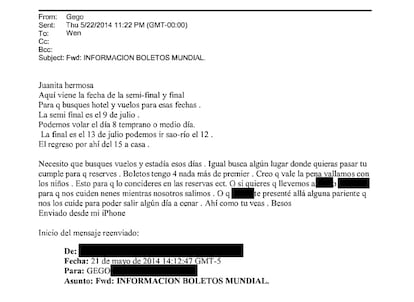
Before traveling to Brazil for the FIFA World Cup, González Valencia and his family toured several countries in Europe and Africa. In Botswana, the cartel leader went hunting, one of his favorite pastimes. He also returned to Jalisco — the Mexican state where his criminal organization originated — on several occasions.
In February 2013, he attended one of his son’s birthday celebrations, according to photographs his lawyers submitted as evidence in the criminal case in an attempt to show that he led a family-oriented life and had distanced himself from drug trafficking.
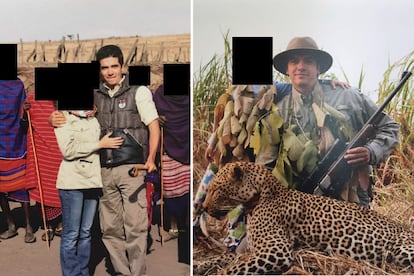
“The frequency of these routine family trips to and from Mexico, and around South America and the rest of the world, is plainly inconsistent with the conduct of someone whom the government claims was, at the time, a leader of a criminal organization,” his lawyers argued in a court filing. “He started a new life when he moved to Argentina.”
One of his businesses in Mexico, Hotelito Desconocido, was designated by the U.S. Treasury Department for laundering money for the CJNG. He also lost the chain of convenience stores in South America that helped explain his lavish lifestyle. Those stores drew about 1,000 customers a day.
“Yesterday [September 2011], the stores set a sales record: 24,063 pesos. We hit our target ahead of schedule,” his manager told him in an email.
But the image of a wealthy businessman eventually came crashing down in April 2016, when he was arrested in Uruguay. Authorities seized fake identification documents and birth certificates, cellphones and jewelry.
Four years later, he was extradited to the United States, where he pleaded guilty to drug-trafficking charges. Today, the only way González Valencia can follow a World Cup is on the television set at the medium-security federal prison in Victorville, California, where he is serving a life sentence.
Sign up for our weekly newsletter to get more English-language news coverage from EL PAÍS USA Edition









































