
Mexico reveals alliance between the Jalisco New Generation Cartel and Los Chapitos
Security chief Omar García Harfuch confirms the pact under which El Mencho provided ‘funding and personnel resources’ to the Guzmán faction. The DEA, videos, and even Google Maps had pointed to the agreement

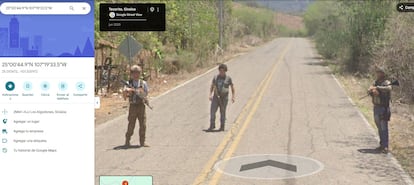
It is June 2025. Three men stand in the middle of a road 14 miles north of Culiacán, the capital of the Mexican state of Sinaloa. They are armed with rifles; two wear boots and another only sandals. One of them, who is also wearing a helmet, has a vest bearing four letters: CJNG, the Spanish acronym for the Jalisco New Generation Cartel.
The image of several men from the CJNG in the cradle of the Sinaloa Cartel was captured by one of the vehicles that work for Google Maps. It had been uploaded for users to see when activating the “Street View” feature. In other images, captured between El Tecorito and the community of Los Algodones, the same members of the Jalisco New Generation Cartel can be seen in different positions: signaling cars to stop, directing them to the side, and walking after the arrival of more armed men.
The coordinates were shared on the account of a Mexican historian and verified by dozens of users, including this newspaper. Google Maps has since blocked Street View on that stretch of road, which became another example of the pact between Mexico’s two main criminal groups.
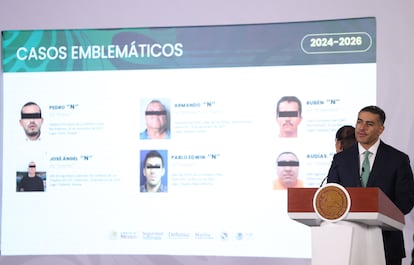
This alliance was acknowledged last week by Mexico’s security chief, Omar García Harfuch. The existence of an agreement between the Los Chapitos faction of the Sinaloa Cartel and the Jalisco New Generation Cartel has been widely suspected for more than a year, but the Mexican government confirmed it for the first time last Tuesday.
During a press conference at Mexico’s National Palace, García Harfuch reported on the “link” between the leader of the CJNG, Nemesio “El Mencho” Oseguera Cervantes, and the sons of Joaquín “El Chapo” Guzmán, who lead Los Chapitos. According to the security chief, this was a direct relationship: El Mencho provided “funding and personnel resources in southern Sinaloa”: “nothing more.”
García Harfuch’s statements align with the report published by the U.S Drug Enforcement Agency (DEA) in May 2025, which warned of this possible “strategic alliance.” The seizure of vests bearing the CJNG initials in Culiacán and the appearance of videos on social media showing members of that group in the Sinaloa Cartel’s stronghold reinforced the theory.
At the time, local authorities revealed that members of the Jalisco Cartel were operating freely in the rural northern area of Culiacán, a territory dominated — according to data from Mexico’s Attorney General’s Office (FGR) and the Defense Ministry — by Los Chapitos. It was the same area where, that very June, the Google Maps images were captured.
However, García Harfuch himself dismissed the existence of an alliance between the two groups in August of last year. That had been the case — until now.
Betrayal
That pact cannot be understood without the fratricidal war that has torn through the Sinaloa Cartel since September 2024. The fact that Ismael “El Mayo” Zambada was kidnapped and handed over to the United States by his godson Joaquín Guzmán López, son of his former partner, is not something easily forgotten in a criminal family. Since then, Sinaloa has been gripped by violence and disappearances. In the past 20 months, the fighting between the groups has left more than 2,800 people dead and 1,700 missing, according to official figures, in what is now the most serious security crisis of Claudia Sheinbaum’s government.
That betrayal, says Eduardo Guerrero, a security analyst and director of Lantia, led to “most of the organizations that formed part of that cartel siding with the Zambada family.” “That initially gave them an advantage,” he explains. “Many other groups preferred to stay out of it, and a smaller group supported the Guzmán family, which invested heavily in securing allies because they had enormous profits from fentanyl exports.”
However, as the months passed, the balance remained uneven. The downfall of figures such as Kevin Alonso Gil, known as “El 200,” head of security for Iván Archivaldo Guzmán, and “El Güerito,” a financial operator, in February 2025 tightened an increasingly suffocating noose around Los Chapitos. In recent months, the faction had lost most of its key operatives on the ground.
It was in this context that the agreement with the CJNG emerged. It was a “request for an alliance and support” from the Guzmán family to the Oseguera family, Guerrero notes. Guerrero, the director of the security consultancy Lantia, reconstructs the origins based on conversations with intelligence agents and media leaks: “The first thing El Mencho asked for was a show of loyalty, which apparently involved one of the Guzmán brothers — Alfredo, it seems — having to go live at a ranch next to El Mencho’s, without his own guards; the guards would be provided by El Mencho.” This kind of “special invitation” worked for a few months.
The deal included protection and money for Los Chapitos “as long as they facilitated the expansion of the Jalisco Cartel in the northwest of the country,” Guerrero explains, referring to the state of Sinaloa, as well as Sonora, Chihuahua, Baja California, and Baja California Sur. The Guzmán family presented these territories as areas they controlled, including key trafficking routes.
“It’s an alliance that quickly wears thin because, reportedly, the Guzmán family is unable to fulfill these promises and deliver these territories, since they are being contested. It wasn’t so easy to move into or hand over control of a territory they didn’t fully control,” the security analyst notes.
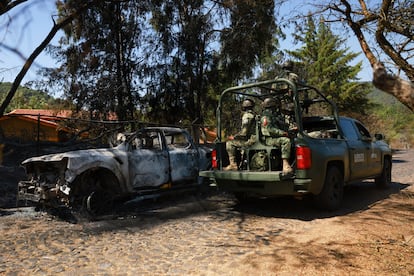
García Harfuch said that the alliance stopped working after the death of Nemesio Oseguera in a military operation in Tapalpa on February 22. “At present we have no indication that it continues. But we do not rule it out,” the security chief said.
The fall of El Mencho profoundly disrupted Mexico’s criminal landscape. While some of the main figures of the Sinaloa Cartel — such as Ovidio Guzmán and even El Mayo Zambada — are signing cooperation agreements with the U.S. Department of Justice, the succession within the CJNG remains uncertain, especially following the arrest of Audias “El Jardinero” Flores Silva.
Guerrero, who points to the intense monitoring currently being carried out by Mexican and U.S. intelligence in Jalisco because of the World Cup, believes the uncertainty will not be resolved until the soccer tournament is over. The analyst highlights the strong regional leadership within the CJNG and notes that they “do not want to risk any internal conflict now, given the reinforced security lockdown.”
On the other hand, he points to the economic strain in Sinaloa after nearly two years of conflict. “There are attempts by the Zambada family to bring about a truce,” he observes. “What remains is a great deal of uncertainty.”
Sign up for our weekly newsletter to get more English-language news coverage from EL PAÍS USA Edition









































