
Tai O, a town in rural Hong Kong, where life unfolds just a few feet above the water
Very close to the Asian megalopolis, this floating fishing village distances itself from the hustle and bustle of skyscrapers, offering a calm and traditional scene
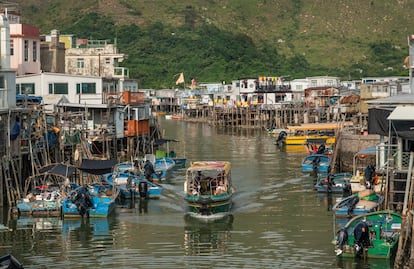
On the far side of Hong Kong’s hyper‑urban chaos — away from the frantic rise of futuristic façades and the churn of next‑generation technology — lies a place that seems to have resisted time. Just a short distance from the city often described as Asia’s Manhattan, there is a corner that has remained much as it was before this forest of skyscrapers took shape. In this small fishing village — accessible by a combination of subways and buses — time, rather than advancing, seems to stand still.
Tai O is hidden on Lantau, one of the 262 islands that — along with the Kowloon Peninsula — make up the Hong Kong Special Administrative Region of the People’s Republic of China. Lantau is also home to Chek Lap Kok International Airport, the main hub for Cathay Pacific. It is often described as the megacity’s playground — a place where nature offers a serenity that stands in stark contrast to Hong Kong’s concrete jungle.
On the western coast, the sleepy village of Tai O appears on the calm waters, its colorful houses perched on stilts. Fragile and solitary, it seems to float adrift. In the background, the mountains form a barrier, as if to safeguard its rural essence, protecting the humble fishing spirit that still constitutes the community’s main economic activity.
The sea as a way of life
The Tankas arrived in Tai O more than 300 years ago. Originating from southern China, they were known as “the boat people.” They occupied a low rung in society and lived in precarious vessels. These communities, who practised artisanal fishing, traded salt and searched for pearls, gradually began to build their homes on stilts, piling them one atop another and sketching out a kind of floating neighbourhood.
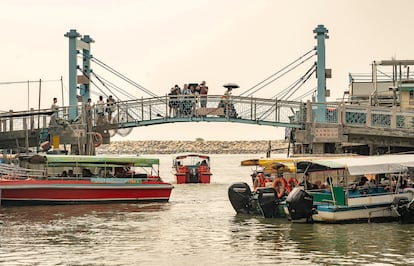
Since then, life has unfolded on wooden platforms a few metres above the water. Beneath your feet, along the frayed alleyways of wood and bamboo — some now reinforced with concrete — you can hear the constant murmur of the tide. From Rope‑Drawn, a small hand‑operated pedestrian drawbridge that serves as the village’s entrance, you get the best view of this strangely beautiful enclave, nicknamed — with a touch of whimsy — the Venice of Hong Kong.
Connected by passages so narrow that cars can’t pass, bicycles are the main mode of transport here, the way locals move around on solid ground. A strong smell of fish hangs in the air near the local market, where most stalls sell products from the sea. This is also where fishermen lay out their catch to dry in the sun — from squid and lobsters to octopus and sea cucumber — and where vendors display curiosities such as fermented shrimp paste and salted duck‑egg yolks, used to make mooncakes mixed with lotus‑root paste. You’ll also find collagen extracted from fish stomachs, used to prepare a soup that is said to have rejuvenating powers.
Lanterns, dolphins and Buddhas
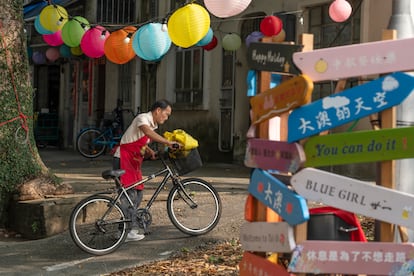
There’s little else to do in Tai O but soak up its authentic atmosphere, which focuses on the simplicity of life, free from haste and devices. You can stroll along Kat Hing Street, adorned with colorful paper lanterns. And, when hunger strikes, you can grab a bite at Tai O Heritage, which was once the police station protecting the village against pirate attacks. It’s now a restaurant and hotel, offering traditional dishes on a glass-enclosed terrace (and in nine rooms that were once holding cells).
Another great option is to take a boat trip, not only to admire the town from the sea, but also to spot the friendly Chinese white dolphin (also known as the pink dolphin). It’s estimated that only about 50 members of this species remain in the area: they’re threatened by pollution and underwater noise from maritime traffic. Sightings require a stroke of luck, but even if they don’t appear, the outing is rewarded with a magnificent view of the HZMB Main Bridge, the longest sea bridge in the world (34 miles), linking Hong Kong with Macau and mainland China. It also features the unusual addition of a four-mile tunnel submerged underwater.
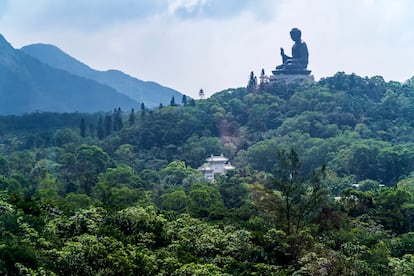
Tai O itself is worth a leisurely visit. But in addition to the village, nearby stands the majestic Big Buddha (Tian Tan) atop Ngong Ping Hill, which is accessible by a glass-bottom cable car. This 111-foot-tall, 250-ton bronze Buddha represents the harmony between humanity, nature and faith. However, admiring it up close requires climbing 268 steps, a feat meant to symbolise the obstacles one must overcome on the path to enlightenment.
Equally impressive is the Po Lin Buddhist Monastery, a temple complex founded in 1906 that houses three Buddha statues (representing the past, present and future), as well as a beautiful array of iconography. Here, a bell rings every seven minutes, exactly 108 times a day. Legend says that its ringing cures 108 different ailments.
Surrounding the monastery, lush vegetation covers the hillsides of a Hong Kong far removed from its steel skyscrapers.
Sign up for our weekly newsletter to get more English-language news coverage from EL PAÍS USA Edition









































