
The survival of the Negros Mascogos, the only community in Mexico descended from US slaves
El Nacimiento, a small town in Coahuila, is fighting to preserve the identity, memory and traditions of its ancestors, who came to the area from Texas fleeing slavery


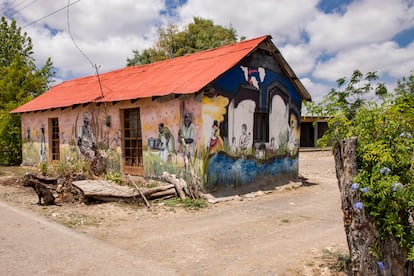
It could be any rural Mexican town. But it is unique. Two long streets and about eight cross streets. The houses are single-story and painted in pastel shades. The heat is heavy and the sun merciless in this area of northern Coahuila. The calm is almost absolute. Only the walls painted with murals hint at the particularity hidden in El Nacimiento, an arid stretch of land at the foot of the imposing Sierra de Santa Rosa de Lima and located 124 miles (less than 200 km) from the Texas border, precisely where the key chapter of the story told by the weathered walls was written. Two Black women dressed in red adorn one façade. And on another, a route is traced across maps: Africa, Florida, Mexico.
That is the path that was followed over the course of centuries by the ancestors of the roughly 250 current residents of the town, the Negros Mascogos, because El Nacimiento is home to the only community in Mexico that is descended from enslaved Africans from the United States. “I am Black,” repeats Arely Vázquez, 22, speaking at the town’s cultural center, the Casa de la Cultura, founded in 2021 to preserve the community’s memory and traditions. “At school they don’t teach us anything about our heritage. And at home they didn’t show me either. I learned about it when I was 16 or 17 and started to get more involved—learning the traditional songs, the history. What we seek is that: to preserve everything that was being forgotten.”
Time and migration have eroded the narratives that tell the Mascogos’ history and the traditions that sustain their identity. During the first half of the 19th century, according to tales passed down through generations, the Mascogos’ ancestors were forcibly displaced along with native Indigenous people from Florida and other southern states to what is now Oklahoma, in a dark episode of U.S. history known as the Trail of Tears.
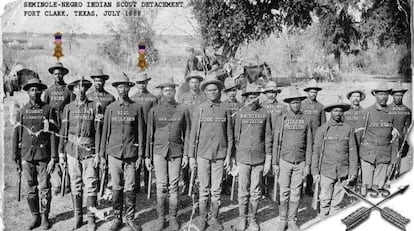
It is this association—Black people displaced as slaves of the Indigenous people —that gives the Mascogos their name, a deformation of muskogee, the language of some Indigenous groups of Florida. The Mascogos are also known north of the border as the Black Seminoles, a designation that likewise stems from the relationship between the enslaved people and Indigenous groups.
But their passage through native territories at the edge of the Wild West did not last long. First they fled the areas designated by the government, in search of freedom. Then, persecution by those seeking to recapture and re-enslave them in Texas led them to cross the Río Grande southward—the river had recently been established as the new border between Mexico and the growing United States. Led by John Horse—known in Spanish as Juan Caballo—the Mascogos negotiated with Mexican authorities, who granted them land along the banks of the Río Sabinas, where El Nacimiento now stands, in exchange for patrolling the border and keeping at bay the Texas Rangers, who regularly ventured south.
When slavery was abolished in the United States in 1865, some members of the group chose to return north, where many of their relatives had remained, and for decades the Mascogo community was transnational; it still is, but the hardening of the border has complicated ties with the sister community concentrated in Brackettville, Texas. Today, El Nacimiento celebrates Juneteenth every June 19, the date that marks the end of slavery and which, more than 150 years later, was finally designated a federal holiday in the U.S. by Joe Biden.
Recognition of the Mascogo people
In Mexico, generations of Mascogos lived in El Nacimiento on the margins of the national narrative. Relations with the Mexican government were practically nonexistent for more than a century, until they revived with the official designation of the Negros Mascogos as an Indigenous people in 2017. The recognition sought to facilitate access to public programs and resources but generated friction with the National Institute of Indigenous Peoples (INPI), which applied to them the generic label Afromexicanos—a label the Mascogos reject given their particular history and origins, very different from Afro-Mexican communities in Oaxaca, Guerrero, or Veracruz. The Mascogos are the only Black community in the country’s north.
Raúl Torralba, who serves as a municipal representative and on national councils, emphasizes that their identity is a matter of ancestral honor more than a bureaucratic formality: “For me it is a matter of pride to be descended from brave people who fought for their freedom and who brought us here. This is where our ancestors died, where they remained; this is our land too. Here is our navel, as we say. My words would fall very short to express everything that being Mascogo is, but it is something you feel deep inside.”
Torralba’s pride is the product of a more contemporary consciousness. The elders of the town say they never thought about it much. “There wasn’t a chance to ask them much [the parents or grandparents], and if you asked, they would scold you badly. Because at school there were Mexicans and there were Black people like me, so when they fought with you, they would say nasty things: ‘Black people smell like rubber, like burning rubber,’” recalls Zulema Vázquez, frowning, seated on her porch as she waits for rains that have been absent for a long time.
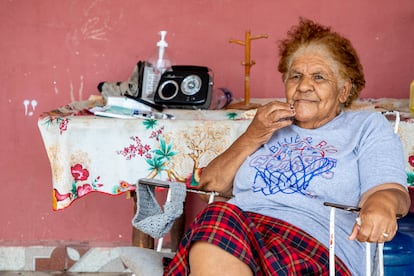
For her, born in 1948, despite the taunts, the identity carried on her skin was nothing more than pigment; everything else she took for granted. But the memories she shares contrast sharply with the present. “It has changed a lot. Customs, food, traditions. There is none of what used to be planted. Red cane, okra… They now plant more pumpkin or corn. But right now nothing is being planted. It hasn’t rained, there’s nothing.” Only “Black Day,” June 19, “is still celebrated.” “That day we have the party,” she says, for the first time with enthusiasm in her voice.
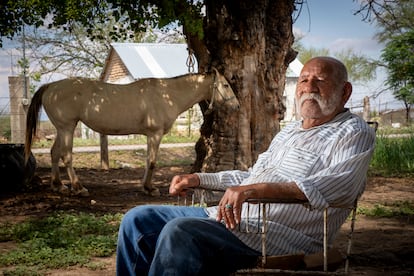
Along with the more traditional food—both ingredients and recipes—the community’s language was also lost, says 84-year-old Santana Vázquez—everyone in the town is family, near or distant. Sporting a shaved head showing white hair and a western-style mustache, he sits in the shade of a tree in his yard. “Here they created the English they called cascajo, because they spoke half in English and half in Spanish. But no one speaks English anymore, and even less our cascajo,” he says.
A cross-border history
Migration, driven by various factors but mainly by a lack of opportunities, gradually emptied the town, especially in the second half of the last century. Some people moved to the municipal seat, Melchor Múzquiz, only half an hour by car—though before there was a paved road the trip took hours on horseback or on foot—but many others crossed the border northward, to reunite with cousins and earn dollars.
Santana belongs to that generation. He crossed the border as an undocumented migrant, like so many others, against his mother’s wishes, who feared what could happen to him in the brush. In Texas he worked on ranches, on horseback or fixing fences. For a long time, he says, when the border was not what it is today, he went back and forth, showing off his American clothes in town. Until he regularized his status there—he proudly shows his green card—and eventually obtained a pension, which he still receives monthly. But despite that, he always knew he would return to El Nacimiento.
For Corina Torralba, the call of her homeland came more unexpectedly. Born in an adobe house in El Nacimiento 51 years ago thanks to her grandmother’s midwife skills, she moved to the outskirts of San Antonio, Texas, at age seven and has lived there ever since. She had always heard that 124 miles (200 km) west, in the town of Brackettville, there were distant relatives of hers and, in the cemetery, her grandfather’s grave, but it was only 15 years ago that she went to see it for the first time.
What she found was a revelation: the Black Seminoles’ cemetery and an organization dedicated exclusively to protecting that history, which on the Mexican side was fading into the fog of family memory eroded by migration. The discovery gave her a new life mission to recreate that effort to preserve her people’s memory and to reconnect the two communities divided by the border.
In 2021, Corina returned to El Nacimiento determined to open the Casa de la Cultura, rehabilitating a small community space that had been abandoned. The goal was clear: to ensure the umbilical cord to their past would not be cut permanently. “Many of our young people do not know this history... and I decided to do the work of going and supporting the community,” she now says. The space became home to a small library, as well as workshops and classes to recover traditional songs—gospel-style pieces that had been preserved only in funeral contexts.
In this cultural revival, women have again taken their historic role as the thread that holds the community’s fabric together. They are the ones who pass on the flavors and sounds that define what it means to be Mascogo. “Women have always been the ones leading the way. The ones who unite the family, teach, preserve the food,” explains Arely Vázquez, who since Corina’s arrival has become another leader, in the memory of figures like doña Lucía and doña Gertrudis, historical matriarchs whose names are still heard in the town.
Memory is kept alive through the senses: by the taste of the food or the sound of the music. It is savored in the sosque, a traditional corn atole, and in the tetapú, the sweet potato bread still baked as it once was despite the fact that it is no longer cultivated as before. But perhaps the deepest connection lies in the ancestral songs. Singing them, Arely says, is an almost mystical experience: “It feels like a very strong vibe... My skin would crawl and then I felt like crying,” the young woman confesses.
For Arely, the preservation of memory she carries out is not only a matter of archives and songs but of physical survival on the land of her ancestors. Motivated by love for her surroundings, she decided to study environmental engineering, seeing science as a tool to protect the area’s threatened nature. “My degree would help me a lot to carry out projects or environmental things here in my community... How great that I stayed because I love being here,” she says with conviction, aware that the community’s permanence also depends on environmental conservation.
The greatest challenge to that permanence is the Río Sabinas, the watercourse that rises very near El Nacimiento and gave life to the community. The persistent drought that has shrunk its flow is worsened by human action: indiscriminate extraction of stones from the riverbed and deforestation are killing the river. Representative Raúl Torralba explains with concern that without trees there are no clouds, and without the stones on the riverbed the water simply seeps away and is lost: “If they keep cutting down more trees and extracting the river stones... That makes the water disappear too,” he warns, pointing to how the life cycle that sustained the agriculture his parents lived from is breaking.
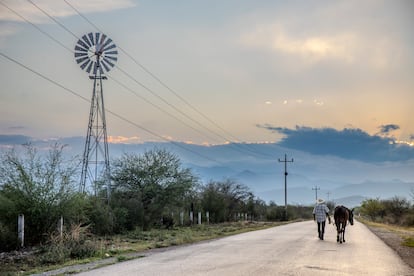
This environmental decline, coupled with the lack of transportation links and higher education, has driven an almost inevitable exodus, generation after generation. In Torralba’s generation, most people left for Texas. It is a painful migration but one forced by the reality of a town where “there is no stable work” and opportunities are “very limited.” Many leave following relatives already established in the north; some have legal status thanks to those family connections, keeping alive the transnational nature that has defined the Mascogos since the 19th century.
However, in recent years, in the face of the inertia of departure, a resistance to leaving has emerged. Torralba, for example, returned after years working in construction in San Antonio, moved by a calling he feels in his blood. For him, staying is an act of protection toward his heritage: “I returned to care for, above all, our land,” he says, describing what he feels as a calling. For him, his role as an ethnic councilor and municipal representative is not just political; it is the defense of his people’s home.
It is a mission he considers part of his very identity. The survival of the Negros Mascogos has never been guaranteed but has been a constant struggle. Santana Vázquez, with the simple wisdom of his years, sums it up under the sun that scorches the yard’s ground: “This is a story that has no end.”
Sign up for our weekly newsletter to get more English-language news coverage from EL PAÍS USA Edition









































