
The prolific pen of inmate 89914053: El Chapo’s letters from his Colorado prison
The former leader of the Sinaloa Cartel is serving a life sentence for drug trafficking in the United States. In 13 missives addressed to the judge presiding over his case, he writes that he is suffering from severe physical and psychological exhaustion
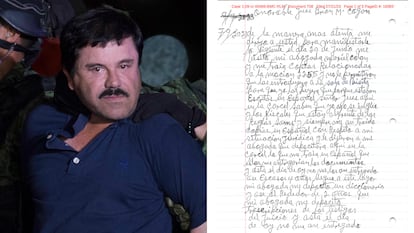

There are two Joaquín Guzmáns. One, known as “El Chapo,” rose to become the world’s biggest drug trafficker. He was feared by his rivals and by the authorities. He spilled the blood of anyone who crossed his path. It didn’t matter if they were members of a rival cartel, or innocent civilians.
The other, Joaquín Guzmán Loera — inmate 89914053 at ADX Florence, a supermax jail in Colorado — is an elderly man, almost 70 years old, who claims to be unjustly imprisoned: he describes inhumane conditions and protests that he’s unable to speak with his family. According to Guzmán, the U.S. justice system has sentenced him based on a fabricated story that has nothing to do with him. In unintelligible English, he obsessively pleads for mercy.
In reality, both men are the same person. But the first is trying to construct this image of the second through dozens of letters written in prison. The myriad of letters from the criminal — who, in 2019, was sentenced to life imprisonment for drug trafficking — reveal the desperation of the man who, until recently, ruled the Sinaloa Cartel with an iron fist.
This prolific writing began the very day the drug lord was sentenced, on July 17, 2019, in the U.S. District Court for the Eastern District of New York. Before Judge Brian M. Cogan — the recipient of the inmate’s subsequent letters — El Chapo spoke about his family. He entrusted himself to God and denounced the conditions of his confinement: “I have been forced to drink unsanitary water. I have been denied access to fresh air and to sunlight. The only light that I get in my cell comes through a duct, and the air that comes into the cell is forced in and it makes my ears, my throat, my head hurt.”
This would be the starting point of Guzmán’s metamorphosis. It was also the beginning of a journey that would lead him to crafting a revisionist delusion. He has long been attempting to rewrite his own biography, always under the name Joaquín Guzmán L.
In May 2022, Judge Cogan received the first letter in his office. The sender introduced himself as “a 64-year-old Mexican extradited from Mexico to the United States in January of 2017.” It’s a long document (seven pages), written by hand. “I pray that this court will intervene.” In the writing, El Chapo begins to show signs of despair and indescribable suffering. Not only is he confined in a prison known as the “Alcatraz of the Rockies,” but he’s also under a regime of extreme isolation, known as SAMs (special administrative measures). “I have suffered greatly,” he concludes, after describing intense headaches, memory loss, muscle cramps throughout his body, stress, as well as feelings of depression.
Cogan would reply — as in the rest of the correspondence — that, basically, El Chapo should save his breath.
The drug lord’s anxiety escalated in January of 2023: El Chapo requested the intervention of then-president Andrés Manuel López Obrador (2018-2024) through one of his lawyers, who made the request at the Mexican Embassy in Washington. El Chapo no longer wrote about mistreatment or his personal ordeal: the battle had suddenly become racial.
In the letter, Guzmán claims that he was being discriminated against in prison — and treated worse than the terrorists being held there — simply for being Mexican.
The seasons changed… and so did the strategy. In August, the former leader of the Sinaloa Cartel displayed a strange writing style, alternating between the first and third-person singular. By this point, his mission — outlined in two separate letters that same month — was to get the ADX Florence authorities to allow him to receive correspondence from his legal team. According to his account, the guards weren’t allowing this, because they didn’t understand the content of the documents.
“Your Honor,” he writes, in one of the letters from August of 2023, “here, in jail, they know that I don’t speak English [...] They always [block my correspondence by using] the excuse that it’s because ‘Guzmán once escaped from a prison in Mexico,’” he explains to Cogan. He also asks to see his wife — influencer Emma Coronel, who was due to be released from prison the following month — and his two minor daughters: “I ask that you please authorize her to visit me and that she [be allowed to] bring my daughters to visit me.”
Months later, in 2024, he would write about his daughters again. But that wouldn’t be the most striking subject in his letters that year.
A ‘scapegoat’
It was clear that the Spanish language wouldn’t save him. So, he sent a document translated by his legal team: the Sinaloa native went on the offensive, requesting a new trial. To justify this, in his letter, the drug lord rewrote the founding myth that catapulted him to infamy: the 1993 assassination of Cardinal Juan Jesús Posadas Ocampo at the Guadalajara International Airport. According to his version of events, he was simply in the wrong place at the wrong time. In reality, he wrote, he was going to the beach and, by sheer chance, was caught in the crossfire: “Before that event, Mr. Guzmán didn’t exist for the Mexican government.” This unfortunate coincidence, he claimed, turned him into a “scapegoat.”
El Chapo would end the year with a demonstration of legal skill. The criminal — who, according to the evidence he has accumulated in recent years, has supposedly lost his memory — displays a meticulous knowledge of the law. In September 2024, he argued to Judge Cogan that his extradition was illegal because Mexico should have sent him to Texas or California, not New York. But the true crux of his situation came to light thanks to U.S. intelligence.
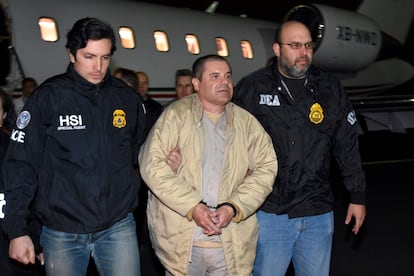
In February 2025, U.S. authorities discovered that the impenetrable walls of ADX Florence hadn’t broken the drug lord (famous for his Hollywood-style escapes from two Mexican prisons). Guzmán had managed to send messages to his sons — known as Los Chapitos — through his lawyers. Months earlier, one of his sons betrayed his partner — Ismael “El Mayo” Zambada — by bringing him to the United States by force, so that they could surrender together. This event has unleashed a full-blown war between the two factions of the Sinaloa Cartel.
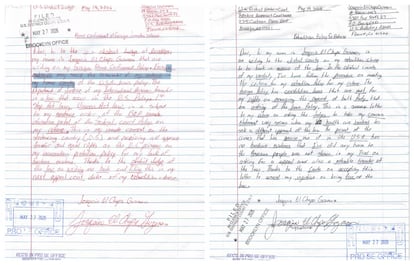
The passage of time has also led to increasingly feverish letters, which are sometimes disjointed. And, in a new development, he’s writing his letters in English. The drug trafficker invokes the U.S. Constitution, speaking of legal and procedural technicalities like an American lawyer who’s familiar with convoluted passages of jurisprudence. He describes the Mexican government as being the true source of the violence ravaging his country. And he writes weekly: up to 13 letters between April 17 and May 27 of this year alone, according to a count by Ángel Hernández, a journalist for the newspaper Milenio.
The drug trafficker fires shots in all directions. He wants to be extradited. He also argues that the prosecution didn’t file charges against him in time. As a final point, he politely requests that his petitions reach the U.S. secretary of state and the governor of New York (although he actually wrote “Brooklyn”). The response he’s been met with has been the same as throughout his career as a letter-writer: a deafening silence.
Sign up for our weekly newsletter to get more English-language news coverage from EL PAÍS USA Edition









































