
US warns its crusade against cartels and corrupt politicians does not end with El Mayo
Washington maintains that the relationship between organized crime and the Mexican government is indissoluble, while Claudia Sheinbaum demands respect for sovereignty
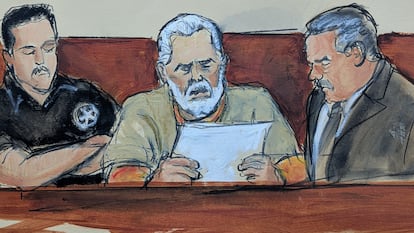
The two major targets have already been taken down. But Washington is not satisfied. Life sentences for Joaquín “El Chapo” Guzmán and Ismael “El Mayo” Zambada — the latter confirmed on Monday by a New York court — who will both serve their terms in U.S. facilities, do not mark the end of the fight against drug trafficking in Mexico and its ties to corrupt politicians. They are, perhaps, a milestone the Donald Trump administration wants to build on. That was made plain on Monday by Terrance Cole, director of the U.S. Drug Enforcement Administration (DEA), outside the Brooklyn courthouse that minutes earlier had sentenced Zambada to spend the remaining years of his 76-year life behind bars, and ordered the seizure of $15 billion to compensate the victims of decades of cocaine, heroin, and fentanyl smuggling.
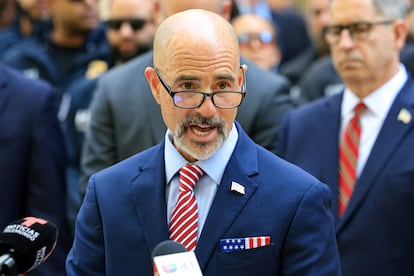
“It’s a warning to every cartel leader, global criminal enterprise, and foreign terrorist, if you traffic deadly drugs, profit from the suffering of others, and threaten our communities, DEA is coming for you,” Cole said. “Whether you’re a drug trafficker or a corrupt government official, DEA is coming for you. Our work is far from over.”
The warning leaves no doubt. And it threatens to further inflame already tense relations between the two neighbors. Cole spoke shortly after what everyone already knew had been confirmed transpired: that El Mayo would be sentenced to life after pleading guilty in August last year to avoid the death penalty.
The apologies the bloodthirsty former head of the Sinaloa Cartel offered in a letter read in Spanish were of little avail. Judge Brian Cogan said he had no choice but to impose a life sentence on Zambada, adding that even if he were able to use discretion, that would be the punishment he considered most just. “The almost unimaginable amount of drugs attributable to him and the number of murders that we can document is enough to justify Congress’s decision to make this a mandatory life sentence,” the judge said.
But later, outside the courthouse, the DEA director went much further. With his rhetoric of all-out war against drug trafficking, he effectively said that the resentment sparked in Mexico by the expansion of U.S. agency operations into Mexican territory matters little. Take the arrest of El Mayo, for example, which U.S. authorities initially did not acknowledge as their own doing, but about which there is now little doubt.
“[El Mayo] used bribery, influence, and intimidation to shield the cartel from justice, both within Mexico and beyond its borders. The cartel continues to corrupt institutions and undermine the rule of law for its own criminal purposes,” Cole said in an impromptu address at the foot of the U.S. District Court for the Eastern District of New York. “Today is a great day for law enforcement, but let me be clear — this sentencing is not the end. It’s just the beginning.”
Narco-politics
The claim that El Mayo and his criminal organization paid bribes to authorities to safeguard their illicit activities might seem obvious. It would not be the first or the last cartel to rely on corrupt public officials. However, today the accusation carries added weight, with the Trump administration using the issue of “narco-politics” to attack Claudia Sheinbaum’s government and justify its agencies’ operations beyond its borders, which Mexico has denounced as violations of its sovereignty.
President Sheinbaum has argued that the two countries must jointly address the drug trafficking phenomenon, given that the cartels meet U.S. consumer demand, not to mention the criminal networks (also involving corrupt officials) that operate north of the border and make distribution possible.
Perhaps the biggest blow from the United States to Mexican politics came with the formal accusation against Sinaloa governor Rubén Rocha, alleging he collaborated with the Sinaloa Cartel. That was followed by press leaks that Washington also had the governors of Sonora and Tamaulipas, Alfonso Durazo and Américo Villarreal, in its sights. Another governor, Marina del Pilar Ávila, was recorded speaking with supposed U.S. officials and offering to cooperate by sharing privileged information.
Mexican government officials have warned that these allegations lack evidence and are, in fact, political maneuvers — driven by the international right — that seek to undermine the authority of Morena, the ruling party, and pave the way for leaders who are compliant with Washington’s agenda to assume the presidency. Sheinbaum believes that Mexican sovereignty is at risk and has called on her government to close ranks in this regard. The accusations against the governors, however, do little to bolster that defense. While the ruling party looks for an external threat, the enemy may well be at home.
Sign up for our weekly newsletter to get more English-language news coverage from EL PAÍS USA Edition









































