
Israeli families seek descendants through sperm retrieved from their dead sons
A temporary measure introduced after the 2023 Hamas attack allows posthumous collection without a court order. Four hospitals now store samples from around 250 soldiers
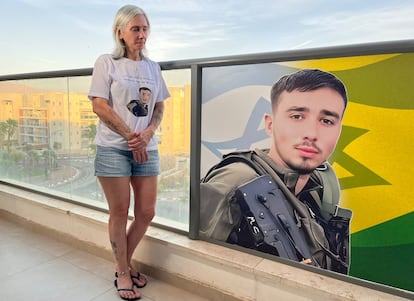

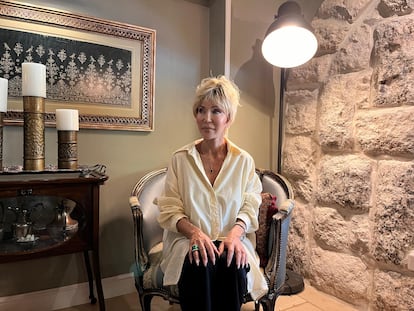
Sharon Eizenkot’s house is overwhelming. Everything revolves around Maor, her son, who died in 2023 while serving as a soldier in the Israeli army in Gaza. Like a mausoleum of grief, the white walls bear no decoration other than dozens of mementos, from the jersey of his soccer team to the uniform and assault rifle he was carrying when he was hit by an explosive device in Khan Younis.
Maor will never know it, but he is about to become a father, likely soon. The soldiers who came to his mother’s door to inform her of his death also offered her the option of taking advantage of the 72-hour window to extract tissue from the corpse’s testicles and retrieve sperm while it was still viable.
Eizenkot agreed and later sought court permission for a woman of her choosing to be inseminated with her son’s sperm to give him posthumous descendants. Last July, she became the first Israeli to receive judicial approval since the Hamas attack and Israel’s invasion of Gaza in October 2023. “I did not send my son to war. The state of Israel did, so it is the state’s duty to do this now,” she says. The court accepted oral testimony that Maor wanted to be a father, even though he did not put that wish down in writing.
Israel, which already had one of the world’s most permissive laws on postmortem sperm extraction, has in the past three years almost institutionalized the practice, eliminating the need for prior judicial authorization and driving the numbers up. Today, four hospitals store frozen semen from about 250 soldiers, a quarter of the fatalities since 2023.
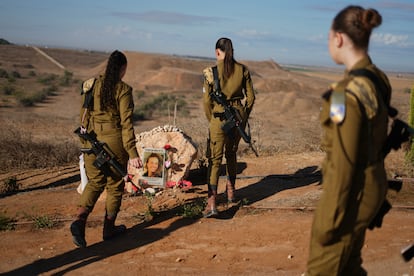
The last time she spoke to her son, he told her from Gaza that he was about to take part in a more dangerous mission. Eizenkot comes from a military family. Her brother, Gadi, was chief of staff of the Israeli military and now leads Yashar, the party list running first in almost every poll ahead of the Israeli election on October 27.
So when, a few days later, military officers knocked on her door, she immediately understood why. “The same person who gave me the worst news read out the message [asking for consent to retrieve the sperm]. I told him I understood. I saw three words in big letters, ‘retrieval of sperm,’ and I said, ‘I’ll sign.’”
Eizenkot, 52, has in fact already chosen a young woman for the pregnancy after the court’s approval. She is one of the “hundreds” who wrote to volunteer, free of charge, inspired by a desire to become a single mother, the importance of family in the Jewish tradition, and Maor’s story, which tugs at the heart in a society that has grown more nationalist and militarized since the Hamas attack. Eizenkot received so many inquiries that the platform she was using had to assign three call-center operators exclusively to handle the flood of applications.
“They wanted to be mothers anyway, so rather than going to a sperm bank they preferred to connect with the father’s family. And there is an added value, a moral one, in the fact that Maor is an Israeli hero,” she says at her home in the city of Eilat, on the shores of the Red Sea at the country’s southernmost tip. Eizenkot imposed only two conditions: that the woman intend to remain in Israel and that she be relatively young, because the stored sperm samples are limited and she did not want to take the risk of choosing someone at a less fertile age.
Something living
The grief in the mother’s voice lifts only when she speaks about the woman she has chosen, and a sparkle returns to her eyes. “I feel like Maor’s messenger. That’s my primary motivation. It is the only dream of his that I can make come true. All the others, I cannot. And then, for me, it will be something living from Maor. Not photographs, like the ones you see in the house, nor a gravestone I visit every Friday, but something living. Nothing will replace Maor. I am not looking for that. The void he has left will remain until I leave this world, but this will bring joy to my home and my life. In a way, Maor will be with us again.”
She now needs the approval of the court, likely a mere formality after the landmark ruling issued earlier. “In the meantime, we are learning to be a family. We talk a lot and are getting to know each other.”
Posthumous sperm retrieval consists of making an incision in the testicles to remove tissue from the body in the hours following death. The sooner it is done, the better, ideally within the first 48 hours, although it can be carried out up to 100 hours later. The tissue is then taken to a laboratory and examined under a microscope to locate and freeze living sperm cells that can be used for in vitro fertilization.
The procedure was already legal in Israel, but it was uncommon and ethically controversial, with only a handful of requests each year. The legal process was also more complex. In 2003, the State Attorney’s Office issued its first guidelines, allowing female partners to use the sperm on the basis of the deceased’s “presumed wish” to have a family.
Since the Hamas attack, however, the practice has become institutionalized and normalized in a more favorable judicial and social climate. The state pays for the procedure, and the Ministry of Health oversees it.
Demographic war
At stake is Israel’s demographic contest with the Palestinians, with roughly the same number of Arabs and Jews — about 7.5 million — living between the Mediterranean Sea and the Jordan River. Israel is pursuing natalist policies that are unmatched elsewhere: it provides child allowances, covers fertility treatments, permits the controversial practice of surrogacy and subsidizes part of the cost of egg freezing. With an average of 3.1 children per woman, Jewish Israelis have the highest fertility rate in the OECD, driven above all by the ultra-Orthodox and religious nationalist communities.
Two cases illustrate the shift. The first is Keivan Cohen, an Israeli soldier killed in Gaza in 2002. His mother needed 11 years and a lengthy legal battle to become a grandmother using her son’s sperm.
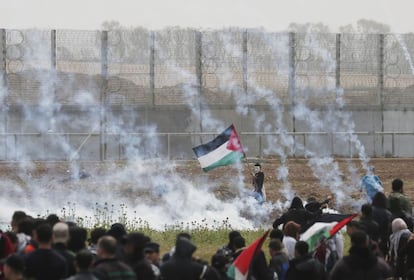
The second, more recent case is that of Nitza Shmueli. Her son, Barel, was a Border Police sharpshooter stationed along the Gaza barrier during the Great March of Return, the protest movement that demanded an end to the Israeli blockade and recognition of Palestinian refugees’ right of return. Over the course of a year and a half, Israeli soldiers killed 214 people and wounded as many as 36,000 when they opened fire on those approaching the border fence or deemed to be “instigators.”
Barel died in 2021 after being shot by a Palestinian, and his mother requested that his sperm be retrieved. A year later, she told a parliamentary committee that 1,400 women had contacted her expressing interest in having a child with Barel’s sperm. However, she did not obtain approval from a Tel Aviv court until last year, even though the same law was in force then as now.
The main legal change is that — in the absence of a parliamentary consensus to pass new legislation — the state has been operating under an emergency regulation adopted in October 2023 and renewed month by month. It allows sperm to be retrieved from those killed in the war without a court order, which had previously been required, and at the request of the parents. Before, only a partner could make such a request. Parents now account for 77% of all applications. No other country in the world grants parents this right, which runs counter even to a 2016 court ruling in Israel.
‘A national response to Hamas’
The shift goes beyond the importance of having children in Jewish tradition. It is also, in a way, a response to the Hamas attack, the deadliest day in the country’s history, with more than 1,200 people killed.
Iris Haim puts it plainly: “It is part of a national response to Hamas. They tried to finish us off, like the Nazis in the Holocaust, so this is about showing them that they wanted to kill Yotam, but that was not his end […] We are Jews, very few in the world, and we cannot give up on anyone. It is not just about me or my family. It is about us, about Israel. We have to grow. Every 50 years they try to erase us from the map, and we need to respond to that.”
The Yotam she is referring to is her son, who was taken hostage by Hamas on October 7, 2023, from a kibbutz near Gaza. After two months in captivity, he managed to escape with two other hostages. They spent five days in an abandoned building in Gaza City, where they arranged breadcrumbs to spell in Hebrew “Rescue three hostages,” hoping Israeli soldiers in the area or advanced reconnaissance drones would see it.
When two of them walked out toward the soldiers with a white flag and no shirt, the soldiers opened fire, displaying the same trigger-happy response used against Gazans. The soldiers then killed the third escaped hostage. It made no difference that he shouted in Hebrew: the soldier thought it was a trick by a Palestinian militant. Yotam was 28 years old.
The incident outraged many in Israel and gave fresh momentum to the protests by relatives of the hostages demanding a deal to bring them home. Iris, however, surprised many by forgiving the soldiers who killed her son and inviting them to her home.
On that day, Haim agreed to the retrieval of sperm from her son’s body. A year later, she also went to court to obtain permission to use it. Last April, she secured a favorable ruling. Hers is one of only five cases to have done so among the dozens of families of victims, both civilian and military, that have turned to the courts after growing tired of waiting for Parliament to act. In 2022, a bill to formally regulate the retrieval and use of posthumous sperm from soldiers passed its first reading, but Israeli Prime Minister Benjamin Netanyahu returned to power, with ultra-Orthodox Jewish parties as coalition partners, and the legislation was shelved.
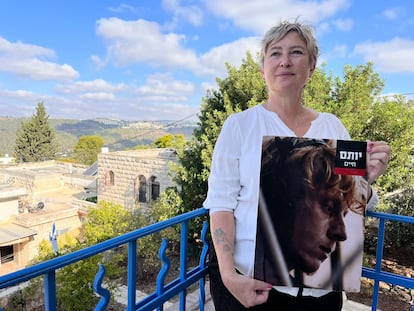
Despite the judge’s approval, the Haim family has agreed to wait. They are daunted by the prospect of making real what had until then been just a dream. “When we received permission, we started thinking: ‘Well, what do we do with this now?’” says Haim at her home in the village of Ein Karem, on the outskirts of Jerusalem, where memories of Yotam fill every corner.
Her other two children feared the potential impact of “bringing a stranger [the future mother] into the complexity of a family that has suffered such a great loss,” so they decided to reconsider it in a year.
In the meantime, she says, she has a list of candidates. She did not have to look for them; people contacted her after learning about her case through the media and social media. Haim explains most are around 40 and would rather have a child with someone who has “a face, a family and a history” than turn to a sperm bank.
She is still waiting, however, for “the right one.” She was particularly taken with a musician, like Yotam, who played the drums, and who was eager to give birth in Israel after spending almost her entire life in New York. But she gave the wrong answer to a key question: “Can you promise me you’ll stay in Israel?” “I told her I was sorry, but I did not want to see my grandchild once every six months or travel to the other side of the world to do so,” says Haim.
Convincing the court
Iris says many candidates came forward saying they would love to have a redheaded child like Yotam. Hair color was precisely one of the elements that convinced the family court. Iris told the judge that her son used to joke he wanted children because redheads are a “unique breed.” His sister added that Yotam had told her while he was alive that he wanted a daughter and had even thought of a name for her.
The judge also accepted as evidence a WhatsApp message Yotam had sent to a close female friend, saying that when they grew tired of endless dates and unsuccessful relationships, they would have a child together. Although Yotam left no explicit consent for his sperm to be used, the judge concluded that he had an “unequivocal desire to have children,” not with any particular woman, but rather as an “altruistic and existential desire to create life.”
Haim, who is politically on the right, wants the future mother not to raise the child to believe that Netanyahu deprived them of a father by delaying an agreement to bring the hostages home. “She must live, love, be part of and want to stay in Israel,” says Haim. “I do not care about her political views, but of course I do not want an atmosphere of hatred and resentment, or for her to tell the child when they are young: ‘You don’t have a father because of this government.’”

The state covers the cost of “saving the sperm” — to use an expression that reflects the increasingly nationalist overtones the practice has taken on — but not the legal costs of petitioning the courts for permission to use it. That is where Or Lemishpajot (Light for Families), an NGO, comes in. It has reached an agreement with the Ministry of Justice under which all families of fallen soldiers are provided with pro bono legal representation.
Its president is former lieutenant colonel Irit Oren Gundars, who receives us at her luxurious home in Reut, halfway between Jerusalem and Tel Aviv. Displayed prominently is the Israel Prize, the country’s highest honor, which she received for her “special contribution to society and the state.”
“Our starting point is that every human being needs descendants,” she says, describing sperm as “a hope” for parents who have lost children serving in the military.
Oren Gundars insists that many women who wish to become single mothers would rather have a child while being connected to another family than turn to a sperm bank. And, she argues, it is unfair that an issue of such importance for families and for the country should depend on the ability to spend tens of thousands of dollars on lawyers.
Oren Gundars acknowledges the same thing the families involved do: judges today are “more permissive” in authorizing the use of the sperm, even when relying on the same legal framework. “Before there was more rigidity. Today it is the will of the entire people of Israel. Everyone knows a hero or heroine. Besides, judges are not separate from the people; they are part of the people,” she says.
Shaylee Atari is the other side of the coin. She lived with her husband in Kfar Aza, a kibbutz near Gaza. They had one child and wanted three because, as they used to joke, it was the perfect number for a car and an elevator, she explains from Jaffa, near Tel Aviv.
On October 7, 2023, they heard the first explosions, and Atari asked him: “Love, are we going to die today?” “I promise you we won’t,” he replied.
When the first gunshots rang out, she grabbed her baby, who was one month old, and he gave her “an empty look, like a goodbye” as he tried to barricade the door. “He sacrificed himself so I would have time to escape,” she says.
Atari ran through the kibbutz carrying her baby in her arms as bullets flew around her. She spent 27 hours in hiding while her husband’s body lay outside the house.
One day later, the whimper of her baby, who needed a diaper change, pulled her out of the stupor of grief and back to reality. “At that moment I realized he was all I had and I wanted more of that. And I wanted it from him because he is my husband […] I did not want a sad house with a widow and a child,” she says.
Like all Israelis, she knew the process for obtaining postmortem sperm existed, but she was not sure if it was restricted to soldiers. Once she learned it was not, she sprang into action: “I told myself: ‘Shaylee, you will have a lifetime to grieve, but this has a deadline.’”
She obtained judicial authorization at breakneck speed (a court order was still required at the time), and managed to get someone to reach the body. But the laboratory was unable to retrieve viable sperm from the tissue that was extracted. The problem was not so much the time that had elapsed, two other families obtained sperm from bodies that same day, as the deterioration of the sperm cells in her husband’s body, which had lain in the sun beside the family’s burned-out home.
Sign up for our weekly newsletter to get more English-language news coverage from EL PAÍS USA Edition









































