
Israel, a divided nation, relives the pain of the 2023 Hamas attacks
The country commemorates the more than 1,200 victims on an anniversary overshadowed by the upcoming elections, a gauge of Benjamin Netanyahu’s political accountability
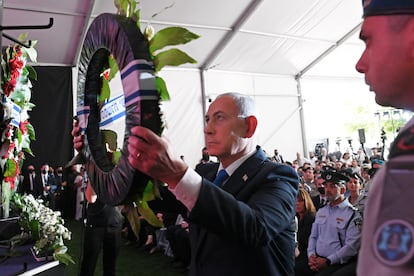

Benjamin Netanyahu used an official event commemorating the victims of the Hamas-led October 7, 2023 attacks (held on Monday, according to the Hebrew calendar date) to accuse the world of spreading “blood libels” about Israeli actions in Gaza.
Suddenly, Yaakov Godo, who that day lost his son Tom (killed by Israeli fire, as was determined two years later), approached and interrupted the speech: “You didn’t protect my son on October 7th; you didn’t protect 1,200 victims murdered in one day. Shame, disgrace!”
— “Sabine Tassa, of Netiv HaAsara, lost...” Netanyahu tried to continue.
— “I lost someone too,” the father replied, wearing a T-shirt bearing a photo of his son.
The scene reflected how the deadliest day in Israel’s history (with more than 1,200 people killed) and its greatest security failure — only comparable to the surprise at the start of the Yom Kippur War in 1973 — continues to shape the national debate three years on.
Television, radio, and newspapers have spent days recalling stories of heroism, loss, and pain from that day, which left the country in a state of shock and sharply accelerated a two-decade shift: toward the right, toward religion, toward the dehumanization of Palestinians and the normalization of genocidal rhetoric and support for ethnic cleansing, even among the country’s own Arab minority.
Over these past three years, the Middle East has taken a violent turn. Scenarios once considered unlikely, such as a direct confrontation between Iran and Israel (which had been fighting a shadow war through third countries, cyberattacks, and covert operations), have materialized up to four times — especially last February.
The weakening of Hezbollah, after Mossad detonated thousands of explosive charges in pagers the Lebanese militia had ordered, contributed to the fall of Bashar al-Assad’s regime and the end of nearly 14 years of civil war. Israel now faces an open genocide case at the Hague and a prime minister subject to an arrest warrant from the International Criminal Court for alleged war crimes and crimes against humanity in Gaza, where it has not achieved its stated objective: Hamas still controls more than 40% of the Strip.
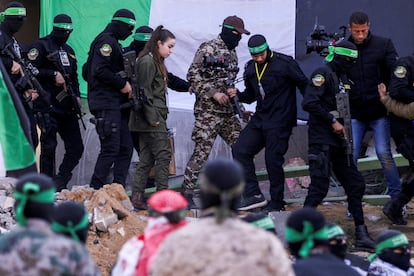
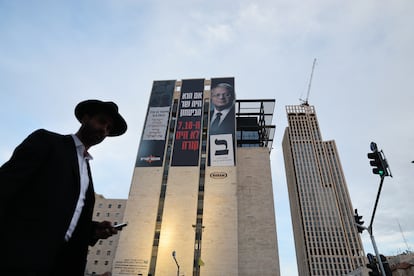
However, the central issue in the imminent elections is not the present. The vote on October 27 is, above all, about October 7, 2023 and Benjamin Netanyahu’s political responsibility. Even the far-right minister Itamar Ben-Gvir uses it for campaigning. He has put up a billboard in Tel Aviv bearing his face and the words: “If he had been defense minister [the post he has already said he wants], October 7 would not have happened.” In fact, on that day he was minister of national security, the post that oversees the police.
The symbolism of both dates falling in the same month is not lost on many. An online campaign against Netanyahu displays the date 7.10 in blood-red with a 2 added at the front, set against a background of graves and the caption: “The Day of the Fallen.”
“If they had woken me”
Netanyahu is the only senior political or military leader from that day who has not resigned or offered self-criticism. He generally retreats to a vague reference to collective responsibility before promoting the theory that security officials did not wake him that morning because they feared the response he would order. “If they had woken me up, everything would have looked different,” he has said. Unlike then–prime minister Golda Meir (who resigned over the Yom Kippur failure, even though a commission absolved her of direct responsibility), Netanyahu remains in power, is standing for re-election, and has spent the past three years blocking an independent commission from investigating the security errors.
“When he chose the election date — and many advised him not to hold them in October — he did so because he thought the impact of the massacre would have diminished, that three years had passed and everyone’s positions would already be set,” but “the question of responsibility for what happened on October 7 remains a deeply felt issue for Israeli society,” political commentator Daphna Liel of Israeli national television Channel 12 analyzed on Sunday. “The significant point is that public opinion is still finalizing its position.”
Today, according to a poll released Tuesday by that channel, 65% of Israelis consider Netanyahu “largely” responsible — with another 22% saying “to some extent” — for the October 7 security failures, driven by an arrogant strategic view toward the Palestinians focused on managing the conflict rather than resolving it. Warnings from the United Arab Emirates and Egypt were ignored, about 100 soldiers on the Gaza border were relocated days earlier to the West Bank (where settler violence had been increasing), and military commanders treated warnings from female soldiers in control towers with chauvinistic condescension.
Pollsters asked voters in Netanyahu’s coalition — among his party, Likud, the far right, and the ultra-Orthodox — whether “the failure of October 7 and its repercussions” had made them reconsider voting for them. Thirty-three percent said “to a large extent,” 22% “to some extent,” and 41% “not at all.”
Instead of a commission of inquiry, Netanyahu proposes vengeance. After the October 7 attacks, the Israeli security agency, Shin Bet, and Mossad, the intelligence agency, formed a special unit called Nili (an acronym drawn from a biblical verse) dedicated to tracking down and killing anyone who had entered Israel that day. When its creation leaked a month after the attack, reports said it would target roughly 2,500 members of the Nukhba forces, Hamas’s most highly trained units who led the assault. The plan resembled Mossad’s international campaign to kill the Palestinians responsible for the murder of 11 Israeli athletes at the 1972 Munich Olympics.
Last Sunday, according to a leak of a political-security cabinet meeting, the head of the army’s Intelligence Directorate, Shlomi Binder, said they have already killed about 4,000 of the 6,000 Gazans who crossed into Israeli territory on October 7. As can be seen in videos from that day, not all were militants: some were civilians celebrating the attack or the breaching of the border barrier, or taking advantage to loot.
“Anyone who was involved in the attack against us, anyone who held our hostages, has their days numbered. We will find them, as we found others. Day after day, we settle accounts with these despicable murderers,” Netanyahu said Monday in his speech.
National security
Gayil Talshir, an expert on Israeli politics at the Hebrew University of Jerusalem who has extensively studied the Netanyahu era, explains that the prime minister is trying to make national security “the main issue of the elections,” even though, a priori, it would be a weak point for him: the surprise attack occurred during his term and had been enabled by a policy that kept Hamas in power in Gaza to fragment Palestinians geographically and politically and weaken the Palestinian Authority, so Israel would not have to negotiate the creation of a Palestinian state. “His narrative is that Israel managed to regroup after the attack, wage a war with Iran alongside the U.S., and, basically, change the situation, with the army controlling security zones in Syria, Lebanon, and Gaza,” Talshir says by phone.
He illustrated it last month in a speech to a half-empty UN General Assembly: “We didn’t collapse. Instead, we rose and fought like lions.”
That animal, recovering from its wounds in Netanyahu’s metaphor, is today the worst-rated country in the world, with an average perception score of minus 24 — five points below the next two on the list: North Korea and Afghanistan, according to the Democratic Perception Index released in May by global public-opinion analyst Nira Data.
It is visible daily across cultural and sporting spheres. The most recent example: the return leg of a UEFA Nations League fixture in Serbia between Israel and Ireland. Irish players (from one of the EU’s most pro-Palestine countries) wore black armbands for the more than 74,000 dead in Gaza and bowed their heads when the opposing anthem played.
UEFA is investigating whether an Israeli player spat at the Irish coaching staff during halftime. The press conference ended in chaos: they abruptly removed the microphone from an Israeli journalist after he claimed an Irish player called the opponents “monkeys.” Another Israeli reporter asked Ireland coach Heimir Hallgrímsson why “they support people” whose “ideology is based on murder.” Hallgrimsson is calling for the two teams never to be drawn against each other again, as happens with teams from countries at war, past or present — such as Russia and Ukraine; Armenia and Azerbaijan (over Nagorno-Karabakh); or Serbia and Kosovo.
Sign up for our weekly newsletter to get more English-language news coverage from EL PAÍS USA Edition









































