
Authorities fear death toll will rise in Nepal and Tibet after severe flash flooding
Rescue teams are still unable to reach some of the hardest-hit areas after a massive landslide that sent an avalanche of ice and rock down the Lhende River
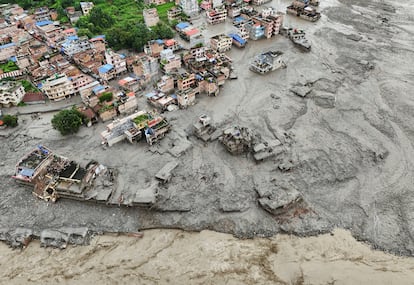

The world woke up this Thursday with its eyes on Nepal after a violent flash flood on Wednesday morning left at least 330 people dead in the Himalayan country, wedged between India and China, according to the latest police tally cited by the BBC. There are also at least three other fatalities in Tibet. The main provisional lists of people who have not yet been contacted include more than 1,468 names on both sides of the border, including almost 800 foreign nationals, as well as members of the security forces, customs officials, and workers at various hydroelectric projects. While rescue teams struggle to make their way along destroyed roads and international experts attempt to determine exactly what happened, satellite imagery is already helping to reconstruct the possible cause of the disaster.
In Nepal alone, the number of people unaccounted for stands at 910, most of whom are travelers. The Nepal Tourism Board has raised the number of people with whom contact has not been established to 644; 517 of them are foreigners from 32 different countries. On the Chinese side, authorities have raised the number of people unaccounted for to 558, including 260 foreign nationals. The Chinese Foreign Ministry has stated that Beijing and Kathmandu are “cooperating closely in search and rescue efforts.”
“The death toll will rise, because we have resumed the search and expect to recover more bodies,” Nepalese police spokesman Abi Narayan Kafle told Reuters. Thirty-three people are receiving treatment, according to the Nepalese police.
Other official Nepalese reports indicate that contact has not been established with 85 members of the country’s security forces, 15 customs officials, and 60 workers on hydroelectric projects.
Authorities have not clarified whether there may be overlaps on the two lists. This is particularly true in the case of foreigners who were crossing the border. All tallies are still being verified and may include people who are safe but cut off from communication due to road, electricity, and telephone outages.
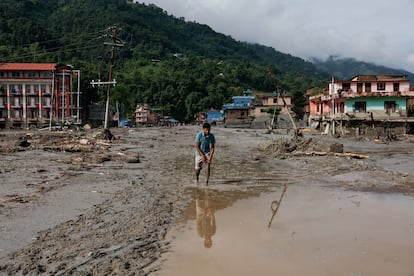
Nepalese police reported at 5.00 a.m. local time this Thursday that bodies had already been found in eight districts, in some cases carried tens of miles downstream. Operations resumed with 15 helicopters (seven military and eight private) after 97 people were airlifted on the first day. The injured will be initially treated at medical posts set up in Dhunche and Bidur, while serious cases will be transferred to Kathmandu. Helicopters have also begun distributing tents, food and other emergency supplies provided by India to the hardest-hit districts, the Nepalese army said.
Massive landslide
Seismographs detected a strong signal in the Himalaya — the world’s highest mountain range and home of Mount Everest — at 8.37 a.m. on Wednesday. It was initially identified as a 4.4 magnitude earthquake, but the United States Geological Survey later reclassified it as the seismic trace of a gigantic landslide. Seven minutes later, according to the recordings’ time stamps, a huge mass of water, mud and rock struck the Gyirong Tibetan border crossing.
Satellite images from Planet Labs, analyzed by experts cited by Reuters, place the origin of the catastrophe on the Nepalese side of the border. A substantial section of a glacier front detached at about 5,200 meters altitude and fell roughly 1,200 meters to the valley floor. The avalanche of ice and rock hit the Lhende River and sent a massive flow of water, mud, and sediment downstream that first devastated the Gyirong border crossing on the Tibetan side and then swept down into Nepal, destroying numerous towns and infrastructure.
Security camera footage from the Chinese side of the border, verified by Reuters, shows the scale of what happened. The images show dozens of people running to safety seconds before a wall of water, mud, and rock surged into the border crossing, overturning buses and other vehicles, engulfing a government building and destroying bridges and warehouses. Those scenes, together with the hundreds reported missing and the fact that rescue teams still cannot reach some of the hardest-hit areas, raise fears that the death toll could rise considerably.
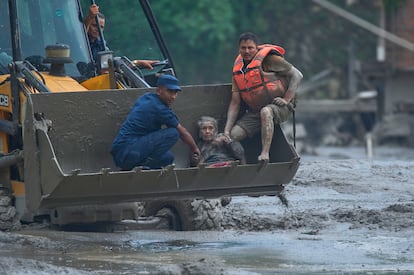
In the early hours in China, the state news agency Xinhua acknowledged that rescuers had still not managed to reach the core of the devastated area in Gyirong as night fell. The current had completely destroyed the roadway, the river remained too swollen, and the rain increased the risk of further landslides and casualties among the emergency teams themselves. Police officers and firefighters were advancing with heavy machinery to open a provisional route, while telecommunications technicians deployed satellite phones and tried to restore service, Xinhua reported.
Chinese authorities said on Thursday that a dammed lake formed by the landslides was moving toward Gyirong port. They have not yet reported its volume or stability and are preparing observation posts to assess the danger of another surge. Nepal’s Flood Forecasting Division, however, says there is currently no sign of another large imminent flood in Rasuwa or Nuwakot, although it remains on alert and warns that rainfall could raise river levels.
China has carried out a preventive evacuation of 369 residents from four villages within a 14-kilometer (8.6-mile) radius of the border crossing. A plane carrying 111 members of the China International Search and Rescue Team landed at 8.26 a.m. local time at the Tibetan Dingri airport with search, communications and extraction equipment. Two military helicopters departed shortly before from Lhasa to survey the terrain and plan aerial rescue routes. A Chinese Wing Loong drone equipped with mobile base stations and satellite communications is also flying over the area, although it has not yet been confirmed that heavy teams have reached the heart of the border crossing.
Sign up for our weekly newsletter to get more English-language news coverage from EL PAÍS USA Edition









































