
Families of victims abducted from Canadian-owned mine in Mexico criticize company’s inaction
In an interview with EL PAÍS, Priscila Murrieta and Alan Esparza – relatives of the miners who disappeared back in January in the mountains of Sinaloa – reveal new information about what happened to their loved ones
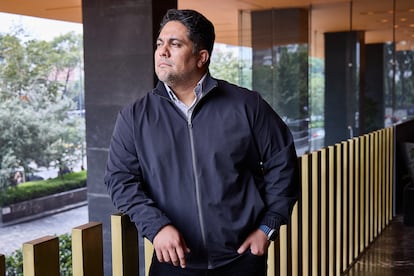

It was all thanks to a small metal screw – an orthodontic mini-screw, to be precise – that was placed in the jawbone underneath José Antonio Jiménez’s gums. His wife, Priscila Murrieta, waited in the hallways of the Attorney General’s office in Mazatlán, a city in the south of the Mexican state of Sinaloa. Meanwhile, the forensic dentist went in and out of a room. Of the bodies recovered from the mass graves in the small town of El Verde, Jiménez could be one of them. With moles and tattoos ruled out, only two bodies remained with similar characteristics. Both of the victims wore braces on their teeth.
The dentist came out and asked Priscilla if her husband had a screw embedded in his gum. “When he told me that, I was like, ‘My God, it’s him!’” the woman remembers. Then, she went inside the room to examine him. She saw his mouth, the screw, two missing teeth... the horror.
Murrieta lived through that hell between February 7 and 8 of this year, spending hours upon hours at the Attorney General’s office, waiting her turn. It was a strange and awful situation. She didn’t want her turn to come.
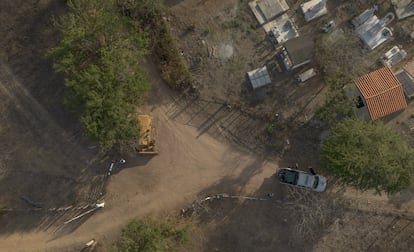
“They had to break his jaw to get a look at his teeth. And when you see that… how can you [believe that this] is your husband? Right? Because you remember him with his beard, with his eyes,” she sighs, in an interview with EL PAÍS. But Jiménez no longer had a beard, nor eyes. He no longer even had a nose. On January 23, criminals had taken him from a house – which the company he worked for had rented – in Concordia, a city in the mountains of Sinaloa. Then, they killed him and threw him in a pit. The decomposition process was rapid. When the authorities found him, time had taken a toll on his body.
Nine other men suffered the same fate as Jiménez. And all but one were employees or contractors at Vizsla Silver’s mine. They all lived in Concordia. The Canadian company had been working in the area for years, trying to find silver veins. Jiménez was in charge of “asset protection” for the mining company, which outsourced this work to a subsidiary. The others had various jobs, working in everything from security to community relations.
One of the 11 missing men was grabbed in the middle of the street while he was waiting for the bus. His body was also found in El Verde. And, of the 11, only one remains missing: 68-year-old Francisco Antonio Esparza, an engineer and geologist.
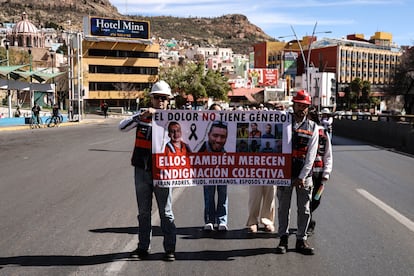
Murrieta reviewed the details of the case at the start of October, in Mexico City, along with Esparza’s son, Alan. The two of them, along with five other families, have launched a protest campaign. They’re challenging the slow pace of the investigations into what happened, as well as the lack of support from Vizsla Silver and its legal entity in Mexico, Minera Canam.
Over the past few months, the mining company has offered two “solidarity support payment” agreements to the nine families of the workers whose bodies were found in the mass graves in El Verde. One was a severance pay, Alan Esparza explains, while the other was due to the “tragic circumstances of death as a result of a criminal act.” A total of $42,000 per family… $42,000 for a life.
Both Murrieta and Esparza criticize the fact that they don’t even know exactly what happened on January 23, the day of the incident. They do, however, offer a crucial detail that was previously unknown: the criminals — suspected members of Los Chapitos, a faction of the Sinaloa Cartel — abducted the workers from two different houses. When the men’s disappearance became known, it was only reported that the criminals had taken them from their work camp, located in a residential complex in Concordia known as Las Clementinas.
The sight of the criminals entering the houses and kidnapping the workers made it difficult to understand the motive. Were the criminals specifically targeting them? Or was it a coincidence? The fact that they were taken from two different houses suggests the former.
Still, it remains unclear why the criminals took the young man who was waiting for the bus on the street: what did he have to do with the others? Everything happened at roughly the same time, between 7:00 and 7:30 a.m., on January 23. The criminals went to one location, then another. And, at one point, they snatched the young man off the street. His name was Pablo Osorio; he was from the state of Oaxaca and worked as a civil engineer in Concordia. The cases are linked by the time and day of the disappearances, and because his body was also found in the mass graves of El Verde, the town near Concordia where almost all the others were buried.
Murrieta and Esparza point to another mystery: the reflective vests. Days after the abductions, the federal government pushed a particular version of events: that the criminals had targeted the workers because they mistook them for members of a rival cartel. It remains unclear whether the supposed rivals, like the workers, were wearing any kind of reflective vests – a possible form of camouflage.
“My husband told me that they were asked to change the color of the vests they were wearing,” Murrieta recalls. This was between December of 2025 and January of this year. The request, Esparza notes, supposedly came from the company. At first, the families didn’t pay much attention to it, but when their relatives were taken from them, it suddenly became a relevant detail.
Murrieta and Esparza have criticized the lack of support from Vizsla Silver, which hasn’t even reported the incidents to Mexican authorities. This is according to their lawyer, Odracir Espinoza.
EL PAÍS contacted the Canadian mining firm’s legal representative in Mexico, Joel González, to ask about this, about the recommendation to change the color of the work vests, as well as the amounts of money offered to the victims’ families. This newspaper also inquired about a matter that is causing the families great distress: the company’s alleged negligence.
“There were many documented safety incidents in the preceding months,” Esparza points out. “They even stopped operations in April of 2025. Why did they allow them to continue working?” he adds. González has not responded to the questions sent by EL PAÍS.
The situation in Concordia and across Sinaloa’s mountainous region in general — has been difficult for the past two years. Los Chapitos and another faction of the Sinaloa Cartel, Los Mayos, are embroiled in a war that has already left thousands of people dead or missing. Since early 2025, battles have become more frequent in the city of Mazatlán and in the state’s mountainous region, from Concordia to Rosario. The onslaught of criminal gangs linked to one faction or the other has swept through the community. This was the context that the Vizsla employees were working in.
“In September of 2025, my husband had to go rescue some drillers: they were trapped in the crossfire in the mountains,” Murrieta describes, “He’s not in charge of personnel security – only asset protection – but, out of empathy, he grabbed a paramedic and went to look for them,” she adds.
There have been many rumors about what happened to the miners: that it was a case of mistaken identity, that they were specifically targeted, that the mine was being extorted and wasn’t paying off the criminals… the list of theories goes on. But the truth is that, beyond the grim reality of what happened to the victims, it’s still unknown why they were taken in the first place… and why most of them were killed. This is yet another point of contention for the families.
Murrieta and Esparza are demanding progress in the investigation: they’re asking that the authorities give them regular updates. And they want Vizsla Silver to cooperate in the process. They’re demanding that the company hand over the security camera footage from the houses it rented for its workers and – if they’re available – provide statements from the employees responsible for maintaining those properties.
In early September, the government announced the arrest of two men in Sinaloa, linking them to these crimes. “But we don’t even know why or how they’re involved,” the two family members protest.
Sign up for our weekly newsletter to get more English-language news coverage from EL PAÍS USA Edition









































