
The best strategy against superbugs: Wait 48 hours before taking antibiotics, and only use them if symptoms worsen
Spain’s Health Ministry and regional governments are promoting delayed prescribing for respiratory infections, a safe strategy to curb antibiotic resistance that still faces resistance from patients
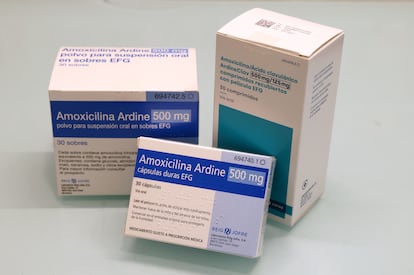

The so-called “delayed prescribing” is an evidence-based strategy that remains underused despite concerns over the misuse of antibiotics and the rise of superbugs, which are responsible for an estimated 1.2 million deaths worldwide each year. Under this approach, a doctor prescribes treatment for a patient with a respiratory infection but advises them to monitor their symptoms and wait up to 72 hours before collecting the medication from the pharmacy and starting the course.
If symptoms improve during that period, as is often the case with the viral infections behind most consultations, the patient avoids taking an unnecessary antibiotic. If symptoms persist or worsen, however, the patient already has the prescription they need and can begin treatment without having to schedule another appointment.
“It’s the most cost-effective measure that can be taken in primary care to reduce antimicrobial use and the problem of resistance. But implementing it is a challenge we still haven’t overcome,” said Antonio López, coordinator for Human Health at Spain’s National Plan against Antibiotic Resistance (PRAN), at the national congress of the General Council of Pharmaceutical Associations, held last week in Oviedo.
Patients’ reluctance, as well as time constraints, limited resources and training of some healthcare professionals, together with technical issues related to prescribing systems, have so far hampered the adoption of the approach in Spain. That is a situation that the Spanish Ministry of Health and the regional governments are now seeking to change. Two weeks ago, they set up a dedicated working group to address the issue, sources at the Spanish Agency of Medicines and Medical Devices (AEMPS) confirmed to EL PAÍS.
“We are going to work with the regions and health professions, including pharmacists, to see how we can implement delayed prescription,” said López. The decision follows other measures such as removing larger antibiotic pack sizes to prevent self-medication with leftover pills stored in households.
The rollout of this strategy is examined in a report by the Spanish Network of Health Technology Assessment Agencies and Services of the National Health System (RedETS), which highlights that “between 30% and 50% of prescriptions in Spain are estimated to be inappropriate.” The problem is concentrated in primary care: nine out of every 10 antibiotics are prescribed outside hospitals, and half are issued for respiratory infections, even though more than 90% of common conditions such as pharyngitis, laryngitis and sinusitis “are caused by viruses,” against which antibiotics are ineffective.
José María Molero, infections spokesperson for the Spanish Society of Family and Community Medicine (semFYC), points to a lack of public education as another cause. According to the 2022 Eurobarometer, “46% of Spaniards believe antibiotics cure infections caused by viruses” and “36% believe they are effective against colds.” For Molero, “those figures show that education about their use has not been addressed efficiently.”
“Patients want to get better as soon as possible,” adds Iván Espada, from the General Council of Pharmaceutical Associations. “From the pharmacy it’s hard to make them understand that fever or pain are symptoms of a virus and that an antibiotic won’t relieve.” Experts note that every unnecessary course of antibiotics not only fuels antimicrobial resistance, but also represents an inefficient use of public funds and can harm the gut microbiome.
Molero notes that physicians often sense that patients arrive at the consultation expecting to leave with a prescription, creating difficult situations when an antibiotic is not clinically indicated. Refusing to prescribe one “can undermine the doctor-patient relationship,” while prescribing it simply to avoid disappointing the patient means departing from good medical practice. “That same perception also makes delayed prescribing more difficult, because the doctor may think the patient will ignore the instructions and start taking the antibiotic from day one,” he says.
This is where pharmacists can play a particularly important role, Espada argues. “The responsibility for prescribing always lies with the doctor, but patients often have questions after leaving the consultation. In a process such as delayed prescribing, that will be even more common, so pharmacists can help them make the best decisions. If doctors and pharmacists deliver consistent messages, we will be able to move more quickly towards the appropriate use of antibiotics,” he says.
Where it has been implemented, delayed prescribing has delivered encouraging results. In the United Kingdom, the approach is well established and is used in nearly half of respiratory tract infections. The findings from the limited number of initiatives carried out in Spain have also been positive.
In 2023, for example, the Valencia region introduced a tool to support delayed prescribing and summarized the results in a press release as follows: “Among patients for whom delayed prescribing was used [...], only 35.02% of pediatric patients and 49.5% of adults ultimately needed antibiotic treatment, and antimicrobial consumption has decreased.”
12 randomized clinical trials
The RedETS report included a systematic review of 12 randomized clinical trials involving data from 3,750 patients. AEMPS cites this evidence in arguing that “delayed prescribing significantly reduces antibiotic use compared with immediate prescribing, without any meaningful differences in overall symptom control.”
On the downside, “pain and discomfort may be somewhat greater in the short term with delayed prescribing, particularly between the third and sixth day, but the duration of symptoms is similar with both approaches.” Even so, “patient satisfaction with delayed prescribing is comparable to that seen with immediate prescribing and higher than with no prescription at all.”
Another conclusion of the study is that “the rate of follow-up consultations is also similar across the different strategies” and that “no increase in complications or meaningful differences in adverse effects such as vomiting, diarrhea, or skin rashes were observed” when delayed prescribing was used.
The AEMPS emphasizes that delayed prescribing can be a “particularly useful tool in situations where there is uncertainty about the need for antibiotic treatment,” as it allows more time for the infection to evolve and for clinicians to assess whether antibiotics are actually required. This approach maintains patient safety while avoiding unnecessary antibiotic use.
To that end, a new working group bringing together all of Spain’s regions was launched in September to validate existing antibiotic-consumption indicators, assess the extent to which delayed prescribing has already been implemented across regional health services, and promote its adoption where it has not yet been fully integrated.
In parallel, Spain’s National Plan Against Antibiotic Resistance (PRAN) will roll out a series of initiatives to raise public awareness of the benefits of delayed prescribing. These efforts will complement its annual campaigns aimed at reminding the public that antibiotics are not a cure-all and should be used only when necessary, specifically to treat bacterial infections.
Sign up for our weekly newsletter to get more English-language news coverage from EL PAÍS USA Edition









































