
The investigation into ‘human safaris’ in Sarajevo: ‘We hope to identify some of those responsible’
A writer and two lawyers experienced in international cases are behind the case into Italians who allegedly paid to shoot civilians during the Bosnian War
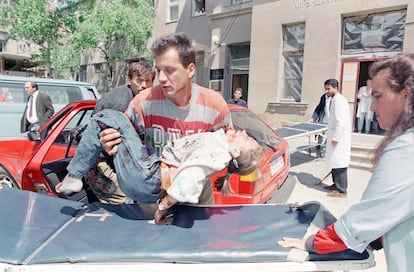

Milan’s Attorney General’s Office is moving to learn more about the alleged “human safaris” in Sarajevo, denounced in Italy by a writer and two prominent lawyers experienced in complex cases. It is suspected that during the Bosnian War in the 1990s, some Italians paid to travel to Sarajevo and shoot civilians from the hills controlled by Serb-Bosnian militias.
“We have submitted documentation full of evidence that warrants further investigation, which we have suggested to the court. We firmly believe that it can lead to the identification of at least some of those responsible for these horrendous crimes,” lawyer Nicola Brigida told EL PAÍS in a telephone conversation. He hopes that eventually the name of at least one suspect will emerge, which could speed up the investigation.
On Wednesday, new details emerged about one of the key sources cited in the complaint — a former Bosnian intelligence agent who is expected to be one of the main witnesses and will be called to testify. The ex-agent claims that in 1993, they informed Italy’s intelligence agency, then known as SISMI, about the existence of these organized trips.
“They replied two or three months later: ‘We’ve discovered that the safari departs from Trieste. We’ve stopped it, and there will be no more safaris,’” the former agent stated in his testimony, according to Italian media reports.
The route of these so-called “war tourists” began with a flight from Trieste, the Italian city near the Slovenian border, to Belgrade, and from there they traveled by road to Sarajevo.
After that, nothing more was heard about the matter. “We didn’t obtain the names of the hunters or the organizers from SISMI; there should be a SISMI document certifying this,” the source noted.
In other words, there could be classified information on the subject within Italian state archives. This raises a crucial question: why were no actions taken against these individuals at the time? One of the formal requests to Milan’s Attorney General’s Office is precisely to verify whether Italy still holds a copy of that documentation.
Brigida, who prefers not to provide further details about the case in order to let the investigators work, is one of the lawyers who drafted the complaint submitted to Milan’s Attorney General’s Office in July, which became public this week. He did so alongside former magistrate Guido Salvini, using material collected by journalist and writer Ezio Gavazzeni, who has been investigating this matter for years and subsequently sought their legal advice.
Brigida has extensive experience handling highly complex cases regarding missing Italians in Chile and Argentina. Specifically, he participated in trials against Admiral Emilio Massera and Generals Suárez Mason and José Antonio Rivera of the Argentine military junta, who were key figures during the dictatorship (1976-1983). And worked on cases involving Oscar Alfonso Podlech Michaud, a senior official under Pinochet’s dictatorship in Chile. He was also involved in cases concerning victims of Operation Condor, the coordinated campaign of repression carried out across South American dictatorships in the 1970s and 1980s, and attacks during Italy’s Years of Lead, such as the 1980 Bologna train station bombing.
The other lawyer, Guido Salvini, is a respected former magistrate, now practicing law, who in the past investigated highly secretive and dark networks, including Italian neofascist terrorism and the secret military network Gladio.
Given the cases he has handled throughout his career, Brigida admits that it is hard for him to be surprised: “This story has surprised me to a certain extent: after dealing with things like the death flights [in Argentina], nothing surprises me anymore.” He points out that the group in question is “a group of criminals” with a common profile: “Evil people, perhaps also ideologically motivated, passionate about weapons, who went to shooting ranges.”
The two lawyers have joined this difficult battle for the truth, which began with the submission of a 17-page complaint to Milan’s Attorney General’s Office, outlining a series of leads, clues, and potential witnesses to be interrogated — threads that Prosecutor Alessandro Gobbis, now in charge of the case, can follow up.
“Obviously, our report was considered well-founded and serious, and deserved to be verified and investigated. The [Milan] Attorney General’s Office has opened an investigation, which it has delegated to the anti-terrorism section of the ROS [Raggruppamento Operativo Speciale, a Carabinieri unit specializing in terrorism],” the lawyer explained.
“It was universally known”
This news has caused a stir in Italy, but the Italian writer and activist Adriano Sofri — who was in Sarajevo during the Bosnian War and sent reports to Italian newspapers — published an article on Wednesday in which he argues that the practice was “universally known.” Furthermore, he says the participants in this macabre activity were “enthusiastic and numerous.” In his article, he reproduced excerpts from his writings of the period in which he discusses it, such as this one from May 17, 1995:
“In Grbavica, where the Chetnik snipers [ultranationalist Serbian militia] and the international hunting participation do not hide — on the contrary, they are flaunted on [Radovan] Karadžić’s television — even when the target is children (smaller target, greater achievement for the shooter), there is also a Greek group and the remarkable case of a Japanese volunteer.”
Sofri notes that the Japanese volunteer explained to the Serb-Bosnian television that he had come to shoot in Sarajevo “because of a broken heart.” In the same article, Sofri said that one of the people who came to shoot civilians was the Serbian ultranationalist Vojislav Šešelj, who killed a passerby in front of cameras.
The Italian Attorney General’s Office, Brigida notes, is also obtaining the case files from various proceedings of the International Criminal Tribunal (ICTY) in The Hague for the crimes committed in the former Yugoslavia over the past decades. Some witness statements in those trials refer to these so-called war tourists. The former mayor of Sarajevo, Benjamina Karić, who held office from 2021 to 2024, has also sent a formal communication to the Milan court providing the information she has.
The case is still open, Brigida explains, because it concerns an extremely serious crime punishable by life imprisonment, which in Italy is never subject to a statute of limitations. “The Penal Code provides that even if the final stage of these crimes was committed in another country, Italian jurisdiction is maintained and prosecution can take place in Italy. Otherwise, a citizen could go abroad, commit horrific crimes, and then seek refuge in Italy with impunity,” he argued.
Sign up for our weekly newsletter to get more English-language news coverage from EL PAÍS USA Edition









































