
Family tragedy, the repression of Argentina’s military dictatorship and the delicate legacy hidden in ‘The Eternaut’
Martín Oesterheld is the grandson of the man who wrote the comic of the same name. He has led the Netflix series adaptation of the legendary graphic novel. The original creator of the series was disappeared during the Argentine military dictatorship, along with his four daughters and three sons-in-law
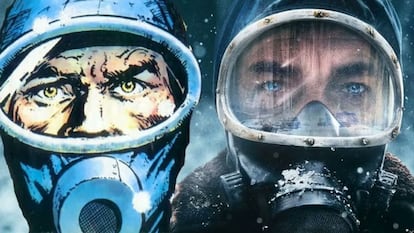

In secret, from phone booths, at the age of 58, screenwriter Héctor Germán Oesterheld — one of Latin America’s most famous creators thanks to (among other comics) El eternauta (The Eternaut) — dictated the installments of El eternauta II, so that cartoonist Francisco Solano López could progress with the work. This was before the writer was devoured by the repressive apparatus of the Argentine military dictatorship on April 27, 1977.
Héctor was allowed to say goodbye to his eldest grandson, Martín Mórtola Oesterheld. Just three years old, he became the last person in his family to see the comics legend. “I don’t remember my parents’ faces, but I do remember being with my grandfather, his physical contact,” Oesterheld explains to EL PAÍS in Madrid.
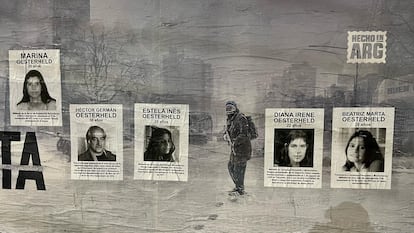
The military dictatorship had already murdered the screenwriter’s four daughters — aged between 19 and 25, two of them pregnant — and three of his sons-in-law. All were militants in the Montoneros resistance group.
Only Elsa Sánchez, the writer’s ex-wife, who took care of Martín, and another grandson, one-year-old Fernando — who was raised by his paternal grandparents — survived. The legacy of El eternauta was left in their hands. Since Sánchez’s death in 2015, Martín Oesterheld, 51, has cared for the work, while fighting for the comic’s reissue. After finding the original pages, he managed to bring an audiovisual adaptation to fruition in the form of a Netflix series. A second season has already been confirmed.

How does one handle such a legacy? How do you preserve a masterpiece, which is considered to be one of the great graphic novels of the 20th century, as well as the most influential comic in the Spanish language?
“By honoring it and understanding that it has very different interpretations,” Martín Oesterheld replies. “It was published in installments from 1957 to 1959 in the magazine Hora Cero Semanal (translated as “Zero Hour Weekly”) and it talked about what was happening at that time in Argentina. But it [also managed to touch on] other perspectives, because it talks about dictatorships… and that trauma even affected our own families two decades later. Or [it talks about] how the protagonists want to find their loved ones, with this transporting us to the disappeared… you can see it as a story of an alien invasion, [while also immersing] yourself in a more complex world.”
“In addition to being a work of adventure and science fiction,” he continues, “[the graphic novel] approaches these genres from a peripheral perspective — our own — which breaks with the preconceived idea that dystopias can only exist in New York or London.”
“With the premiere of the series,” he notes, “you have no idea how many kids are reading it. It’s a classic, to the extent that you can continue to reinterpret its meaning; it’s a transgenerational classic.”
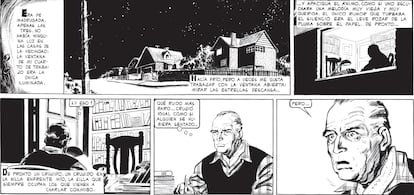
And, at the same time, El eternauta is pure Oesterheld. “My grandfather didn’t just decide that the protagonists would be Argentinians in Greater Buenos Aires; the house that belongs to the main character, Juan Salvo, was his own house in Beccar,” his grandson recalls, describing a town that’s north of the capital.
The word eternauta is a fusion of the Spanish words eternal and astronauta (astronaut). “That’s why some English-speaking critics don’t understand the reason behind [Juan Salvo’s nickname],” Martín smiles. “Luckily, with the recovery of the original pages from an Italian collector, we were finally able to properly publish [the comic] in the English-speaking market in 2015. That opened many doors for us.”
The original graphic novel — black-and-white, 350 pages long — underwent numerous changes and deletions in a 1961 reissue. Those tweaks have been reproduced ever since. In 2011, a new edition was printed, using the original material from the Italian collector. The comic was restored to its original splendor… except for 34 pages that remain missing.
Two more have surfaced since the Netflix series’ premiere: they were kept by the widow of a cartoonist “who was waiting to return them to an Oesterheld.”
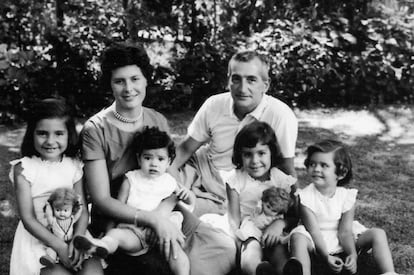
After a bomb attack on the garage at the house in Beccar, Elsa Sánchez took all of her ex-partner’s material home with her.
“There wasn’t a specific day when I decided to read El eternauta‚” Martín notes. “It was a continuum. I [leafed through] the books and notes that my grandmother had been able to rescue. And, when I grew up, my playground was that room at the back of the house, where my grandfather’s memory was kept. It was my point of contact with the past.”
Oesterheld recalls how a bookshelf collapsed from the sheer weight of the paper. “I began reading that pile of books. And, little by little, I became closer to my grandfather’s inner life: his knowledge of English literature, his relationship with [Jorge Luis] Borges…”
“My story intertwines the intimate, the private and the public. Those fallen books are private, while the public [part] is the echo of this carefully curated reissue and [the release of] the series. And the intimate: every March 24 (the National Day of Remembrance for Truth and Justice in Argentina) many people [go out onto the streets] with photos of their missing loved ones. I feel that’s more intimate.”
Obviously, he’s also seen the publicity for the series, which has been plastered with photos of his grandfather, his aunts, and his mother. “My grandmother was part of the Grandmothers of the Plaza de Mayo: she searched for those [missing] grandchildren, [trying to find out] if they existed, if they were born... I don’t want to get into it too much, but my grandmother was an essential force [in my life]. She endured all that pain and also cared for me with love.” Of the missing members of his family, only the body of the youngest, Beatriz, was ever recovered.
The journey to the big screen has also been long, fraught with troubles that Oesterheld — an audiovisual producer, who appears in the series as executive producer — and his wife, Laura Bruno, have overcome. He’s grateful to his colleagues on this journey, recalling Adán Aliaga — a Spaniard who made a documentary about his grandmother titled La mujer del eternauta (The Eternaut’s Wife, 2011) — and Lucrecia Martel, an Argentine director. “Somone else who approached me was Jeremy Renner. He was a huge fan, but he wanted to move the action [of the comic] to the U.S. and shoot it in English. There, we couldn’t compromise. On the other hand, Netflix understood.”
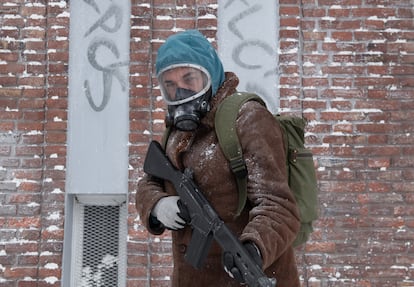
Martín Oesterheld takes responsibility for one of the main changes: bringing the story up to date. He explains: “I liked the concept of Juan Salvo as a survivor, driven by the logic of a second chance. And there’s the [Falklands War] generation, which has largely been ignored. When Salvo’s age was increased — and when Ricardo Darín came on board, [he being the] choice proposed by producer Matías Mosteirín and director Bruno Stagnaro — the whole puzzle fell into place.”
Sign up for our weekly newsletter to get more English-language news coverage from EL PAÍS USA Edition









































