
Abelardo de la Espriella authorizes US extradition of five cartel leaders
The president of Colombia green lights transfers that were suspended during negotiations with the government of Gustavo Petro
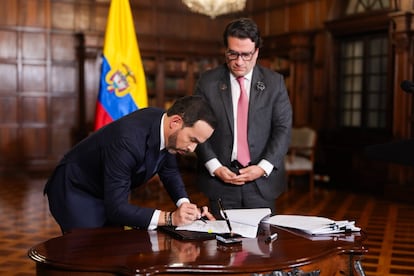

Colombian President Abelardo de la Espriella has ordered the extradition to the United States of five ringleaders of organized crime groups. Authorities in the country currently hold three of them in custody: Willington Henao Gutiérrez, known as “El Mocho Olmedo;” Carmen Evelio Castillo Carrillo, known as “Muñeca,” and Geovany Andrés Rojas, known as “Araña.” The decision also covers Fredy Castillo Carrillo, known as “Pinocho,” and Gabriel Yepes Mejía, known as “HH,” who are fugitives from justice.
“From day one I was clear: peace cannot be a refuge for criminals or a mechanism for impunity,” the new president wrote on X after announcing the extraditions on Wednesday evening from the San Carlos Palace, accompanied by Justice Minister Iván Cancino. The extraditions had already been approved by the Gustavo Petro government in 2025 but remained suspended because the criminal leaders were part of the negotiation tables of the former president’s total peace policy. Despite some progress, the previous administration failed to seal a final agreement with any of the armed groups in Colombia, and the new government has buried that possibility, just as De la Espriella had promised on the campaign trail.
Those to be extradited belong to different armed structures, all linked to drug-trafficking activities. El Mocho Olmedo is the second-in-command of the 33rd Front, one of the dissident groups of the now-defunct FARC guerrilla that operate under the umbrella known as the General Staff of Blocks and Fronts (EMBF); Muñeca and Pinocho have been members of the Sierra Nevada Self-Defense Forces (ACSN), a narco-paramilitary group that operates in the country’s north; while Yepes Mejía is the commander of the Southern Community Front (FCS), the ELN guerrilla’s dissident front in the Nariño department that was negotiating separately with the previous government. Petro decided to halt his extradition amid one of the negotiations that had garnered most progress, because the FCS surrendered hundreds of explosive devices and signed agreements to replace 5,000 hectares of illicit crops.
The then-president also stopped the extradition of Araña (Spider), whose surprise capture undermined the negotiation tables because it occurred as he was leaving a press conference at a Bogotá hotel in February 2025, under the promise that he was covered by the peace talks. Like Yepes Mejía, Araña is sought by a court in the Southern District of California (United States) on charges related to drug trafficking. His capture was seen as a betrayal, and the government criticized the Attorney General’s Office for carrying it out, arguing it sowed distrust in the other ongoing talks. “Extradition orders can be suspended if peace processes show significant progress,” Petro said at the time, as he sought to resist pressure from the administration of Donald Trump. De la Espriella, by contrast, has shown much greater alignment with U.S. government demands.
Sign up for our weekly newsletter to get more English-language news coverage from EL PAÍS USA Edition









































