
A Cold War 250 miles up: Mistrust between Russia and the US poisons the International Space Station
NASA ordered its astronauts to shelter in a capsule after Roscosmos unilaterally decided to repair an air leak. An incident that exposes a more dangerous fissure: lack of trust between Moscow and Washington
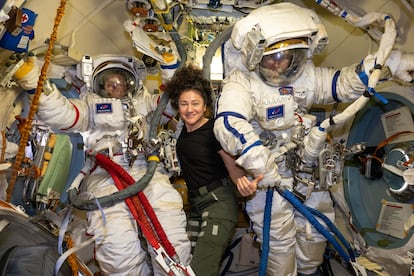
Jessica Meir and Jack Hathaway received a troubling call on June 5. It was 9.04 a.m. Eastern time when officials at Houston’s mission control issued precise orders. The call was not routine. NASA’s instructions were clear: the five astronauts under the agency’s purview aboard the International Space Station (ISS) were to don their pressure suits, move into the SpaceX Crew Dragon Freedom capsule, and prepare for a possible evacuation.
Houston activated a reinforced “safe haven” protocol, which involves preparing for a potential reentry to Earth: boarding the spacecraft that brought them to orbit, docked to the station, in case they need to flee to save their lives. Until now, on the rare occasions that protocol has been triggered, the threat was orbital debris, which travels fast enough that an impact with a module can cause a catastrophe. But this time the trigger was not an external danger, but distrust.
Meir and Hathaway are U.S. astronauts and, together with French astronaut Sophie Adenot of the European Space Agency (ESA) and Roscosmos cosmonaut Andrey Fedyaev, make up the crew of SpaceX Crew-12, currently assigned to the ISS, the large international laboratory orbiting about 250 miles above Earth. The orders also affected another U.S. astronaut, Chris Williams, who has been on the station for more than six months sharing the narrow orbital corridors with two other Russian cosmonauts.
The U.S. activated the protocol after an anomaly was detected in two air leaks during pressurization of the transfer chamber of the Russian service module Zvezda, which connects to the rest of the station’s Russian segments. Those cracks have been known since 2019 and, since 2024, the two powers have disagreed over the severity of the problem. But in recent weeks the amount of leaking air doubled, alerting engineers.
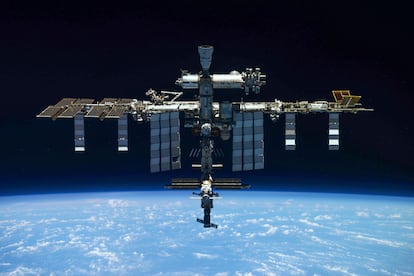
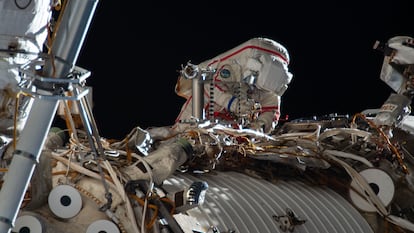
U.S. authorities raised the alarm when two Russian cosmonauts, Sergey Kud-Sverchkov and Sergei Mikayev, decided to repair the leak by sawing off a small metal bracket from the duct “to gain better access to an area for more detailed inspection” with the intention of sealing it later with a special biocomponent. The maneuver “could have increased the risk to the structure in that area,” NASA explained.
While the Russians worked on their part of the station, the U.S. astronauts sheltered in their own spacecraft: the United States did not agree with the decision and did not trust the outcome.
Meir, Hathaway and the rest of the astronauts remained in the Dragon module; they waited sealed inside for two hours with their suits on. When Roscosmos decided it would not cut any component and would, for now, apply sealant to one of the suspected leak points, NASA ordered them to return to their posts. “Roscosmos has paused Friday’s structural repair efforts inside the Zvezda service module transfer tunnel, known as PrK, as more measurements and data is assessed,” NASA spokesperson Bethany Stevens wrote on X. “We look forward to working with Roscosmos on a collaborative approach to address the leaks,” she added.
Roscosmos downplayed the incident. “The situation does not threaten the safety of the crew and onboard systems,” the Russian agency said Friday night. “The pressure on board the ISS is stable and maintained at the calculated level.”
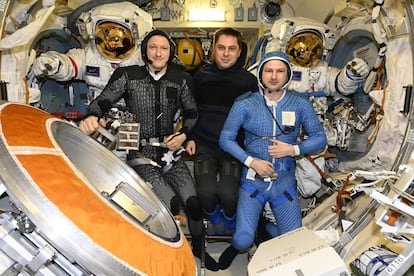
It was the most critical moment for U.S.-Russian coexistence in space since Vladimir Putin invaded Ukraine, which led to the cancellation of numerous joint space projects. But here, for the first time, mistrust between the two space powers erupted like a quarrel between roommates. They have four years left together until the planned decommissioning of the ISS in 2030, and, above all, everyone’s lives depend on maintaining the balance: it is cooperation by dependency, not by trust. The station operates as a hybrid system: Russia controls propulsion and the U.S. most systems, which makes it nearly impossible to separate the two segments of the station.
Although astronauts from both countries maintain close working relationships, the rift between space authorities seems to widen daily. Cultural differences, procedural disparities, and structural divisions become apparent when relations between the two nations cool. Moscow’s resources have been diminished since it attacked Kyiv in February 2022. Current tensions led Roscosmos to threaten to let the station fall over Europe, a structure the size of a football field. With weakened finances, Moscow’s priorities are no longer in space.
The change in the global geopolitical landscape is also drawing Russia closer to China, which has its own space agenda. Moscow has had to alter plans for its own platform, the Russian Orbital Station (ROS). When he announced it in 2015, President Putin emphasized that from the ISS you could see only 5% of Russia. “From our national station we will be able to see the entire territory of our vast country,” he said at the time.
Beyond the air-leak incident, the International Space Station’s days are numbered. Three years ago, the partners in the world’s largest space cooperation project (the United States, Japan, Canada, and the EU) agreed to extend the platform’s operations until 2030. Russia says it will leave the project a couple of years earlier, although it has threatened for years to withdraw sooner. The ISS has been continuously inhabited for nearly 27 years, but the recent incident nearly changed that history and hastened the end of Russian cooperation. The two-year gap between NASA’s and Roscosmos’s timelines is generating much debate. Russia’s disconnection from the ISS will not be easy because they maintain shared resources and joint operations that depend on them. Without their participation, the orbital infrastructure is likely to disappear or drift through space.
June 5 was not the first time a fissure caused concern on the orbital platform. A few weeks earlier a spaceflight that would have carried the first astronauts from India, Poland, and Hungary was postponed due to the leaks. Russia has never fully resolved this recurring problem, which has persisted for seven years, as Houston has repeatedly pointed out, insisting it risks worsening due to metal fatigue. NASA’s inspector general has called the condition of the Russian module “a first-order safety risk.” Several internal agency documents refer to “catastrophic failure” when describing successive incidents in the Russian module.
The Russian space agency first reported a leak in this module four years after its service life expired, in September 2019. It was never fully repaired: astronauts noticed it again in 2020 when they observed floating leaves from a tea bag, and in July 2025 Roscosmos’s deputy director of crewed programs, Sergey Krikalev, said the leak had decreased but not stopped entirely.
“If the country decides to extend the service life of the Russian segment of the International Space Station beyond 2025, a chain of failures in numerous components will be set off,” warned the former cosmonaut and Russian academic Vladimir Solovyov as early as 2020.
Choked by cutbacks, Russia’s current plan, or at least its “most likely scenario,” according to Roscosmos, is to use the ISS modules as an initial base, including the aged Zvezda, which by then will be 13 years past its service life. The agency plans for the first segment of the ROS to attach to the Russian portion of the platform and then separate before its planned decommissioning in 2028.
“This will ensure, among other things, the continuity of scientific experiments in orbit,” Krikalev said last year to justify this patch. Russian scientists aim to make use, above all, of the Nauka module, sent to the ISS in 2021 along with the European Robotic Arm.
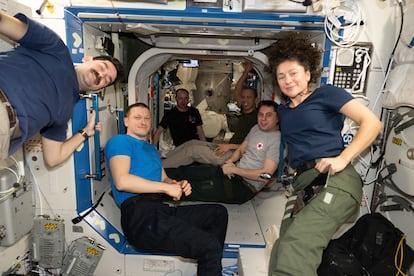
The ROS, the spiritual successor to Mir, is the Russian space agency’s last chance to reclaim the prestige it earned in Soviet times more than 35 years ago. A U.S. crew has just orbited the Moon, and China and India have both landed on the satellite, but Moscow’s return with the Luna-25 probe in 2023 ended in failure when it crashed on the lunar surface. That imbalance and the tense relations between the two countries leave seven astronauts sharing a cramped household in the worst possible scenario, where their lives depend on increasingly fraught cooperation.
Sign up for our weekly newsletter to get more English-language news coverage from EL PAÍS USA Edition









































