
Beaten and persecuted: The hell of three women who broke with the Mennonites in Argentina
María, Elizabet and Katherina are the only women to escape from the oldest Mennonite community in the South American country. Today, they are looking for ways to rebuild their lives and are seeking legal help to regain custody of their children
“This is the last trip. I ask for your forgiveness, but get me there quickly.” Elizabet Bueckert whispered these words to her chestnut horse at dusk on January 17, 2026. Her cart sped along the dirt roads of the Orthodox Mennonite colony of La Nueva Esperanza (“The New Hope”), in the rural Argentine province of La Pampa. That day, she had spent hours away from her husband’s house, sheltering with her two young daughters in a shed, attempting to avoid his insults. The 33-year-old woman decided that the moment she had fantasized about so many times had finally arrived.
She placed her girls María and Anna in the buggy. She filled a bag with clothes and some money that she had discreetly saved up. And, using the cell phone she secretly used, Elizabet texted her friend, Katherina Neufeld, to let her know that they were leaving. Her husband intercepted her as she left and tried to stop her by grabbing the horse’s reins, but the animal — swift (and a bit wild, like Elizabet) — responded to her command and broke free from the man’s grip with a sudden movement.
Elizabet and her two daughters made a quick stop at the workshop where Pedro was employed. He had asked her to delay their departure until he turned 18, so that he could also leave. Pedro didn’t hesitate: he got into the buggy with just the clothes on his back. They drove the wagon to Katherina’s house, where she had already called a car: she, too, was ready to leave, along with her four children, aged between five and nine: Pedro, María, Isaac and Agnetha. The three adults and six children then squeezed into the vehicle, with the driver speeding off into the orange horizon of the plains. Little blond heads peered out the back window; the dark fabric of the women’s dresses fluttered in the summer breeze.

The Mennonite community of La Nueva Esperanza, currently home to 1,948 people, began to be constructed in 1985, when a group of four Orthodox Christians traveled from Mexico to one of the most sparsely populated areas of the continent to survey the land. They were tasked with assessing whether the place was suitable for living according to the tenets of their faith. They wished to lead a life of sacrifice; one that would allow them to face divine judgement and be saved upon the end of the world, an event that’s always imminent in the community.
The Mennonites made a few non-negotiable demands of the Argentine government: they had to be allowed to speak their own language (a dialect of German so archaic that it’s no longer even spoken among German-speaking farmers in Europe), they had to be exempted from military service, and their children had to be able to stay home from school.
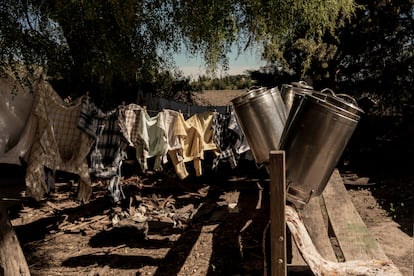
The Argentine government consented to the terms, in exchange for the Mennonites’ promise to revitalize the economy of the forgotten lands. And they kept their word. They bought an old 10,000-hectare ranch, cleared the forest that covered it and began to populate its plots with 120 families who had migrated from other Mennonite communities in Mexico and Bolivia. They cultivated the land and, after a drought that lasted several years, undertook their own industrial revolution: today, there are 140 metalworking shops that produce silos for the entire country, while employing local people. Trucks come and go, as do some Mennonites, who travel to neighboring towns in cars with drivers (since they’re not allowed to drive or own vehicles). The community isn’t enclosed by any wall, not even a gate, but the boundary is very clear. As are the rules about who is permitted to leave and who is not.


More than 40 years after that first informal agreement with the Argentine state, the community maintains its exceptional status. The Mennonites have tax benefits, while their children are educated by community members in the few subjects that interest them, such as mathematics, High German, Gothic literature and religious hymns. And La Nueva Esperanza has also been mostly ignored by the justice system, which, until now, has never closely examined the colony.
It’s well known that, when the Mennonites feel threatened, they abandon everything — even their dead — and pick up and leave. This is how they’ve migrated across the globe, from the Netherlands to Patagonia, managing to preserve the core of their culture since the 16th century. And, in La Pampa, nobody wants them to leave.
Up until January 17, 2026, when Elizabet and Katherina got into the car, only one woman had ever escaped from the colony. María Unger Reimer, now 34, was just 16 years old the first time she tried. She asked the woman who employed her at a neighboring dairy farm to advance her salary. With that small sum, she paid for a taxi that traveled 20 miles to the nearest town, Guatraché. The same driver took her to the home of an elderly couple, who rented her a room. But less than an hour later, she heard knocking at the door: it was the police, along with her brothers, who brought her back.
Upon returning to La Nueva Esperanza, she was severely punished: her parents tied her to a bench and beat her with a spoon on her toes. María vowed to adapt. After being baptized according to the maxims of the Anabaptist religion, she married another young man from the community and had two daughters: Agnetha and Elizabet. After another failed attempt to escape in 2017, she finally managed to leave for good in 2019: she departed with another Mennonite man for the province of Tucumán, more than 800 miles to the north, where they settled on the farm where they still live. The couple had a daughter together, named María Fernanda.

In the stories told by Elizabet, Katherina and María, certain elements (like their names) are repeated: violent childhoods marked by hard physical labor, men who drink heavily, abusive husbands, as well as the hostility of a community that closes ranks to punish anyone who shows signs of discomfort. All of these women have repeatedly endured the humiliation of having to stand in front of the men in church after Mass to ask forgiveness for their sins. These offenses include not wearing the headscarf properly, putting on a dress that has an “inappropriate” color, listening to music, or possessing a cell phone.
Sometimes, this seeking of forgiveness was deemed insufficient. And so, the men — all of them far more sinful than they are, the three women assert — would force them to remain silent for a week, without exchanging a single word with anyone.
The first night outside the colony, Katherina and Elizabet slept in a motel across from the central plaza of Macachín. They decided to go to that town, located more than 40 miles from the Mennonite community, because they had “a contact” there: a woman Pedro knew from work, but whose address and phone number they didn’t have.
Not many hours passed before a group of about 20 Mennonites found them and forcibly took Katherina’s two sons back to La Nueva Esperanza. A few weeks ago, they were finally returned to her by the courts, after more than two months away from their mother.
“My husband always treats me badly; he’s always angry with me and the boys. He hit me, he hit the boys. And I don’t like it when he hits the boys; they suffer a lot.”
Katherina, 30, speaks very basic Spanish. Her children climb the playground equipment and roll around the sandbox in a park in Santa Rosa, the capital of La Pampa province. Currently, they all live in a hotel room in this city, located about 110 miles from their hometown. The family receives some financial assistance from the local and provincial governments. A couple of weeks ago, the children began the process of integrating into school, an institution full of rules and unfamiliar vocabulary. Pedro, the oldest, should already be in fourth grade.

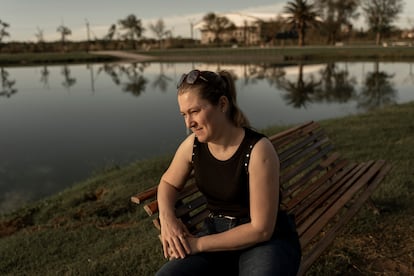


While the Mennonite men speak Spanish due to their work-related interactions with the outside world, it’s frowned upon for the women in the colony to show interest in the language or to interact with outsiders. “Whenever one of us opens up a little more, they’re already a bad person in the eyes [of the men]. A slut, a whore,” María summarizes. She’s also in the park with her daughter, María Fernanda. She came to this city from the province of Tucumán for a few days, in order to testify in the case that she initiated back in February. That was when she entered the community to pick up her daughters, who were visiting, and was beaten by her ex-husband. “I’m going to set you and the girls on fire,” was one of the many threats he shouted at her, drunk and enraged, in front of the children.
Although the girls were living with María in Tucumán for a while — and although she has obtained legal custody of them — her 15- and 12-year-old daughters are currently living in the colony. “The older one has a boyfriend and wants to stay. The younger one has been brainwashed,” she explains.
In the Mennonite settlement, many things are said about María: that she’s a bad woman, that she’s trouble, that she hasn’t taken care of her daughters. “They lie to cover up everything they do,” she asserts. “When someone says something, the whole community believes it and attacks that person. They lie so much that you even start to doubt [yourself].”
Since leaving the closed community, the three women have been under constant harassment. This comes in the form of text messages and social media, which members of the colony use even though it’s forbidden, but also in person. On Tuesday, April 21, a group of Mennonites arrived at the hotel where Katherina is staying and tried to force their way into her room. It’s located on the ground floor, just a few feet from the entrance. She locked the door and yelled at them to leave, while her children hid under the beds. Alone in an unfamiliar city, the only person she could turn to at that moment was her lawyer, Karina Alvarez Mendiara.
In recent weeks, the attorney has worked to secure the return of her children and María’s, while helping Katherina find cleaning jobs. She also buys fruit and medicine for the children. “These mothers did something that’s difficult to fully grasp: without resources, without a support network, and under enormous community pressure, they managed to escape a violent situation, seek help, and trust a professional and the justice system, even though their self-esteem and confidence were deeply damaged,” Alvarez Mendiara points out.
Elizabet’s daughters, ages 10 and six, were also taken from her. Shortly after escaping, she accepted her parents’ offer to take the girls to the colony for a couple of weeks, only because she didn’t have a job yet and was afraid that she wouldn’t be able to feed them. Her parents were supposed to return the girls, but they didn’t. Instead, they gave them to their father. “The girls are suffering a lot there; they miss me terribly. They’re down, feeling on edge,” she tries to explain in broken Spanish.
“This isn’t just another case of child abduction. The difference lies in the culture clash,” Martín Saravia says. The public defender of La Pampa, he’s handling Elizabet’s case. “Here we have someone, a woman who no longer consents to following the rules imposed by a certain culture. And cultural identity cannot be invoked to justify practices that violate rights.”
Saravia refers to the lack of education and social skills among the women of the community, This limits their chances of successfully integrating into the outside world. “There are women who don’t even know where they live in the world,” he sighs. And this is no metaphor: a simple conversation with a Mennonite woman can reveal, for example, that they don’t know that rivers flow into the sea, or that the Earth is round and has two ice caps at its poles.
The risk is that the escapees’ vulnerability will exacerbate their situation. The state may eventually take their children away and return them to the settlement if they’re unable to guarantee their basic needs, such as food and suitable home. Another major challenge for lawyers is how to enforce child support or divide assets in the event of a divorce. In the eyes of the state, the colony is an undefined entity, a single civil association that encompasses everything and everyone. Only the community’s internal records — where a system that’s as capitalist and unequal as the one outside operates — identify which property each member owns, what they do for a living, or how much money they make. EL PAÍS contacted the legal representative of the Nueva Esperanza Civil Association, who declined to comment.
According to Saravia, in this community, “identity is a burden imposed on women,” because for men, the rules are more flexible and they have access to greater resources. “That’s why they’re so desperate, constantly approaching and harassing the women to force them to return. There’s a sense of ownership,” he says, invoking a concept from feminist anthropologist Rita Segato, “of marking property and trying to take what they consider to be theirs.” The departures of men from the colony, which have occurred, haven’t provoked the same reaction.
Katherina is in the city of Santa Rosa. María lives in the province of Tucumán. And, for now, Elizabet has decided to stay in the town of Macachín.
While waiting to find something better, Elizabet pays a fortune for a small, unfurnished apartment, with no natural light. She works as a substitute cleaner at a butcher shop. The few days she spent with Pedro and her daughters outside the colony – before the girls were taken away – the four of them slept together on a mattress on the floor. “We were happy,” she recalls.
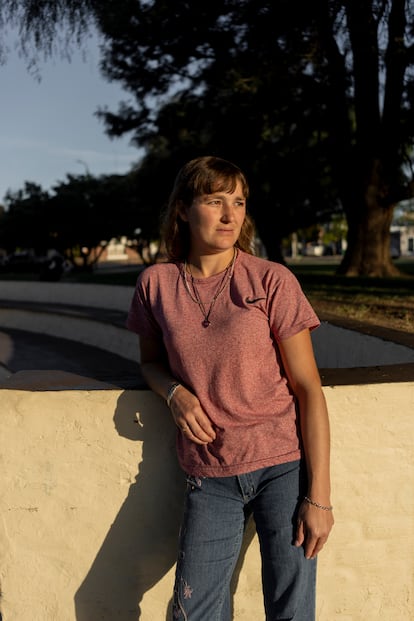
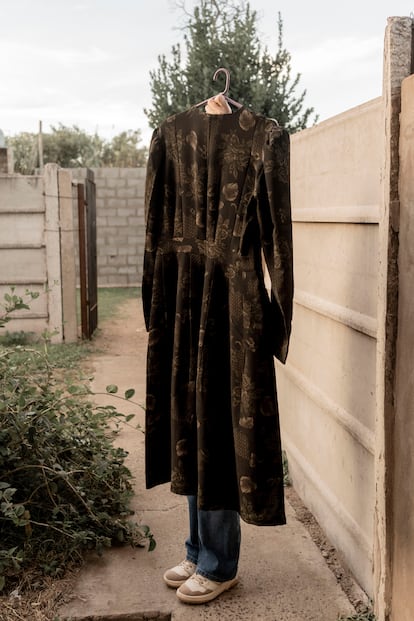
In the settlement, she had a comfortable life and a house that met the enviable Mennonite standards: interiors tiled from floor to ceiling. “But if love isn’t there, what good is it? [Material] things are useless,” she mutters, as she rummages through a bag to find the dress she last wore three months ago, on the afternoon when she left the colony in an overcrowded car. She sewed it herself; it’s black with flowers, long-sleeved and ankle-length. Today, dressed in jeans, a pink cotton t-shirt and sneakers, she holds it up: the reunion with the fabric that covered her for so long — day and night, winter and summer — makes her shake her head slightly. She stares at it, as if she were looking at a strange person or animal… as if she were hearing something it was saying or shouting at her. It brings back bitter memories.
Credits:
Sign up for our weekly newsletter to get more English-language news coverage from EL PAÍS USA Edition