
Estonia’s prime minister on Trump: ‘Even the strongest guys need friends’
Kristen Michal champions the EU’s predictability as a key asset in a chaotic world, and urges a lifetime ban on entry for Russian soldiers who fought in Ukraine
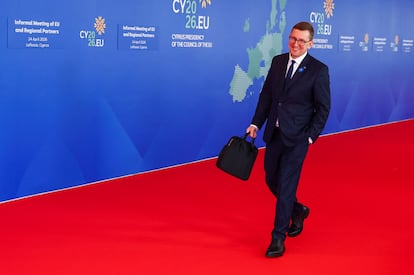

That the world has been spinning at double or triple speed since Donald Trump’s return to the White House is something that European leaders are well aware of. Just like the Estonian prime minister Kristen Michal, 50, they are all trying to maintain their composure and stay on course amidst Washington’s dangerous accelerations. Since the liberal politician sat down with EL PAÍS in Nicosia last Friday during the summit that brought together EU leaders for the first time since the start of Trump’s latest military adventure in the Middle East, the fragile truce with Iran is threatening to collapse, Washington has issued further threats against its European allies, and Trump himself has been the victim of another assassination attempt.
These are dizzying events that, nevertheless, reinforce Michal’s thesis: being “predictable” and even “boring” has become the EU’s best selling point to the world. And even a “strong guy” like Trump ends up needing friends.
Question. While you were meeting in Nicosia, it emerged that the Pentagon is looking for ways to “suspend” from NATO countries that, like Spain, have not allowed the United States to use their military bases for its war against Iran. This comes after Greenland’s annexation threats at the beginning of the year, and renewed questioning of Article 5, which governs the Alliance’s mutual defense. Is the U.S. still a reliable partner for European allies?
Answer. As prime minister, I take a practical approach: NATO is functioning absolutely well militarily. When Russian fighter jets violated our airspace, after NATO had first shot down drones in Polish airspace [in September 2025], Trump was quite clear in stating that he would protect Poland and the Baltic states and that he would shoot down Russian fighter jets if necessary. He was quite tough on Russia. It was a clear message. Article 5 has only been invoked once, by the U.S. [after the 9/11 attacks]. The only one who has needed to invoke it was the U.S. So I would say that even the strongest guys need friends.
Q. In Nicosia, Spanish Prime Minister Pedro Sánchez reiterated that Spain can meet its NATO obligations by spending 2.1% of GDP on defense, not the 5% set in The Hague. The Alliance’s Secretary General, Mark Rutte, doubts this. What’s your take?
A. If Spain says it can achieve this today with 2.1%, it’s up to Rutte and the SACEUR [Supreme Allied Commander Europe, always an American citizen, currently General Alexus Grynkewich] to comment. But what I can say is that in The Hague we agreed on 5%; 3.5% for pure defense, plus another 1.5%. In Estonia, this year in my government’s budget we already have net defense spending of 5.4%. Yes, we are a small country. And I understand the arguments. But it’s not easy for us either. This takes its toll on the government. It’s not popular. You have to raise taxes. But this is the only way to actively combat Russian influence, also the Russian threat to Europe, because we are the eastern flank of Europe, which means we also protect Europe from Russian threats and influence. And I hope all our allies see it this way too. That said, Spain has been a very valuable ally, for example, in defending us against various incursions into our airspace. I must thank Spain and Pedro [Sánchez] for that.
Q. Some say that this moment, when Trump needs Europe’s help, should be used to demand stronger commitments on NATO and Ukraine in return, or to demand that he withdraw his tariffs. Do you see it that way?
A. Europe is based on certain values, and that should make us happy. The important thing is that these aren’t transactional values, but rather values of what is right and wrong in defending personal freedoms and so on. They are values, not a transactional basis. Everyone can make transactions, but at certain times, for example, when Trump said he would impose tariffs on countries that supported Denmark in the Greenland issue, Europe responded firmly that there would also be tariff consequences. And that issue was dropped. So Europe can react. Honestly, I would say that we are not as weak as perhaps we were a couple of years ago. And if the world were reduced solely to a transactional level, it would be a sad world for values and for everything else.
Q. Faced with the chaos imposed by Trump, Europe is claiming to be predictable and reliable. Is being boring now a good thing?
A. Being a member of the EU means behaving predictably in front of the world. In times when the world is upside down, everything is chaos, being boring and predictable right now is the biggest currency.
Q. With the departure of Hungary’s Viktor Orbán after losing the elections, the EU should be even more boring and predictable. So, what now?
A. The fact that Orbán isn’t at the table is already noticeable, given the decision to approve the €90 billion loan for Ukraine and also the twentieth package of sanctions against Russia, while the twenty-first is already underway. Right now, we have a window of opportunity to make certain decisions in Europe; probably the next one will be about enlargement, because everyone knows we’ve been postponing certain decisions because of Hungary.
Q. But there are different views and several Member States have made it clear that for Ukraine there should be no shortcuts on its path to the EU.
A. Everyone expects Ukraine to implement the required reforms, but at the same time, there could be a fast track by saying yes, Ukraine’s future is absolutely in the EU, which is where they belong. And they want to be here. So, we could start by opening several chapters. We could begin with different forms of alliance. We will probably discuss this at the next council meetings, because the most important thing now is to seize this window of opportunity to begin the enlargement process. That is the most important thing, and from there, we will move forward.
Q. Estonia is pushing for the inclusion of a lifetime ban on entry to the Schengen Area for Russian soldiers who fought in Ukraine in the next sanctions package against Russia. We’re talking about more than a million people. Why is this important?
A. They’re not a regular army; they were criminals beforehand, people who should be in prison or receiving medical treatment. Inside Russia, they are celebrated as heroes, but Putin will try to get them to leave. And they’ll travel around Europe looking for exciting jobs and opportunities, they’ll settle down and do business and different kinds of crime. It’s like the TV ads say: Do you want these guys near your home? The answer is no, it’s a matter of national security. And if they enter Europe, there’s a good chance they’ll end up in Spain, where they already have a vacation community.
Sign up for our weekly newsletter to get more English-language news coverage from EL PAÍS USA Edition









































