
Peter Magyar, the man who admired Orbán and ended up bringing him down
The Hungarian lawyer mobilized an ideologically diverse majority that saw him as the only candidate able to end the system from within
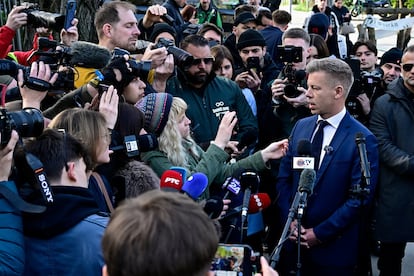

Péter Magyar used to admire Viktor Orbán. When he was young he had a poster of the ultraconservative Hungarian prime minister in his bedroom in Budapest. Later, he forged his social and political path within Fidesz, Orbán’s party. But two years ago, he broke away, exposed secrets of the party leadership, and began his meteoric political career. This Sunday, a social majority that is to a great extent ideologically opposed to him elected this 45-year-old lawyer to dismantle the stronghold built over 16 years by his former boss.
Magyar is a member of the elite. His father was a lawyer, his mother held prominent positions in the Supreme Court, and his sister is a judge. Ferenc Mádl, president of Hungary between 2000 and 2005, was his grandmother’s brother. And his grandfather was Pál Eross, a well-known television presenter who gave legal advice.
During a stay in Germany while studying law, he formed a close friendship with Gergely Gulyás. Today, Gulyás is Orbán’s chief of staff. While at university, he began dating Judit Varga. They got married in 2006 and lived in Brussels: she as a lawmaker for Fidesz in the European Parliament, he at Hungary’s Permanent Representation to the European Union. Magyar held several mid-level positions in Fidesz-controlled organizations, but never reached the top.
Orbán appointed Varga as Hungary’s EU minister in 2018, and between 2019 and 2023 she served as Minister of Justice. During her tenure, Magyar’s mother was appointed Vice President of the Judiciary. “A bit of nepotism,” remarks a person who shared three years of training with Magyar in the courts and who prefers to remain anonymous. “He liked to argue with the veteran judges, but he wasn’t anything special; I never would have thought he could go so far,” he adds.
Being a product of Fidesz has given Magyar credibility among voters to challenge Orbán. He knows the strategies, the tricks and the dirty secrets of the elite that has ruled the country with an iron fist for 16 years. Magyar operates similarly. He is strategic, he is controlling, and he carefully measures every step he and his associates take.
In a campaign video, he shared a Machiavellian plan to corner Viktor Orbán and his closest advisors—his former colleagues—in the European Parliament in 2024. He wanted to force the prime minister to do something he has never done with members of the opposition: shake his hand. He succeeded. Orbán’s surprise was evident.
In his campaign feature film released to the public today, Péter Magyar told the story of his famous EP shot in 2024 shaking hands with Viktor Orbán. pic.twitter.com/FdyCBORWL9
— Csaba Tóth 🇸🇴 (@tothcsabatibor) April 3, 2026
Magyar has expressed disdain for the traditional opposition parties. He preferred to form a new party rather than join any of them. Virtually all of the small parties that united in the 2022 elections to challenge Orbán’s electoral system, aware of their weakness individually, have withdrawn to clear the way for the candidate.
Tisza (an acronym for the Party of Respect and Freedom, and also the name of Hungary’s second most important river) is made up of activists from across the political spectrum. Magyar has assembled a team of specialists around him, including well-known figures such as foreign policy expert Anita Orbán (no relation to the prime minister) and former Shell executive István Kapitány.
Ideologically, Sunday’s winner is more like Fidesz than his own voters. Unlike the traditional opposition, he has reclaimed patriotic and ultraconservative symbols that Orbán had monopolized, such as the national flag, the anthem, and the motto “God, country, and family.” His surname, which means Hungarian, fits his nationalist profile.
He has actively avoided taking a stand on issues such as LGBTQ+ rights, but it is unlikely he will completely reverse Fidesz’s position. Nor on matters such as immigration. He is pro-European but simultaneously pro-sovereignty. He is not anti-Ukraine, although he will not actively support it either. He is not pro-Putin, and yet he will not sever ties with Russia.
Only 11% of his supporters identify as conservatives; 43% declare themselves liberal, and a third identify as left-wing or Green. Orbán is more popular than his party among his grassroots base. With Magyar, the opposite is true. Many of those who voted for him this Sunday reject his personality, his past, the violent machismo that his ex-wife has accused him of, and his way of relating to others. They are not convinced by his aggressiveness, his ideology, the control he exerts over the party, and his reactions to criticism. But at the same time, they believe that these traits are precisely what was needed to defeat Orbán.
He has already achieved that goal. Town by town, in a tireless campaign with up to six rallies a day, he has won the support of Hungarians to dismantle Orbán’s system. It wasn’t easy. The electoral system is designed down to the last detail to favor Fidesz.
Now he will have to use his legal skills to dismantle a corrupt system that shields the Orbán party’s pervasive power within institutions, the media, and the economy. How someone who rose through the ranks in Fidesz will govern the country and his party raises reasonable doubts among some analysts.
Sign up for our weekly newsletter to get more English-language news coverage from EL PAÍS USA Edition









































