
Amnesty International warns of escalating enforced disappearances in Venezuela
In a new report, the organization urges the world not to normalize the human rights crisis in the country
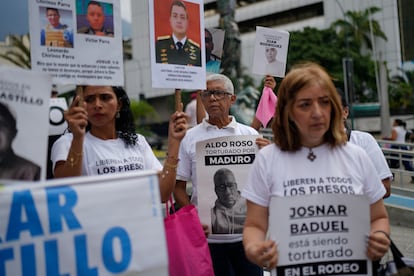

Amnesty International has warned that forced disappearances in Venezuela have escalated following the presidential elections on July 28, 2024, and have become part of a systematic pattern of persecution against government dissidents.
On Tuesday, Amnesty International Secretary General Agnès Callamard called for the International Criminal Court to advance investigations into crimes against humanity in the South American country, documented since 2014, and urged the international community to support the pursuit of justice through the use of universal jurisdiction in human rights cases, as Argentina has already done.
“The international community cannot normalize or ignore the human rights crisis in Venezuela,” said Callamard. “The scale and gravity of the crimes committed in the country — particularly the enforced disappearance of people — must stir the conscience of the world, and propel international justice into action.”
Callamard’s comments were made during the presentation of a report titled Detentions Without a trace: The Crime of Enforced Disappearance in Venezuela, which documents 15 cases of forced disappearances that occurred in the last year. Eleven of the victims remain missing, including six foreigners. According to Callamard, “the threshold of evidence has been reached to establish that crimes against humanity have been committed in Venezuela.”
Researcher Pilar Sanmartín detailed that the disappearances have occurred in the context of arbitrary detentions without judicial orders, targeting individuals critical of the government. “This practice not only exists but has escalated following the July 28 elections and involves the illegitimate deprivation of liberty, refusal to provide information about the person’s whereabouts and fate. It should be clarified that this does not depend on the duration, which can be hours, days, months, or extended over time.”
Journalist Rory Branker, editor of the online publication La Patilla, is one such case. He was detained by officials from Venezuela’s secret service (SEBIN) on February 20, and his family does not know where he is. The same has happened with lawyer Eduardo Torres, an activist from Venezuelan Program for Education and Action on Human Rights (Provea) and political prisoners’ defender, who was detained in May and held for several days without knowing where he was being held.
Regarding the foreigners, Amnesty International noted that there are various reasons for the enforced disappearances. “The detentions of foreign citizens appear to serve a dual purpose: to reinforce the official narrative of international conspiracies and to use them as bargaining chips in negotiations with other countries,” Sanmartín stated. “Although in many cases authorities accept the detention after some time, in all cases they hide the detainees’ whereabouts. The only certainty their families have is that the victim is in state custody, but without knowing their location, condition, or whether they are alive.”
She also accused the justice system of “covering up or facilitating” these human rights violations, which constitute international crimes, through actions such as the systematic denial of habeas corpus appeals filed by relatives.
For example, Sanmartín explained that on September 2, 2024, the families of Spanish tourists José María Basoa and Andrés Martínez Adasme lost contact with them. Twelve days later, Minister Diosdado Cabello confirmed their detention and accused them of being Spanish intelligence agents, although no evidence was presented. They remain missing.
Sanmartín also mentioned the case of Fabián Buglione, an Uruguayan citizen residing in the United States, who traveled to Venezuela last October to visit his partner. He was detained by military intelligence, and nine months later his whereabouts remain unknown.
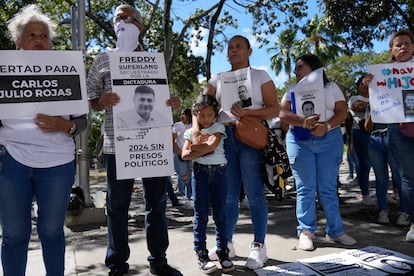
During the report’s presentation, Sophie Hunter, sister of Lucas Hunter, a French-American citizen detained in Venezuela in January, shared his story — most of which had remained unknown until now. Lucas, 37, a financial analyst residing in London, had traveled for vacation to Colombia, specifically to the La Guajira region, at the end of 2024 to practice kitesurfing. “He doesn’t speak Spanish, but he managed to tell me that he had approached the border area on a motorcycle and was arrested by Venezuelan soldiers,” said his sister, who noted that she had to stop working to focus on international lobbying efforts for her brother’s release, appealing to authorities in the United States, the United Kingdom, and with less success, the European Union.
Venezuelan activist Luis Carlos Díaz spoke during the presentation, calling for stronger support from states that have signed the Rome Statute to support the investigation being conducted by the International Criminal Court’s Prosecutor, as well as for the victims and their families. “We ask that there be no more hostage diplomacy,” Díaz said. “Those who are disappeared need to know that we haven’t thrown in the towel, and we continue to search for them.”
Sign up for our weekly newsletter to get more English-language news coverage from EL PAÍS USA Edition









































