
What Trump can’t stop: Renewable energy is growing and setting world records
Wind and solar power are expanding across the world’s major economies, as fossil-fuel consumption stagnates. Meanwhile, the US president derides wind turbines as ‘those damn things’
In his disjointed speech at the World Economic Forum in Switzerland, Donald Trump once again lashed out against renewable forms of energy, the European Union and its Green Deal, which aims to transform the energy and mobility system to break dependence on fossil fuels, the main cause of climate change. Trump, like the European far-right, dismissed the accord, calling it a “Green New Scam.” But the truth is that, despite his attacks, renewables continued to grow in 2025 and set records, while fossil fuel consumption for electricity generation stagnated.
The U.S. president, whose last campaign was funded in large part by the oil industry and who has a former fracking executive as his secretary of energy, used his appearance at Davos to urge the EU and the U.K. to abandon renewable energy via lies and insults. He lashed out harshly against wind turbines, with which he seems to be obsessed. “Those damn things,” he called them. “Stupid people buy them,” he said.
But renewable energy makes economic sense, particularly when it comes to European budgets. Implementation of renewables between 2019 (when the European Green Deal was first presented) and 2024 stands to save the 27 countries $70 billion in coal and gas import reductions alone, according to a report published a year ago by the Ember analyst group. The gas burned in Europe comes largely from the United States, which is the world’s leading producer of oil and gas. And the Trump administration has openly urged the EU to purchase more of its fuel.
But Europe, and a large part of the world, is going in the opposite direction, as shown by the first data available from the energy sector from last year. For example, for the first time, in 2025 wind and solar energy (including “those damn things”) generated more electricity in the European Union than fossil fuels, according to another report from Ember that was published a day after Trump spoke out against Europe and renewable energy at Davos.
Nic Fulghum, a senior analyst at Ember, explains that the speedy implementation of these technologies, particularly solar energy, “is bringing renewables to record levels” in all “the major economies.” According to his latest calculations, in 2025, the world’s generation of electricity via fossil fuels did not increase due in large part to the “record growth of solar energy.”
Fulghum and his peers predict — albeit based on data from November, with the final tally due to be presented in April — that renewable power capacity in 2025 will rise by 11% around the world. There has been a significant streak over the last three years. The annual growth of renewable power capacity was 22% in 2023, and 66% in 2022. Around 18% of the world’s electricity comes from panels and wind turbines, with a year-on-year growth of two points.
There’s a long, long way yet to go. And the world is well behind where it needs to be. But there have been undeniable advances: the market penetration of renewable energies is light years ahead of figures from a few decades ago. The total sum of solar, wind and hydro (another renewable source) broke a new record in 2024 “for the 23rd consecutive year,” said analysts from the International Energy Agency in its latest annual report, which was published at the end of 2025. “Renewables grow faster than any other major energy source in all scenarios, led by solar photovoltaic,” it added.
The study presented an interesting piece of information: 80% of global electricity consumption occurs in regions with “high-quality solar radiation.” Even oil-heavy states like Saudi Arabia are changing their energy mix, boosting photovoltaic generation and freeing up barrels of crude oil that are still burned today to generate electricity and can now be dedicated to the export market.
Rafael Salas, professor of economic analysis at the Complutense University of Madrid, says there’s no turning back from the path that will lead to higher prevalence of renewables and electric mobility, even though there may be delays along the way. Technological advances have simply made it impossible to compete with solar and wind power. “There is nothing that can be done against technological improvements,” he sums up.
Fulghum adds another factor to this reasoning: energy security, which has become a global priority since the 2022 crisis. Far from allaying fears about dependence “on coal, oil and gas imports” in many areas like Europe, China, Japan and Brazil, Trump’s return has fueled them. “There is concern about dependence on energy exports from U.S. sources, such as liquefied natural gas,” explains Fulghum. “Deploying renewables is the fastest way to avoid costly attachment to volatile global fossil markets.”
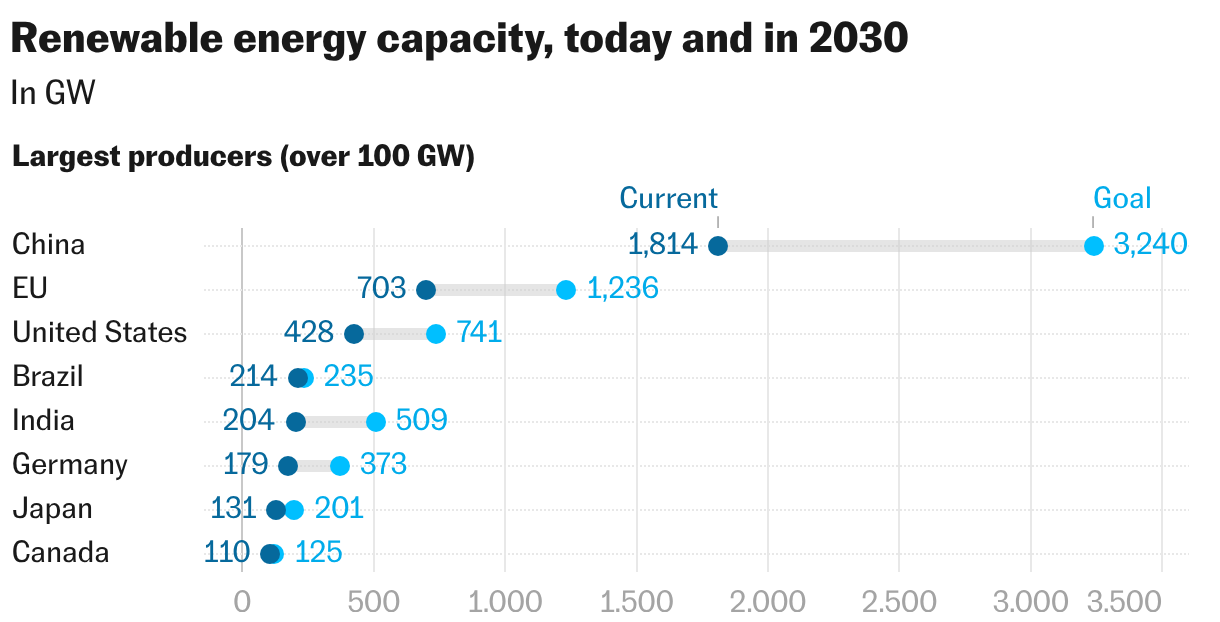
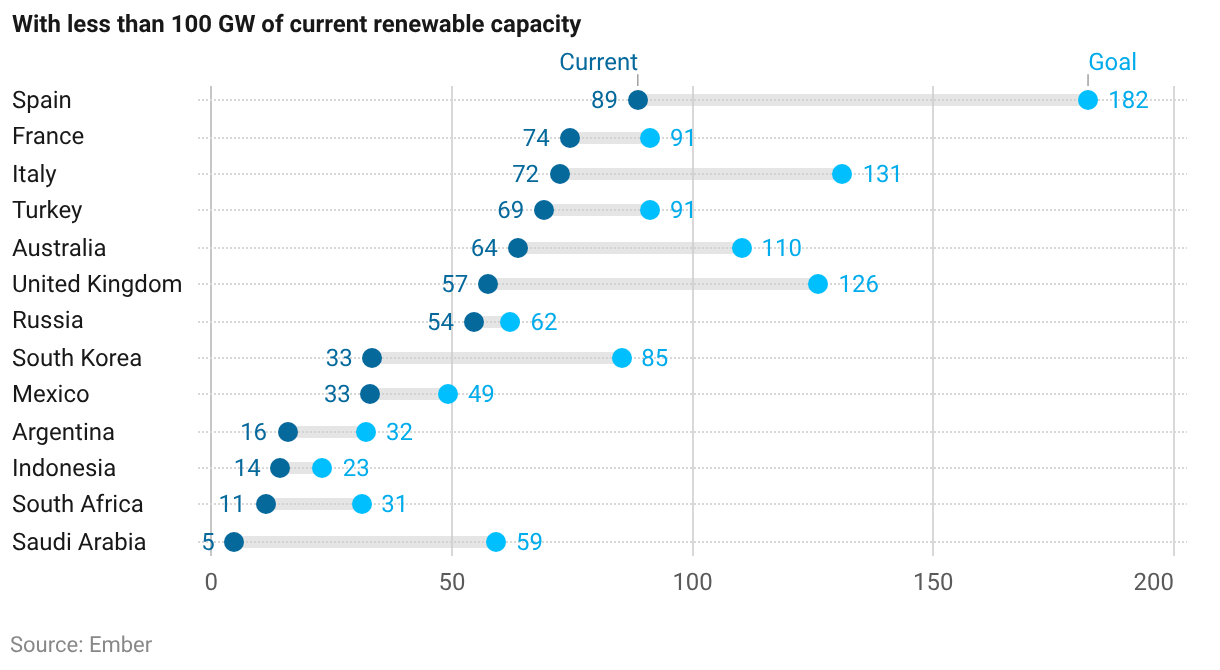
In all of this, China is playing a major role. Trump attacked the country at Davos, accusing it of selling wind turbines but not installing them in its own territory. Indeed, China is the leading exporter of wind (and solar) technology. But it is also the leader in wind turbine installation: almost half of the world’s wind power capacity is located there. And two-thirds of the panels and wind turbines installed worldwide are located in the country, according to the IEA. The same is true for electric mobility: China leads global sales within its own nation, while its exports are growing as U.S. manufacturers decline.
This is precisely why the journal Science criticized the Trump administration in its special issue that designated the global push for renewables as the most important scientific advance of 2025. The publication warned that the United States is not benefiting from “its own innovations.” That’s because a significant portion of the technology that has led to this growth in renewables around the world “was developed in the United States.” But it is China that has perfected and manufactured the technology. The country already supplies 80% of the world’s solar panels, 70% of wind turbines and 70% of lithium batteries.
But the U.S. federal government continues to bet on fossil fuels, with a special emphasis on petroleum, as can be seen by its recent actions in Venezuela. “Global demand for oil is destined to stall out and fall in the next decade,” warns Fulghum. “Increasing production will not reverse that trend, and will only further undermine the economic case for oil producers in a market on the verge of decline,” he adds. “In transportation and heating, the world is moving away from oil and toward electric vehicles and heat pumps.”
More coal in the United States, less in India and China
2025 was also the year in which, for the first time in half a century, coal-fired power generation fell in India and China — by 3% and 1.6% respectively — according to a recent analysis by the energy and climate outlet Carbon Brief. The explanation lies largely in the record rollout of renewables in the world’s two most populous countries.
Salas warns, however, that at the same time the United States saw a sharp increase — 13% year on year — in coal-fired power generation in 2025. Some analysts point to rising energy demand from data centers. But Fulghum adds that this was largely due to “a shift from gas to coal because of higher gas prices.” “Solar generation still covered most of the increase in demand in the United States in 2025, growing more than fossil fuels,” says the Ember analyst.
Sign up for our weekly newsletter to get more English-language news coverage from EL PAÍS USA Edition









































