
Arctic warming Trump dismisses reaches record highs, stoking interest in Greenland
In this region, which experienced the greatest temperature increase in 2025, ice loss has accelerated, exposing new shipping routes and resources

Climate change — which U.S. President Donald Trump calls the “greatest con job ever perpetrated in the world”— is precisely what is driving the push to gain control of Greenland, an ambition openly declared by Trump. Human-caused global warming is reaching record levels in the Arctic region. This triggers ice melt, opening new shipping routes that major powers want to control, as well as theoretically easier access to the island’s resources — minerals and fossil fuels.
The Arctic is warming faster than the rest of the planet — three to four times faster than the global average, explains Samantha Burgess, deputy director of the Copernicus Climate Change Service, part of the European Commission. Copernicus, in collaboration with several international agencies and the World Meteorological Organization (WMO), released its 2025 climate summary on Wednesday, showing that the year ended as the third-warmest on record since at least 1850, the point when humans began burning fossil fuels on a massive scale — the main driver of global warming.
The warmest year on record is 2024, followed by 2023. In other words, the last three years are the hottest ever recorded, further proof of the climate change Trump denies. While some factors have influenced the recent streak of hot years, Burgess clarifies that the main cause is the “record concentration of greenhouse gases in the atmosphere.”
It was at the last United Nations General Assembly, held in New York at the end of September, that Trump insisted that climate change was the “greatest con job ever perpetrated in the world.” Returning to falsehoods, he also claimed that the United Nation’s predictions had been “wrong.” The truth, however, is that the trajectory of global warming continues to follow the paths outlined by scientific models, and if anything, the members of the IPCC — the U.N.-linked international panel of experts — could be accused of underestimating their predictions.
When the Paris Agreement was signed in 2015, it was expected that the limit of 1.5 degrees Celsius of global temperature increase above preindustrial levels would be permanently exceeded in about 20 to 30 years. Now, Copernicus estimates that this could happen by the end of this decade — 10 years earlier than projected at the time of Paris. Burgess explains that this is because, when the Paris Agreement was finalized — which set the goal of keeping warming between 1.5 and 2 degrees — “it was expected that emissions would fall faster than we have observed over the past decade.” “That’s really the big difference,” the expert says.
According to data collected by Copernicus specialists, the global air temperature at the Earth’s surface in 2025 was 1.47 degrees Celsius above preindustrial levels. In 2024, the hottest year on record so far, it reached 1.6 degrees.

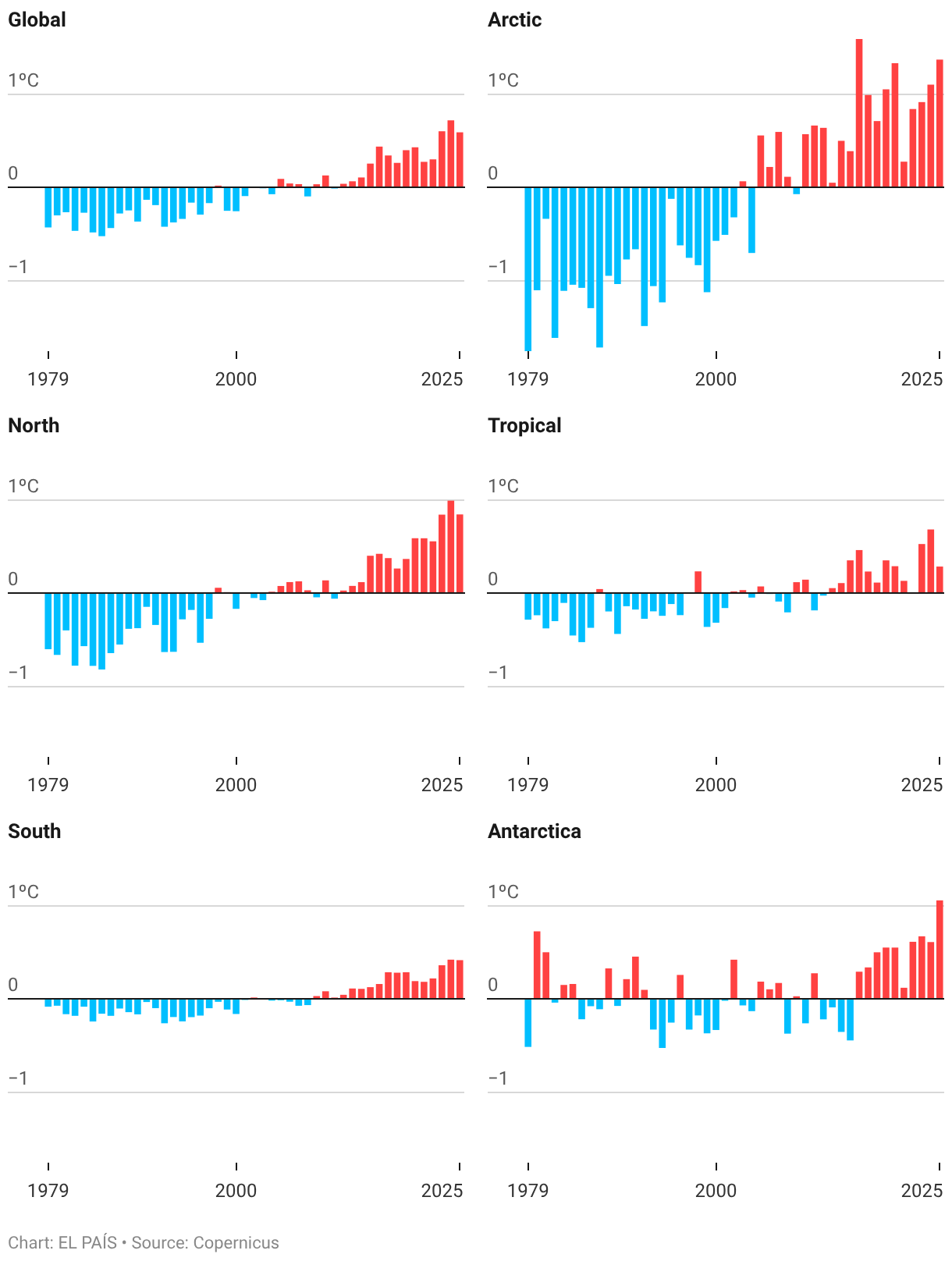
But when the planet is divided by latitude, what stands out is the accelerated rate of warming in the Arctic, where 2025 was the second-warmest year on record so far. This has direct effects on ice coverage. According to Copernicus, in 2025 the monthly extent of Arctic sea ice was the lowest ever recorded for that time of year in January, February, March, and December, and the second lowest in June and October. This reduction is what opens the new shipping routes that China, Russia, and the U.S. are eager to control — and which has led Trump to threaten to seize Greenland by force.

The rate of warming in the Arctic — taking the 60°N parallel as a reference — was again the highest in 2025 compared with the 1991–2020 baseline. The average temperature in that region was 1.37°C above normal, compared with 0.6°C for the planet as a whole. The second-highest anomaly was in the Antarctic region — between 60°S and 90°S — at 1.1°C. Burgess notes that this rapid ice loss has a “feedback effect,” because it increases the amount of heat absorbed by the land, which exacerbates the problem.
The Copernicus report, released on Wednesday, was produced in collaboration not only with the WMO but also with U.S. agencies such as NASA and NOAA, whose observational data from recent years have been essential for climate science. However, the Trump administration has launched a campaign of funding cuts, claiming that scientists contribute to “climate alarmism.” The latest step by the White House has been to announce that the U.S. is withdrawing from the IPCC.
Asked about these attacks on climate science, Florian Pappenberger, director general of the European Centre for Medium-Range Weather Forecasts, which runs Copernicus, said it is “worrying” that a problem could arise with the data, because “observations are essential for efforts to address the challenges of climate change and air quality.” He also noted that the new NOAA administrator, Neil Jacobs, has pledged not to delete the data collected so far on climate change. The question is: what might happen in the coming years, when global warming does not abate?
Sign up for our weekly newsletter to get more English-language news coverage from EL PAÍS USA Edition









































