
Trump’s legal dragnet closes in on Kilmar Abrego García
The US government has revived the idea of deporting the Salvadoran back to his country, where he previously suffered torture
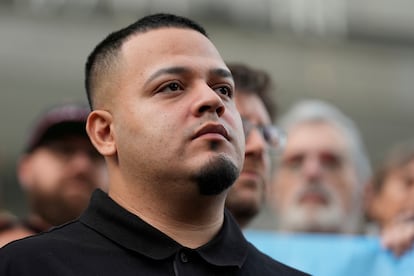

Kilmar Armando Abrego García has been held in a detention center in Virginia since August 25, and is facing a second deportation. The government has proposed two possible destinations for the Maryland resident — Uganda or, as revealed last week, El Salvador — both of which are far from ideal.
The latter was thought to be off the table, since it was the Central American country to which he was mistakenly sent last March. Court documents released Friday reveal that the Trump administration could repeat the operation.
The 30-year-old Salvadoran’s future will be decided by several legal cases. Media outlets, politicians, civil rights organizations, and much of the public are closely watching, as Abrego García has become a symbol of resistance against Donald Trump’s deportation policies.
His lawyers filed a lawsuit to guarantee his right to due process while his deportation case continues. Judge Paula Xinis of Maryland, who is overseeing the case, temporarily blocked a possible expulsion by ordering that Abrego remain in the United States until she rules on the petition, which is expected around mid-October. The judge also ordered that Abrego remain in ICE custody within 200 miles of the court in Greenbelt, Maryland.
Xinis is scheduled to hold a hearing, expected to include witness testimony, on October 6.
Human trafficking case
In parallel, Abrego García faces a criminal case in Tennessee for human trafficking, with a trial scheduled to begin in January. According to his attorneys, this case is a clear example of “vindictive and selective” persecution by the Trump administration. For months, the Republican administration has been engaged in a legal battle against the Maryland resident, one of its most criticized actions.
Abrego García’s case drew attention both inside and outside the United States after a federal official admitted that he was mistakenly deported to El Salvador on March 15, along with more than 250 migrants, mostly Venezuelans, accused of belonging to criminal gangs such as the Tren de Aragua. Last week, a federal judge declared the application of the 1798 Alien Enemies Act, which the government used to deport them, illegal.
Abrego García had been granted judicial protection in 2019, which protected him from deportation to El Salvador.
Since then, although the Trump administration acknowledged the error, it has worked to criminalize the Salvadoran to justify his detention, accusing him of belonging to the Salvadoran gang Mara Salvatrucha (MS-13). Abrego García and his lawyers have consistently denied any connection to the violent group, and the government has not provided evidence to support its claim.
Trump himself, along with Secretary of Security Kristi Noem, Attorney General Pam Bondi, and other high-ranking officials, described Abrego García as “a monster” who should remain outside the United States. The administration has defied court rulings, including from the Supreme Court, that ordered his return.
In June, the government yielded to pressure and brought Abrego García back to the United States — not before preparing a case to arrest him as soon as he landed on U.S. soil. The Salvadoran was taken into custody as he stepped off the plane and brought to a Tennessee prison, charged with human trafficking.
The criminal case is based on a 2022 traffic stop video in Tennessee recovered by the government. Abrego García was driving a vehicle carrying nine other people. Agents suspected it might involve smuggling undocumented migrants, since the passengers claimed to be traveling for work in Maryland but had no luggage. However, they were allowed to continue their journey.
Government lawyers claim it was one of many trips Abrego García allegedly made since 2016 as part of an illegal human transport network. He denies the accusation. Using this charge, the administration kept him detained until August 22, when he was released on parole. His release allowed him to return to Maryland to reunite with his wife, Jennifer Vasquez, and their three children (one his own, two from his wife’s previous relationship), from whom he had been separated for 160 days.

His freedom lasted only three days. Abrego García received a notice to appear for an immigration check, where, as his lawyers had anticipated, he was arrested again and taken to a detention center in Virginia, where he remains in custody.
The government entered negotiations with his lawyers to agree on a potential country of deportation. The possibility of Uganda — a country criticized for human rights abuses — is seen by his attorneys as a punishment for speaking out against U.S. anti-immigration policies.
Prosecutors and defense attorneys began confidential discussions about a potential plea deal in mid-July, according to court documents. Abrego García was only interested in an agreement that would allow him to be deported to a third Spanish-speaking country in North or Central America, such as Mexico, where he could live freely and safely after serving his sentence in the United States.
Working with the State Department, U.S. prosecutors secured Costa Rica’s promise that Abrego García would be welcomed there as a legal immigrant and not detained or sent back to El Salvador. According to his lawyers, the U.S. government demanded that he plead guilty to the human trafficking charges in order to be sent to Costa Rica, which Abrego García refused. As a result, the administration has expressed its intention to deport him to Uganda.
Recently revealed court documents show that the administration is now also considering sending him to El Salvador, where Abrego García previously endured torture while imprisoned at the Terrorist Confinement Center (Cecot), the maximum-security facility notorious for its deplorable conditions.
The possibility of being sent back to his home country, reported by The New York Times, has emerged in response to a new asylum application filed by his lawyers, another case currently pending in the courts.
A double-edged asylum request
The defense filed the request with the Baltimore immigration court in hopes of being granted asylum or having Abrego García’s deportation to Uganda suspended if an immigration judge determines that his life would be in credible danger in the African country.
According to the prosecution, because the application stems from Abrego García’s new entry into the United States, it could end the judicial protection he had since 2019 that prevented his transfer to El Salvador, which was ignored during his first deportation.
“Should the Immigration Court grant the respondent’s motion to reopen, the Department of Homeland Security will pursue the respondent’s removal to El Salvador,” the Trump administration argued in its filing. It added that the previous ruling “will no longer be valid” if the asylum case moves forward.
An immigration judge granted Abrego García protection in response to his first asylum request. At that time, the judge rejected the petition because it was filed after the one-year legal window following his entry, but still provided protection, ruling that he could face retaliation if returned to El Salvador.
Abrego García fled his country at age 16 due to pressure from the Barrio 18 criminal gang on his family. His mother, who ran a small homemade pupusa business, faced ongoing extortion, and gang members pressured him, as a teenager, to join. The repeated threats led his parents to send him to the United States, where his older brother had already fled.
Abrego García lived in Maryland with his wife and three children and worked as a metalworker. On the day of his detention, March 12, he was returning from picking up his child, who has special needs, when he was intercepted by immigration agents. Since then, except for three days, he has been in custody.
“President Trump is not going to allow this illegal alien, who is an MS-13 gang member, human trafficker, serial domestic abuser and child predator to terrorize American citizens any longer,” Noem said in a statement. The courts now have the final word.
Sign up for our weekly newsletter to get more English-language news coverage from EL PAÍS USA Edition









































